

• Members of the previous forum can retrieve their temporary password here, (login and check your PM).

The bisulfite thread: Developing a possible experimental harmaline separation method, with a little 'help' from a LLM - "AI chemistry"

Also used AI chat bot to come up with the idea... I did search paper and saw some indoles do form adducts but specific type.
That "DMT bisulfite adduct" looks like another case of AI helper making stuff up just to please people.
AI helper said:
"This adduct is a common form used to stabilize DMT for storage or extraction purposes, as it is more water-soluble and less volatile than free DMT."
:ROFLMAO: This is the first time I've ever heard of it. Good luck with getting AI to provide a reference for that, btw :ROFLMAO: "Common form" - my foot!

Quite a funny coincidence that we've had more or less the same idea (or were you chatting with @Prima Materia, hm?)
 
That "DMT bisulfite adduct" looks like another case of AI helper making stuff up just to please people.
:ROFLMAO: This is the first time I've ever heard of it. Good luck with getting AI to provide a reference for that, btw :ROFLMAO: "Common form" - my foot!

Quite a funny coincidence that we've had more or less the same idea (or were you chatting with @Prima Materia, hm?)
It's spooky action at a distance, I am certain of that!

edit to correct grammar: Have you any idea what this precipitate that @modern got could be?
 
Last edited:
It's spooky action at a distance, I am certain of that!

Have you got any idea what could this precipitate that @modern got [could] be?
TBH, I'm going to have to look into the indole-bisulfite adduct thing. It could be a case of enamine reactivity at the pyrrole ring, rather like the addition to the formal enamines in those nucleosides.

[I've included a small grammar tip for your otherwise excellent English ;) - it's actually a special case where the auxilliary moves across to the main verb when the question becomes subsumed into another question. Otherwise "What could this precipitate be?" would be absolutely fine, but because it's "<Have you any idea> / what <*> this precipitate <*could> be?" we get the shift, if you see what I mean.]
 
[I've included a small grammar tip for your otherwise excellent English ;) - it's actually a special case where the auxilliary moves across to the main verb when the question becomes subsumed into another question. Otherwise "What could this precipitate be?" would be absolutely fine, but because it's "<Have you any idea> / what <*> this precipitate <*could> be?" we get the shift, if you see what I mean.]
Appreciated!
 
It's spooky action at a distance, I am certain of that!

edit to correct grammar: Have you any idea what this precipitate that @modern got could be?
I got this as a response from a chem student on YT... makes sense... The yopo precipitate was quite 'fatty/oil' like

"regards to indole aldehydes (precursors to tryptamines and such), which do form adducts"

Makes sense these being the precursors that didn't get converted to the indoles.
 
I got this as a response from a chem student on YT... makes sense... The yopo precipitate was quite 'fatty/oil' like

"regards to indole aldehydes (precursors to tryptamines and such), which do form adducts"

Makes sense these being the precursors that didn't get converted to the indoles.
I don't understand this clearly. Is your chemist friend saying that the reaction took place with the precursors to tryptamines and an example of that is indole-aldehyde? Do we know these substances to have a fatty texture upon isolation?
 
He mentioned that as far as he knows bisulfite only form adducts with aldehyde and ketones so guesses that the precipitates are precursors to the indoles.

Nothing is known for sure just his educated guess. Makes sense though but honestly IDK.
 
I got this as a response from a chem student on YT... makes sense... The yopo precipitate was quite 'fatty/oil' like

"regards to indole aldehydes (precursors to tryptamines and such), which do form adducts"

Makes sense these being the precursors that didn't get converted to the indoles.
This seems to imply that the 'indole-ness' of the material was largely irrelevant. Was the chem student in question able to provide some reference for the presence of indolic aldehyde tryptamine precursors in yopo?

Oiliness is practically useless as a presumptive identification tool as well.

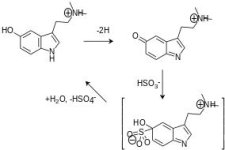
Bufotenine could form a bisulfite adduct via its ketonic/quinonoid oxidation product, perhaps. That seems somewhat unlikely, however, since the bisulfite equally might want to reduce the ketonic form back to bufotenine.
bufotenone bisulfite.jpg
 
One more thing, of course, is that bisulfite would react with the aldehyde portion of the main part of Ehrlich reagent, p-dimethylaminobenzaldehyde
maybe it did work and my testing method was just flawed... the mimosa precipitate did have MINIMAL yield when a traditional extraction was preformed on the bisulfite. I've not been able to isolate bufo myself yet but do plan on fixing this soon with outdated method.
 
maybe it did work and my testing method was just flawed... the mimosa precipitate did have MINIMAL yield when a traditional extraction was preformed on the bisulfite. I've not been able to isolate bufo myself yet but do plan on fixing this soon with outdated method.
All I have to add is good to see you @modern

One love
 
maybe it did work and my testing method was just flawed... the mimosa precipitate did have MINIMAL yield when a traditional extraction was preformed on the bisulfite. I've not been able to isolate bufo myself yet but do plan on fixing this soon with outdated method.
Do I understand correctly, that you have tried a traditional approach (A/B) extraction on the material precipitated with bisulfite, and have obtained minimal yield of the extracted material? Was this done trying to get bufotenine or dmt?
 
Do I understand correctly, that you have tried a traditional approach (A/B) extraction on the material precipitated with bisulfite, and have obtained minimal yield of the extracted material? Was this done trying to get bufotenine or dmt?
For the DMT but again MINIMAL and the expected yield should have been higher... I think the best method to test this would be starting with pure alkaloids then working backwards. Start with pure/crude dmt or bufo then acidify slightly and add the bisulfite to test if it works.

I personally didn't have results worth repeating... MAYBE the bufo adduct worked but I didn't/don't have a method of testing it properly at the moment.
 
For the DMT but again MINIMAL and the expected yield should have been higher... I think the best method to test this would be starting with pure alkaloids then working backwards. Start with pure/crude dmt or bufo then acidify slightly and add the bisulfite to test if it works.

I personally didn't have results worth repeating... MAYBE the bufo adduct worked but I didn't/don't have a method of testing it properly at the moment.
This appears to indicate - judging by the negative result from mimosa - that bisulfite does not form a specific adduct with non-oxygenated indoles at the very least.
 
Back
Top Bottom