
Sometimes I see people conveying confusion about whether or not MAOIs amplify or diminish the effects of psychedelics. Some people have caught wind of research stating that MAOIs diminish psychedelics and yet there are comments like these ⇩
"I have taken harmala before with mushrooms and it was a happening not to be reckoned with..."
Solipsis, 2014-04-13, https://www.bluelight.org/community/threads/harmaline-dmt.719208/post-12271060
"…harder and longer." –Description of the effect of LSD taken with moclobemide (rtg, bluelight.org, 2011-26-06*)
Here is some info that provides insight into this discrepancy. Also includes some insight into the difference between reversible and irreversible MAOIs. Copied from another post.
Emphasis ⇩
*Using LSD as a substitute for DMT in ayahuasca
Understanding the safety profile of MAOIs
"I have taken harmala before with mushrooms and it was a happening not to be reckoned with..."
Solipsis, 2014-04-13, https://www.bluelight.org/community/threads/harmaline-dmt.719208/post-12271060
"…harder and longer." –Description of the effect of LSD taken with moclobemide (rtg, bluelight.org, 2011-26-06*)
Here is some info that provides insight into this discrepancy. Also includes some insight into the difference between reversible and irreversible MAOIs. Copied from another post.
They list MAOIs as having a diminishing effect on LSD, which I find hard to believe.
It must depend on the MAOI to some extent. What would moclobemide + LSD be like, for example, versus using, say, phenelzine?
Hallucinogenic Drugs. Katherine R. Bonson. 2012. doi: 10.1002/9780470015902.a0000166.pub2 [eLS. John Wiley & Sons, Ltd.] (Interactions Between Hallucinogens and Other Drugs, page 6)One class of medications that can have profound psychological effects on the human hallucinogenic response is that of antidepressants. A retrospective study showed that prolonged use (3 weeks or longer) of serotonin-reuptake inhibitors (such as fluoxetine (Prozac)) or MAO inhibitors (such as phenelzine (Nardil)) will significantly reduce or eliminate the hallucinogenic response to hallucinogens like LSD (Bonson et al., 1996; Bonson and Murphy, 1996). In contrast, prolonged use of lithium or tricyclic antidepressants (such as desipramine (Norpramine)) will produce an exacerbation of the hallucinogenic response, often to a very unpleasant degree (Bonson and Murphy, 1996). See also: Serotonin
In contrast, acute (single-dose) administration of antidepressants does not appear to have the same effect. Acute administration of serotonin-reuptake inhibitors or MAO inhibitors, for example, seems to potentiate the response to LSD in humans (Bonson et al., 1996) and in rats (Fiorella et al., 1996). This difference in response, based on duration of antidepressant administration, seems to be related to adaptive changes in serotonin levels, receptors and neurotransmission.
Bonson KR, Buckholtz JW and Murphy DL (1996) Chronic administration of serotonergic antidepressants attenuates the subjective effects of LSD in humans. Neuropsychopharmacology 14(6): 425–436.
Bonson KR and Murphy DL (1996) Alterations in responses to LSD in humans associated with chronic administration of tricyclic antidepressants, monoamine oxidase inhibitors or lithium. Behavioural Brain Research 73(1–2): 229–233.
Fiorella D, Rabin RA and Winter JC (1995) The role of the 5-HT2A and 5-HT2C receptors in the stimulus effects of hallucinogenic drugs. I: Antagonist correlation analysis. Psychopharmacology (Berlin) 121(3): 347–356.
Jonathan Ott. Pharmahuasca: On Phenethylamines and Potentiation. MAPS newsletter, Volume 6, Number 3, Summer 1996, 32-34 emphasis addedThe limited data suggest a neurochemical effect of MAO inhibition is as DMT- and LSD-blocker - when MAOI are taken chronically, as used medicinally, so that therapeutic, high serotonin levels are achieved in the brain, both the effects of intramuscularly-injected DMT and oral LSD are inhibited.(9,12)
Emphasis ⇩
Monoamine Oxidase Inhibitors (Kevin Happe) in xPharm: The Comprehensive Pharmacology Reference, 2007 (Introduction)The biochemical effect of MAOI to elevate serotonin and norepinephrine levels occurs rapidly. However, the therapeutic relief of depression requires several weeks of daily treatment.
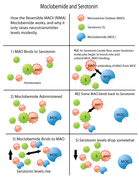
Yeah, I wonder. They also probably should have made a distinction between reversible and non MAOIs. It's my understanding that harmalas are less able to lock you into an MAO-inhibited condition, which may be the difference between "kind of dangerous" and "very dangerous".
–ChatGPTReversible MAOIs inhibit monoamine oxidase by temporarily attaching to the enzyme’s active site. They act as competitive inhibitors: serotonin, norepinephrine, and epinephrine can displace them, because these neurotransmitters compete for the same binding spot. This provides some built-in flexibility — the inhibition can lessen if monoamine levels surge. However, combining reversible MAOIs with medications that elevate serotonin, norepinephrine, or epinephrine can still trigger life-threatening toxicity, including serotonin syndrome or hypertensive crises. The flexibility does not make these combinations safe, and fatalities have occurred.
Irreversible MAOIs corrupt MAO enzymes when MAO enzymes metabolize them. In this process, a reactive intermediate forms a covalent bond with the enzyme, while the excess of the molecule is excreted. Because the inactivated enzymes must be replaced by new ones, which are synthesized slowly, the risk of dangerous interactions with serotonin-, norepinephrine-, or epinephrine-elevating medications persists well beyond the drug’s clearance from the body.
In short:
• Reversible MAOIs = More forgiving than irreversibles, but still dangerous and potentially fatal.
• Irreversible MAOIs = Highest risk. Their permanent enzyme inactivation means serotonin surges can spiral out of control, making such combinations life-threatening.
*Using LSD as a substitute for DMT in ayahuasca
Understanding the safety profile of MAOIs
Last edited:


