• Members of the previous forum can retrieve their temporary password here, (login and check your PM).

Curated cultivars yields - community results

dstark93

Esteemed member
Joined
Aug 30, 2026
Messages
4
Merits
220
On reddit there is a community pdf by Wizard which curates the cultivars with their extracted percentages. Anything similar here?
People post their CIELO checklist image extraction summary - is this being used for curation of results?
 
There was some list, but it is quite old.
Currently you can find my project. It is not aimed for the highest yield, but rather for direct comparison of clones, so I can see what clone is the strongest. The growing process and extraction process is uniform, everything is the same. I would say it has much higher value than comparing clones grown and extracted by different people. I will finish this project this year, I have ready and will add CSD, Oceanside 02, Malacht's cut, Jade Hearts, Matucana(herbalistics), Adele and Landfill. It is extracted from whole fresh plant as HCl. There is a way how to estimate whole dry citrate, but it is not giving the right numbers, because they are grown in ideal conditions grafted on strong rootstocks, so they are probably at their half potency for this test.
 
Nice, thank you for sharing and taking time for making this comparison.

It is true that the community would benefit from knowing which cultivar, given same growing conditions, would produce the most. Though this would be true for your specific conditions (maybe there is a cultivar which for some different conditions would produce more than one that beat it with yours).
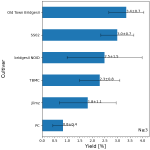
What I'm talking about is a curation of mean and standard deviation which could give people the right ballpark (- for the worse and + for the best). This is done through people reporting.

From using reported data (going a few months back on reddit, where people used the interactive CIELO checklist), one can (probably) expect a yield within some range:
Figure_1.png
 
Thank you. It is a pleasure to do this. This medicine deserves it.

Yes - if there is enough data, this could be very valuable. The problem is that there are so many input variables (growing conditions, mastery of the extraction process, etc.), and each cultivar’s extraction can involve any combination of these variables. The question is how many extraction entries are necessary for each cultivar to produce output data that are independent of these properties. I would say quite a lot. Nevertheless, if you collect at least ten extraction results, filter out the extremes, and calculate averages, it might give you a rough idea. However, to obtain truly reliable numbers you would need much more input data imo.
 
There's the additional problem of some of us receiving/keeping strains where the names and origins are unknown, lost or forgotten. Is there a simple means of 'fingerprinting' cacti in some hope of retracing identity and lineage? Going by morphological characteristics alone is fraught with the high level of variability within a single phenotype resulting from differences in growing conditions and developmental phase - and not all growers are in a position to bring their plants to flowering which might otherwise be a further tool towards identification.
 
There's the additional problem of some of us receiving/keeping strains where the names and origins are unknown, lost or forgotten. Is there a simple means of 'fingerprinting' cacti in some hope of retracing identity and lineage? Going by morphological characteristics alone is fraught with the high level of variability within a single phenotype resulting from differences in growing conditions and developmental phase - and not all growers are in a position to bring their plants to flowering which might otherwise be a further tool towards identification.
I would say that, when it comes to identifying unknown clones, there is really only one reliable approach: obtain them from a trustworthy source and maintain strict labeling. An unknown clone should remain unidentified, or be given a new name if it has desirable properties, rather than being assigned an existing cultivar name based on appearance or other assumptions.
 
I would say that, when it comes to identifying unknown clones, there is really only one reliable approach: obtain them from a trustworthy source and maintain strict labeling. An unknown clone should remain unidentified, or be given a new name if it has desirable properties, rather than being assigned an existing cultivar name based on appearance or other assumptions.
Thanks. It's got to the stage where I'm having to assign my own names to unknown clones simply as personal mnemonics for management purposes. Ideally, I should attempt to trace back along the chain of custody as far as possible just in case there's a reliably-named specimen in someone's possession. It might prove to be a bit of an adventure, at least :D

Until then we'll have to put up with my choices of things like "Lowland Headache", "Jolly Dentist", "Doctor Who" and "Witchbitch" - which kind of makes me feel obligated to provide some analyses now.
 
Back
Top Bottom