




We frequently forget this, but every time you cast your gaze upon the night sky, you're not just looking at pretty little specks of light. You're seeing billions of years of history. You're literally looking back in time. And an aspect of that look back in time is the gradual expansion (or contraction, depending on perspective) of the universe at large.
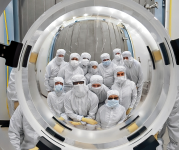
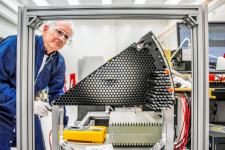
To understand this better, some incredibly intelligent people got funded by multiple governments to create what is now known as the Dark Energy Spectroscopic Instrument (DESI), which started operating in 2021. To get an idea of what it is - it's basically an enormous focal plane array of 5000 robots, each individually controlling a fiber, all feeding through a set of lenses onto the surface of a spectrograph. Here are some actual photos of what those look like:
One of the lenses:
A slice of the focal plane:
And the whole thing:
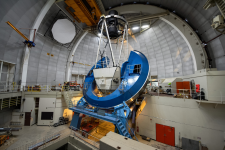
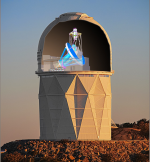
It sits at an elevation of 6,880 feet (2,100 m), atop the Mayall Telescope on Kitt Peak in the Sonoran Desert.
So how does it measure the expansion rate of the universe over time?
Our very early universe, well beyond DESI’s view, was a hot, dense soup of subatomic particles moving too fast to form stable matter like the atoms we know today. Among those particles were hydrogen and helium nuclei, collectively called baryons.
Tiny fluctuations in this early ionized plasma caused pressure waves, moving the baryons into a pattern of ripples that is similar to what you’d see if you tossed a handful of gravel into a pond. As the universe expanded and cooled, neutral atoms formed and the pressure waves stopped, freezing the ripples in three dimensions and increasing clustering of future galaxies in the dense areas. Billions of years later, we can still see this faint pattern of 3D ripples, or bubbles, in the characteristic separation of galaxies - what we now call Baryon Acoustic Oscillations (BAOs).
Researchers use the BAO measurements as a cosmic ruler. By measuring the apparent size of these bubbles, they can determine distances to the matter responsible for this extremely faint pattern. Mapping the BAO bubbles both near and far lets researchers slice the data into chunks, measuring how fast the universe was expanding at each time in its past and modeling how dark energy affects that expansion.
A short video by Berkeley Lab explaining the concept visually:
In just its first year of operation, DESI collected data from 450,000 quasars, vastly outdoing any previous efforts at mapping the expansion rate of the universe.
Overall across the 11 billion-year span, the expansion history is measured with 0.5% precision. In the most distant stretch (8-11 billion years ago), DESI achieves 0.82% precision, breaking the 1% barrier for the first time. For seven different slices of cosmic time, DESI already measures the expansion with 1-3% precision in each slice.
To put that in perspective: previous BAO experiments (like BOSS/eBOSS) took more than a decade to reach comparable (or lesser) precision - DESI doubled the power of such measurements in just one year.
The reigning cosmological model, ΛCDM (Lambda Cold Dark Matter), posits that dark energy (Λ) pushes expansion while matter (dark + ordinary) slows it, and with fixed proportions throughout cosmic time, it makes predictions for how the expansion rate should evolve.
With DESI’s new data, the general conclusions of ΛCDM remain intact - the expansion history largely lines up with expectation. But subtle tensions arise when those new data are combined with other cosmological measurements, suggesting either small deviations from the standard model or room for new physics.
One particularly interesting frontier is whether dark energy might evolve over time, rather than staying constant as in the canonical model. The first year results hint at this possibility, but more data will be needed to confirm or refute it.
Beyond dark energy, DESI’s measurements also feed into refined constraints on the Hubble constant - the universe's current expansion rate - as well as the neutrino mass sum - because neutrinos leave subtle imprints on cosmic structure growth.
One important thing to note about DESI is the fact that it's pushing not only data volume and precision but also methodological discipline. It is the first spectroscopic dark energy experiment to use a fully "blinded analysis", meaning that researchers masked the true cosmological results during analysis to avoid confirmation bias. The team also spent considerable effort accounting for instrumental effects, modeling uncertainties, and theory subtleties to ensure the robustness of their findings.
These steps add confidence that the results are not artifacts or wishful interpretations, but real glimpses of cosmic truth, or as close as we can get to that anyway.
Future plans for DESI involve surveying over 35 million galaxies and over 3 million quasars split in different temporal slices, achieving an incredibly accurate map of universal history. To imagine what such a map might look like, you can check out this 3D video of galactic mapping:
Just imagine the same, but with almost perfect precision, mapping almost everything that ever floated in the dark aether of the universe's history. What a glorious sight...
Here's also all the publicly-available papers released by the DESI project - Papers - DESI Data - as well as their YT channel - Dark Energy Spectroscopic Instrument
What a wild time to be alive...
To understand this better, some incredibly intelligent people got funded by multiple governments to create what is now known as the Dark Energy Spectroscopic Instrument (DESI), which started operating in 2021. To get an idea of what it is - it's basically an enormous focal plane array of 5000 robots, each individually controlling a fiber, all feeding through a set of lenses onto the surface of a spectrograph. Here are some actual photos of what those look like:
One of the lenses:
A slice of the focal plane:
And the whole thing:
It sits at an elevation of 6,880 feet (2,100 m), atop the Mayall Telescope on Kitt Peak in the Sonoran Desert.
So how does it measure the expansion rate of the universe over time?
Our very early universe, well beyond DESI’s view, was a hot, dense soup of subatomic particles moving too fast to form stable matter like the atoms we know today. Among those particles were hydrogen and helium nuclei, collectively called baryons.
Tiny fluctuations in this early ionized plasma caused pressure waves, moving the baryons into a pattern of ripples that is similar to what you’d see if you tossed a handful of gravel into a pond. As the universe expanded and cooled, neutral atoms formed and the pressure waves stopped, freezing the ripples in three dimensions and increasing clustering of future galaxies in the dense areas. Billions of years later, we can still see this faint pattern of 3D ripples, or bubbles, in the characteristic separation of galaxies - what we now call Baryon Acoustic Oscillations (BAOs).
Researchers use the BAO measurements as a cosmic ruler. By measuring the apparent size of these bubbles, they can determine distances to the matter responsible for this extremely faint pattern. Mapping the BAO bubbles both near and far lets researchers slice the data into chunks, measuring how fast the universe was expanding at each time in its past and modeling how dark energy affects that expansion.
A short video by Berkeley Lab explaining the concept visually:
In just its first year of operation, DESI collected data from 450,000 quasars, vastly outdoing any previous efforts at mapping the expansion rate of the universe.
Overall across the 11 billion-year span, the expansion history is measured with 0.5% precision. In the most distant stretch (8-11 billion years ago), DESI achieves 0.82% precision, breaking the 1% barrier for the first time. For seven different slices of cosmic time, DESI already measures the expansion with 1-3% precision in each slice.
To put that in perspective: previous BAO experiments (like BOSS/eBOSS) took more than a decade to reach comparable (or lesser) precision - DESI doubled the power of such measurements in just one year.
The reigning cosmological model, ΛCDM (Lambda Cold Dark Matter), posits that dark energy (Λ) pushes expansion while matter (dark + ordinary) slows it, and with fixed proportions throughout cosmic time, it makes predictions for how the expansion rate should evolve.
With DESI’s new data, the general conclusions of ΛCDM remain intact - the expansion history largely lines up with expectation. But subtle tensions arise when those new data are combined with other cosmological measurements, suggesting either small deviations from the standard model or room for new physics.
One particularly interesting frontier is whether dark energy might evolve over time, rather than staying constant as in the canonical model. The first year results hint at this possibility, but more data will be needed to confirm or refute it.
Beyond dark energy, DESI’s measurements also feed into refined constraints on the Hubble constant - the universe's current expansion rate - as well as the neutrino mass sum - because neutrinos leave subtle imprints on cosmic structure growth.
One important thing to note about DESI is the fact that it's pushing not only data volume and precision but also methodological discipline. It is the first spectroscopic dark energy experiment to use a fully "blinded analysis", meaning that researchers masked the true cosmological results during analysis to avoid confirmation bias. The team also spent considerable effort accounting for instrumental effects, modeling uncertainties, and theory subtleties to ensure the robustness of their findings.
These steps add confidence that the results are not artifacts or wishful interpretations, but real glimpses of cosmic truth, or as close as we can get to that anyway.
Future plans for DESI involve surveying over 35 million galaxies and over 3 million quasars split in different temporal slices, achieving an incredibly accurate map of universal history. To imagine what such a map might look like, you can check out this 3D video of galactic mapping:
Just imagine the same, but with almost perfect precision, mapping almost everything that ever floated in the dark aether of the universe's history. What a glorious sight...
Here's also all the publicly-available papers released by the DESI project - Papers - DESI Data - as well as their YT channel - Dark Energy Spectroscopic Instrument
What a wild time to be alive...


