• Members of the previous forum can retrieve their temporary password here, (login and check your PM).

Desmanthus Illinoensis

Migrated topic.

Caravel

Rising Star
Merits
42
anyone know a tek for Desmanthus Illinoensis? or is it possible to use the dried powdered roots of Desmanthus Illinoensis in the same way i would MHRB? what kind of a yield should i be looking for with say 100g Desmanthus root


also just realized that i have about an acre of ground that i let get overgrown has anyone here attempted to grow Desmanthus Illinoensis indoors or outdoors?
 
according to some prarie reserve seed distributors i found that

Desmanthus Illinoensis is a zone 4 which is pretty much everyone in the usa escept northern north dakota

Desmanthus Leptolobus is a zone 9 which is the bottom half of texas and florida

so if i was to grow a crop outdoors starting next spring im pretty much limited to the Illinoensis veriety unless i grow a small ammount indoors this winter - not sure if i could grow enough indoors to make it worth my while because i have a small house but im going to try to order some seeds and see if i can get a root yeild worth my while from a Lepotlobus this winter

seem to remember a friend who used to grow pot and he used some fert or chem to cause his plants to throw roots fast in his hydro system - i need to have a word with him about that maby it'll work with this
 
..groovy Caravel..
Snu Voogelbreinder 'Garden of Eden' (2009) says of D. leptolobus:

..recently D.leptolobus extracts have been bioassayed, both in the form of ayahusaca analogues,
and vapourised freebase extracts.
while D. illinoensis is published as having more DMT (0.34%DMT, 0.11%NMT, traces gramine & indole-acetic acid), Trout and others say that D. leptolobus is the more consistent and higher yileding species..may also have traces gramine and some NMT
..i can't find any alkaloid info. about D. pernambucanus,
D. cooleyi had traces of DMT, and D. velutinus sometimes small amounts [Applessed 1993;Van Heiden 1998 ) ..it is possible that low yields in D. illinoensis could have been due to mis-identification of these other species..it grows as far north as Canada
..northern explorer, this plant can take snow, but dies back to the roots over winter..from '90s reports i think it is worth experimenting with..
fall would seem the time to harvest..acacia experimenters are used to having to working out what the ideal seasonal time is..

also, because Desmanthuses are small plants, they are suited to indoor or hydroponic growing
techniques.. (suggest plenty of nitrogen)

in extraction techniques it is worth exploring full spectrum non-polar solvents like xylene, d-limonene, or maybe
hexane..these can bring out higher yields than napatha, & gramine is only trace and not a real issue..
.

 
..a Lycaeum mod recently suggested (partly based on past extraction) that in D. illinoensis, spring would be the time higher in NMT, and fall the time of more DMT..this has yet to be verified, but has evidence..Ott(1994) got 0.18%dmt
of D. leptolobus, Trout's Notes says: "It was first successfully bioassayed on 28 November, 1992 by Mr. Johnny Appleseed, who had just discovered it to contain DMT." he found 0.14%dmt, apparently can be higher...
 
ranges -

being familiar with the local illinoensis, i attest that standard technique (that works for MHRB) with it back in the day did not result in isolation of psychoactives at times in summer and fall. a quantity of gum that looks and kind of smokes and smells like crude MHRB extract was obtained but was not active by smoking. the Thompson, 1987 material was from MS, far southish of here in zone 4/5.

the result with the local Phalaris (leaves from the top 1/3 of the plant) was the same, haven't tried the ornamental variety actually in my yard.

pulling wild Desmanthus roots out of clay soil and grinding the dried peeled bark is quite difficult without special equipment, which has discouraged experimentation.

lovely plant up close, kind of weedy looking for ornamental purposes, but going to try some root cloning when the ground thaws this spring.
 
😁

In the USA with rare exception the USDA has kindly mapped most species by state if you click on the state map you will get distribution by county. Make sure to check your spelling and alternate synonymous latin names.

In many major cities you will often find Botanical gardens, Parks, reserves, etc. that have labeled specimens you can view.

Searching ones city, state or university vascular plant database's or tree locaters can get you down to a field, lot, address, gps coordinates, etc. where harvestable plants may occur.

Often botanical gardens and wildflower centers gardeners or operators welcome taking of seed.

Happy hunting to all, its fun to work from a name to an example to harvestable specimens.

Getting a branch cutting of an example is a good idea as so many acacias look alike often the size type and number of thorns or lack there of can help positively ID it as well as in spring the flowers, and in fall the seed pods.


Caravel said:
nen888 said:
some times of year have been said to be mainly NMT..

most of what i've read does indicate that Desmanthus leptolobus is the stronger species, and more consistent..

not wanting NMT

the name of the Desmanthus Illinoensis implies that it is native to this portion of the country although yesterday i went for a walk in the state forest prarie reserve area looking for this plant and didnt see any - assuming that the park authorities forgot to plant this with the other prarie grasses and not that it dont grow in illinois

i cant seem to find much information on where Desmanthus leptolobus grows do you know if it grows in the same climate as the Desmanthus Illinoensis veriety?
 
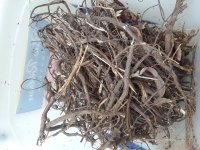
It doesnt look like it got moldy or covered in bacteria slime, it should be fine.
If in doubt extract it to crystalline hydrochloride.

It looks more like whole root than bark. Beat the whole roots with a hammer before boil.
 
Elrik said:
It doesnt look like it got moldy or covered in bacteria slime, it should be fine.
If in doubt extract it to crystalline hydrochloride.

It looks more like whole root than bark. Beat the whole roots with a hammer before boil.

It did get some mold on it before but it is dry now lol. I do have a pound of desmanthus leptolobus roots in the freezer
 
Back
Top Bottom