• Members of the previous forum can retrieve their temporary password here, (login and check your PM).

DMT polymerization

Migrated topic.
benzyme said:
endlessness said:
From a synth, I suppose? Or is it sourced from a plant material?

Also, what are the other peaks there?

'twas from a synth. The other peaks may be adducts, from residual dcm.

Recrystallized product from my initial run gave only a single large peak around 189 m/z, m.p. 66-68 C, with a fragment around 144. <- that was from fluffy, off-white dmt free base crystals.

regardless of the method, the polymerization somehow occurs in the solvent itself...a supersaturated solution. I've never seen an extraction that didn't have goo in it.

benzyme, how exactly did you re-X? In particular what solvent did you use? How long did you boil? Thanks.

PS: I think polymerization can occur in other places also (plant itself and basing step). Also, de-polymerization can happen not only during re-x, but also during acid treatment - particularly with vitamin C.
 
Loveall said:
benzyme said:
endlessness said:
From a synth, I suppose? Or is it sourced from a plant material?

Also, what are the other peaks there?

'twas from a synth. The other peaks may be adducts, from residual dcm.

Recrystallized product from my initial run gave only a single large peak around 189 m/z, m.p. 66-68 C, with a fragment around 144. <- that was from fluffy, off-white dmt free base crystals.

regardless of the method, the polymerization somehow occurs in the solvent itself...a supersaturated solution. I've never seen an extraction that didn't have goo in it.

benzyme, how exactly did you re-X? In particular what solvent did you use? How long did you boil? Thanks.

PS: I think polymerization can occur in other places also (plant itself and basing step). Also, de-polymerization can happen not only during re-x, but also during acid treatment - particularly with vitamin C.

I can definitely see it occurring in basification. And yes, acidification does cleave them into monomeric salt complexes.

I'm using sigma pet ether to re-x.
 
Thanks DFZ, makes sense.

Jees, for what it is worth, I once tested magnesium sulfate to thoroughly dry naphtha before freezing but did not notice a significant difference in the final product.

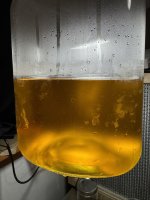
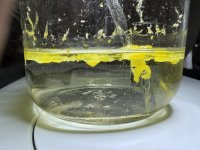
Here are two pictures from some of the earlier discussion above as reference.

First picture: Orange goo from an A/B extraction (pH above 12, and NaCl used to increase ionic strength). How I got 3 jars: Warm naphtha pull was allowed to cool to room temp. As this was happening clouds formed and eventually a thin orange layer appeared at the bottom. This was decanted off, but the same layer settled on the new jar. This was repeated until the red layer stopped appearing. The decanted jars are shown in the picture.

Second picture: Goo from all jars was dissolved in vinegar and combined. Vit C and citric acid were added to this and it was left to stir overnight. Quick A/B was performed (no salt was used this time) and fluffy white-ish xtals formed upon freeze precipitation (image taken after pouring off naphtha). There is still a little off color (light yellow towards the bottom). That could be some remaining DMT polymer that crashed out first (or something else of course).

What I will try during my next extraction is to be quick during the base step and back off on the pH and ionic strength. Also, will add a new step where the naphtha is kept hot for a couple hours before freeze precipitation. Maybe all this put together minimizes DMT in goo form.

Not that the goo is necessarily a bad thing. It is just difficult to handle and also difficult to distinguish from non-DMT stuff if any of that comes through. It has been said many times that goo is fine as is, we are just wanting to understand what determines if DMT decides to show up as humble sticky goo or in fancy designer clothes (aka crystals). This is something I think we all agree on (and dozens of nexus threads discuss), just making it explicit here too :)

I'm now wondering about extractions that also have NMT (like acacia). Not sure if NMT can crystalize/polymerize too, but if it does, the modulators we are exploring here may be relevant.
this is such phenomenal work mate.. currently mixing up some liquid jungle spice juice in some 0.74ph water hoping I can recreate this result. did you find anything else that aided you in recent years in this same line?
 
also am i right in thinking that there's no need to backsalt here? just dump the polymerised / red dmt juice in the acid water and leave to mix?

not: dissolve it in NPS, and then backsalt it into the citric water?
 
After basing I observed the solution go chicken-stock-gold, pinky white, white, all the way down to the deep brown of your standard post-acid based solution.. the NPS is quite darkened - I'm wondering if I've done something wrong!
 
Lastly- n sorry for the spam!!!!- did you let your NPS cool to room temp after heating for 2 hours, before freeze precip or did you stick it straight in the freezer after the heat?

benzyme, how exactly did you re-X? In particular what solvent did you use? How long did you boil? Thanks.

PS: I think polymerization can occur in other places also (plant itself and basing step). Also, de-polymerization can happen not only during re-x, but also during acid treatment - particularly with vitamin C.
 
Okay guys sorry for all the spam lol- i am adding to the research:


--

dissolved some red goo in citric water with some vit c, stirred hot overnight
had reduced by 100ml or so by the next morning so i topped it up with a little more water and reheated
added bicarb soda up to ph10 or so, changed from white to pinky white to golden yellow, to deep brown-ey red

first pull from this, was very, very clear
second pull was discolored -- i believe the only difference was temp (the second pull was done at a higher temp (let it go a little too long)

but still looks significantly less discolored than it did to begin with

---

going to repeat the same tomorrow but with slightly cooler pulls (between 40-50 c max.) will post photos of starter and final material

going to do a parallel with the same conditions and add the hot NPS step at the end, freezing straight away afterward - the other one i will allow to cool to room temp and then freeze

:)


some final thoughts:

1) i am curious if basifying whilst NPS is in the solution and mixing would make any difference? I am going to try this too- just because the golden yellow stock-ey looking colour looked far too appealing not to try and capture

2) does the stuff drop out before ph10? because even around ph9 lots of colour changes that make me think the crystals were already dropping out at that point - if so, what would pulling them at this ph look like?
 
This is a great thread! Thanks Benzyme, Jees, Loveall for sharing your results. Reading your results rang a lot of bells and I got some similar results that I would like to share.

Crude yellow freebase was dissolved in HCl solution. About 6g crude per 100ml. There was some particles that did not dissolve into HCl and coagulated at the top as a frothy cloud. It might have been oversaturated?

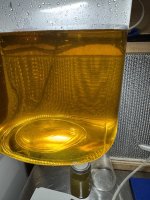
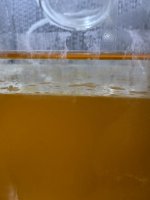
The urine colored solution was washed with hexane a few times. I can't recall what happened to the particles, if they dissolved in hexane or formed a goo that gave me trouble. I remember seeing an orange layer on top of the hexane (pic below) but I think it might have just been a reflection of the solution. There was a nearly invisible film at the solvent boundary though, I kept trying to avoid picking it up, but then figured I better separate it. It sucked up in mostly one piece, like a snot web, and I remember thinking what if this was a huge polymer?
IMG_0813.jpeg
Hexane layer on DMT hcl aq. Orange layer on top of hexane might be reflection?

Anyway, the hexane-washed dmt + hcl solution was a little cloudy, then after filtration it was crystal clear. Still very yellow-orange, basically iced tea.
IMG_0817.jpegIMG_0820.jpeg
Before and after vac filtration

I freebased the solution with NaOH, idk how concentrated it was, but it raised the pH of the solution to 11. Massive clouding occurred and from within this cloud, drops of orange oil started oiling out. They floated to the top, and coagulated into a red oil layer. Eventually there was only a clear (light yellow) solution, with red oil layer on top. I mixed in hexane until lightly yellow, pulled and salted DMT out with benzoic acid saturated hexane drop by drop. It was noted that the hexane turned back to clear as DMT was depleted.

Eventually I got impatient and used a drill to power-stir the hexane into the water and red oil solution, hoping to get a bigger pull. The hexane was much more yellow this way, except after separating it I could no longer salt out anything with benzoic acid. The hexane was stuck being super yellow.

I knew the solution wasn't depleted and there had to be more DMT in there, so I did a mini-A/B on the hexane. HCl solution (didn't calculate) pulled all the yellow color out of hexane. NaOH solution pulled all the yellow color out of the aqueous solution and created a yellow oily layer above the water again. I used the same hexane I just washed to pull again, which only picked up a fraction of the oil and turned the hexane light yellow. I was able to salt DMT out with benzoic acid again, and the hexane returned to clear.

The remaining oil in the mini-A/B jar was left for 24 hours and crystallized on its own, to my surprise. The crystals had a MP of 66-68 C, same as benzyme's MP from post #5.
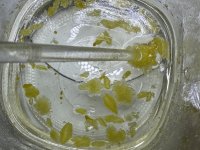
IMG_0831.jpegIMG_0833.jpeg
Yellow oil layer between alkaline water (below) and hexane (above and mostly evaporated) turned into yellow gemstone crystal agglomerates overnight.

This seems to align with the theory that highly concentrated DMT (above basic, highly ionic water) causes polymerization. Although, I was still able to pick up DMT from the oil with hexane, until I aggressively mixed it. Either it was a coincidence that the oil had given up all of its monomers, or aggressively stirring the oil-concentrate polymerized the remaining monomers. Or maybe it wasn't the oil that polymerized but the DMT dissolved in hexane that polymerized? Although, I tried doing a gentle pull on the stirred-oil with fresh hexane and still couldn't salt anything out of that pull.

I think there's a correlation with naphtha yellowing overtime in later pulls. For me, re-using the same solvent eventually turns it so yellow and starts yielding more yellow and oily freeze precipitate. But freeze precipitating doesn't resolve the yellow color in the solvent, and each pull is accumulating more yellow tint. Could it be that the solvent is accumulating polymer DMT that can't precipitate? I find it strange that my hexane was deep yellow, but nothing could be salted out. Yet the mini-A/B revealed all that yellow hexane was DMT saturated. Oversaturated, since I couldn't pick back up even half of it in one gentle pull.

What if the diminishing returns from repeated pulls is due to the re-used solvent becoming increasingly saturated with polymer, that it's simply not picking up reasonable amounts of monomer DMT anymore? Or maybe what is getting picked up is getting fused to the polymers stuck in the solvent? I guess that's what I'm suggesting is that polymer can be picked up and get stuck in solvent, in addition to being an oil that is hard to pick up at all.

I'm also wondering now whether the stuff that crystallized from my mini-A/B oil layer is a monomer crystal or possibly a polymer crystal? The red oil layer in the original A/B didn't crystalize though... so why did this oil layer crystalize? And why did it crystallize in a spectrum from colorless to yellow? Some agglomerates have both clear and yellow crystals connected to each other.

 
Last edited:
Until last night, I was thinking of polymer DMT as a sort of specific species, and an uncommon minority. But what if it's the opposite? Should we consider DMT to be a polymer by definition, and it's more rare to see it in a non-polymer form?

Was just going down a wikipedia rabbit hole last night and attempting to relate it to what I've seen recently in slides of DMT under polarized light microscopy.

Solidification from the melt
Polymers are composed of long molecular chains which form irregular, entangled coils in the melt. Some polymers retain such a disordered structure upon freezing and readily convert into amorphous solids. In other polymers, the chains rearrange upon freezing and form partly ordered regions with a typical size of the order 1 micrometer. Although it would be energetically favorable for the polymer chains to align parallel, such alignment is hindered by the entanglement. Therefore, within the ordered regions, the polymer chains are both aligned and folded. Those regions are therefore neither crystalline nor amorphous and are classified as semicrystalline. Examples of semi-crystalline polymers are linear polyethylene (PE), polyethylene terephthalate (PET), polytetrafluoroethylene (PTFE) or isotactic polypropylene (PP).

Nucleation
Nucleation starts with small, nanometer-sized areas, where a result of heat motions in some chains or their segments occur parallel. Those seeds can either dissociate, if thermal motion destroys the molecular order, or grow further, if the grain size exceeds a certain critical value.

Apart from the thermal mechanism, nucleation is strongly affected by impurities, dyes, plasticizers, fillers and other additives in the polymer. This is also referred to as heterogeneous nucleation. This effect is poorly understood and irregular, so that the same additive can promote nucleation in one polymer, but not in another. Many of the good nucleating agents are metal salts of organic acids, which themselves are crystalline at the solidification temperature of the polymer solidification.

Crystal growth from the melt
Crystal growth is achieved by the further addition of folded polymer chain segments and only occurs for temperatures below the melting temperature Tm and above the glass transition temperature Tg. Higher temperatures destroy the molecular arrangement and below the glass transition temperature, the movement of molecular chains is frozen. Nevertheless, secondary crystallization can proceed even below Tg, in the time scale of months and years. This process affects mechanical properties of the polymers and decreases their volume because of a more compact packing of aligned polymer chains.

The chains interact via various types of the van der Waals forces. The interaction strength depends on the distance between the parallel chain segments, and it determines the mechanical and thermal properties of the polymer.

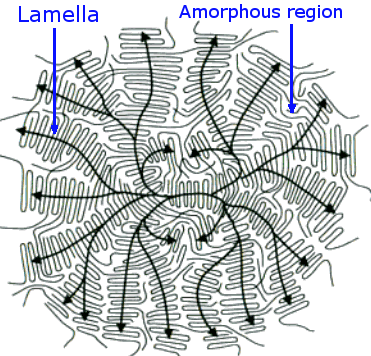
The growth of the crystalline regions preferably occurs in the direction of the largest temperature gradient and is suppressed at the top and bottom of the lamellae by the amorphous folded parts at those surfaces. In the case of a strong gradient, the growth has a unidirectional, dendritic character. However, if temperature distribution is isotropic and static then lamellae grow radially and form larger quasi-spherical aggregates called spherulites. Spherulites have a size between about 1 and 100 micrometers and form a large variety of colored patterns (see, e.g. front images) when observed between crossed polarizers in an optical microscope, which often include the "Maltese cross" pattern and other polarization phenomena caused by molecular alignment within the individual lamellae of a spherulite.
"The chains interact via various types of the van der Waals forces. The interaction strength depends on the distance between the parallel chain segments, and it determines the mechanical and thermal properties of the polymer."

Could this be why DMT has so many different melting points?

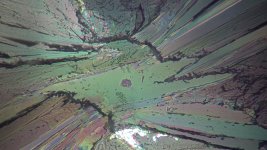
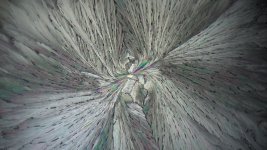
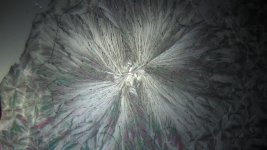
Here are some of the cross-polarized photos I took of a slide of DMT that crystallized from a melt. The sample had a melting point of 68 c. The descriptions of a "spherulite" seem to relate to what we're seeing here.

IMG_0030.jpg
The first image is the most I can magnify this crystal formation. The colors we see are birefringence from light bending as it passes through the crystal. The center green shape has a uniform color, representing a uniform crystal orientation in that region. Centered within it is a pink brain-looking nucleus. Idk if that is just a coincidence, but it appears to be the seed that nucleated this crystal. Then we can see it flays out into conjoined segments separated by fine lines, like a fish fin. Each segment has its own color, representing a shift in the crystal's orientation. Then there's a coarse line outlining this entire formation before it transitions into something else, better viewed from the second photo.

IMG_0050.jpg
Spherulite2.PNG

In the second photo, we see the same crystal under less magnification. The crystal growth radiates outwards from the nucleus, concentrated along an axis that presents as two poles of organized growth. Seemingly individual threads of crystalline material extend out from the nucleus along these poles and feather into each other, overlapping as they spread out. The spreading from the poles eventually enables the rays to even curve back further than 90 degrees from the axis to wrap around and grow toward each other, until the two hemispheres met each other. This somewhat resembles the drawing of a spherulite on Wikipedia.

Through this interpretation, the more uniform feathers and their crystalline stems are lamellae, which are folding patterns that polymer chains assemble into. When the chain fits orderly into the folding pattern, it's called lamellae, and the bits of chain that imperfectly extend out from these folds are amorphous. The amorphous ends on these lamellae formations take up space, causing neighboring lamellae to tilt away from each other in order to find enough space to continue their ordered folding formations. As the rays of lamellae tilt away from each other, it opens up more space for the chain above to occupy before folding - so the lamellae grow wider as they spread.

IMG_0051.jpg
This last image is of the crystal from the lowest magnification, where we can see it did form a large sphere, surrounded by other small spherulites that grew later. Also we see the maltese cross in the large and small surrounding spherulites. The maltese cross seems to be a unique phenomenon that occurs in polarized light microscopy when a crystal is radiating out in a sphere, but not as a single crystal. The green shape at the center of the first photo is a single crystal, and the entire shape changes colors uniformly and goes into complete extinction (darkness) at certain angles to the crossed polarizers. The maltese cross shows that the macro-formation, the spherulite, is composed of many threads of crystalline lamellae that are growing in the same direction, but offset by a degree. When the orientation of the molecules within the crystalline threads lines up with the polarizers, the light is cancelled along that thread. Since there are two polarizers crossed at 90 degrees, we see two axis of extinction in the maltese cross.

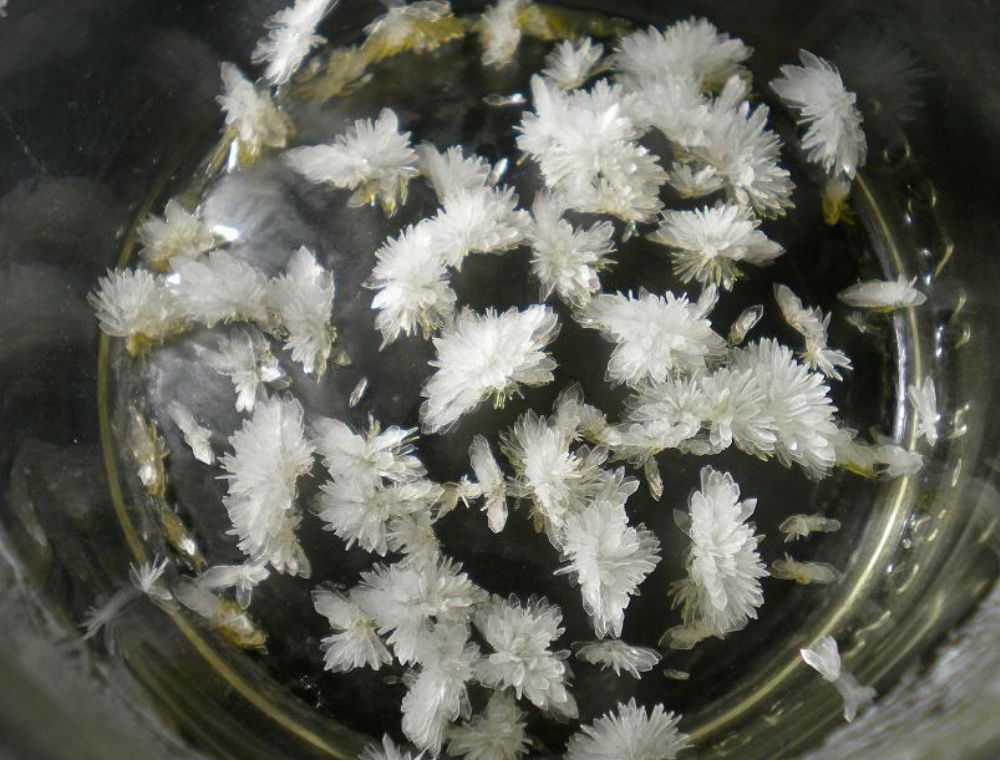
There's more info on wikipedia, like one thing it mentions is degree of crystallinity in a polymer can affect its optical properties. More crystalline is more transparent, and more amorphous is opaque. That seems to track with what I see on the slides with amorphous formations not exhibiting the maltese cross or birefringence. And it could be why most DMT appears white, because it's semi-crystalline. I'm also leaning toward all "fan" formations being semi-crystalline polymers. This is a quick example photo I pulled off google to show what I mean by fan formations:

dmt-crystals-drug.jpg


I think the acicular blade formation is essentially a 3d version of the spherulite - showing lamellae plates that grew out from a center point, forced into a few degrees of separation early in their formation by amorphous end chains. Thus, acicular blades = polymer DMT?

Crystallization from solution
Polymers can also be crystallized from a solution or upon evaporation of a solvent. This process depends on the degree of dilution: in dilute solutions, the molecular chains have no connection with each other and exist as a separate polymer coil in the solution. Increase in concentration which can occur via solvent evaporation, induces interaction between molecular chains and a possible crystallization as in the crystallization from the melt. Crystallization from solution may result in the highest degree of polymer crystallinity. For example, highly linear polyethylene can form platelet-like single crystals with a thickness on the order 10–20 nm when crystallized from a dilute solution. The crystal shape can be more complex for other polymers, including hollow pyramids, spirals and multilayer dendritic structures.

A very different process is precipitation; it uses a solvent which dissolves individual monomers but not the resulting polymer. When a certain degree of polymerization is reached, the polymerized and partially crystallized product precipitates out of the solution. The rate of crystallization can be monitored by a technique which selectively probes the dissolved fraction, such as nuclear magnetic resonance.
 
Last edited:
Back
Top Bottom