
Oh certainly but there is also reported psychoactive effects mostly more of the type of alcohol but also with more of a 'holy communion' type thing going on .. It's just conjecture really but I'm pretty sure that honey was listed as a component at some point and coming from greece.. although honey can contain numerous psychoactive compounds I'm sure. In controlled doses in a similar way to the myriad of admixtures within ayahuasca it could certainly be a part.

-
Members of the previous forum can retrieve their temporary password here, (login and check your PM).
You are using an out of date browser. It may not display this or other websites correctly.
You should upgrade or use an alternative browser.
You should upgrade or use an alternative browser.
Eleusinian Mysteries ~ What was the Kykeon?
- Thread starter 'Coatl
- Start date
Migrated topic.


hummus wrote:
this was one of the main points i made previously against the ergot theory of the Kykeon...i know of no such bioassay..even by the original proponents of the ergot theory (who i assume didn't have enough faith in the theory to actually test it)
except, of course, well known ergot poisoning, which includes
painful seizures and spasms, diarrhea, paresthesias, itching, mania, headaches, nausea and vomiting, and gangrene..
St. Anthony's Fire..
i don't think small doses are much fun either..
.
..No..And does anybody know of any bioassays of simple ergot extract?
this was one of the main points i made previously against the ergot theory of the Kykeon...i know of no such bioassay..even by the original proponents of the ergot theory (who i assume didn't have enough faith in the theory to actually test it)
except, of course, well known ergot poisoning, which includes
painful seizures and spasms, diarrhea, paresthesias, itching, mania, headaches, nausea and vomiting, and gangrene..
St. Anthony's Fire..
i don't think small doses are much fun either..
.
Have no archeological finds ever been done at the former location of this cult's temple in Eleusis?
From the consistent availability of the Kykeon twice every year, you'd expect them to have a stockpile of
either the Kykeon or it's ingredients to have been stored there in sealed jars or boxes in the temple
somewhere.
Mentha pulegium has been mentioned here before. Did someone here say it contain MAOIs?
Well it's interresting to know that the wikipedia-article on the Kykeon mentions
the Kykeon being " a drink of Barley(Hordeum vulgare L.) & Pennyroyal (Mentha pulegium)"
What would be the source for this? I see no sources for this statement.
However the english Wikipedia article on Mentha pulegium sais it to contain highly potent toxins:

 en.wikipedia.org
The Wikipedia page on the Eleusian mysteries tells about a several day long ritual ending at a temple
called "the Telesterion" where the secret rites were performed. I imagine this would be the drinking of the
kykeon. Also in the centre of this templecomplex was a palace called "Anaktoron" only accessible to the Hierophants.
THis is supposedly where the holy objects were kept. Makes sense that in this Anaktoron-palace the Hierophants would
have brewed the Kykeon & stored it's ingredients. This is a picture of what remains of the Telesterion temple:
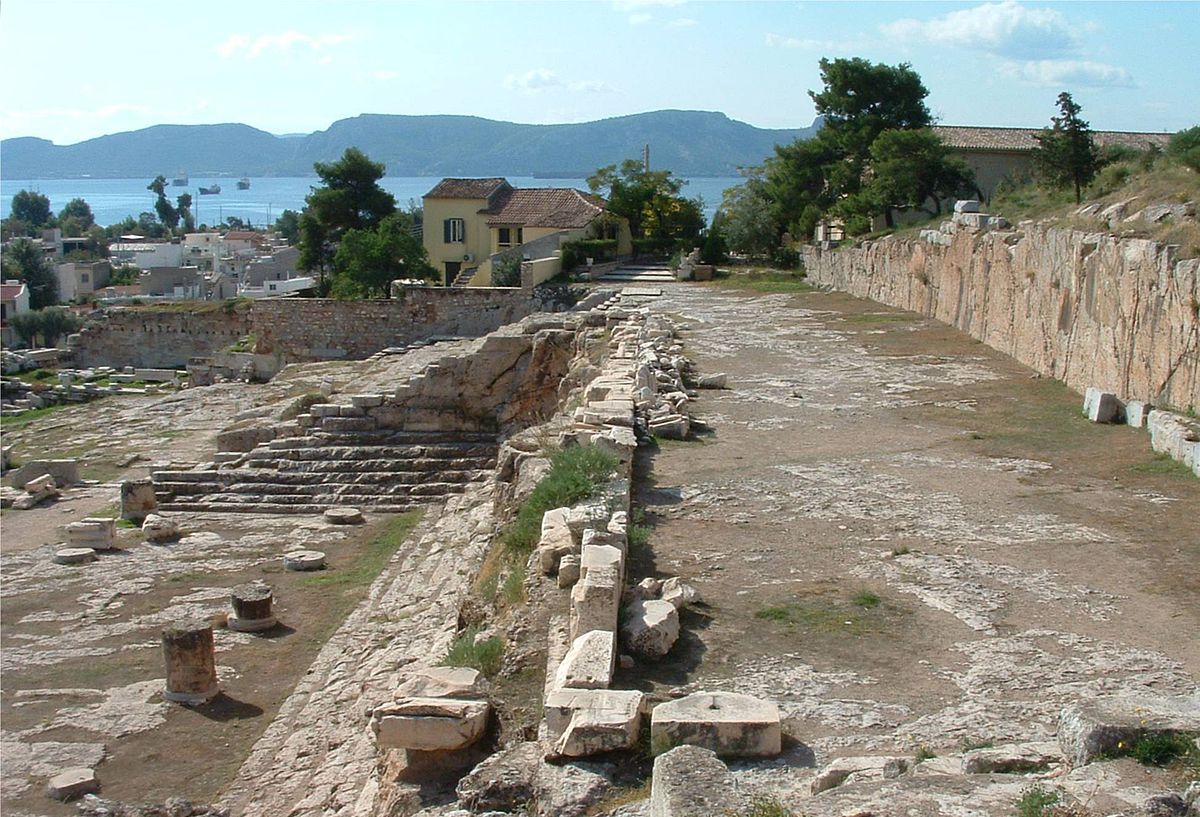
 commons.wikimedia.org
Surely some pottery/amphoras with Kykeon remains or ingredients are to be found there.
I suppose you can't just show up there with a shovel and start digging away,
but it is tempting
From the consistent availability of the Kykeon twice every year, you'd expect them to have a stockpile of
either the Kykeon or it's ingredients to have been stored there in sealed jars or boxes in the temple
somewhere.
Mentha pulegium has been mentioned here before. Did someone here say it contain MAOIs?
Well it's interresting to know that the wikipedia-article on the Kykeon mentions
the Kykeon being " a drink of Barley(Hordeum vulgare L.) & Pennyroyal (Mentha pulegium)"
What would be the source for this? I see no sources for this statement.
However the english Wikipedia article on Mentha pulegium sais it to contain highly potent toxins:
Mentha pulegium - Wikipedia
The Wikipedia page on the Eleusian mysteries tells about a several day long ritual ending at a temple
called "the Telesterion" where the secret rites were performed. I imagine this would be the drinking of the
kykeon. Also in the centre of this templecomplex was a palace called "Anaktoron" only accessible to the Hierophants.
THis is supposedly where the holy objects were kept. Makes sense that in this Anaktoron-palace the Hierophants would
have brewed the Kykeon & stored it's ingredients. This is a picture of what remains of the Telesterion temple:
File:Eleusis1.jpg - Wikimedia Commons
Surely some pottery/amphoras with Kykeon remains or ingredients are to be found there.
I suppose you can't just show up there with a shovel and start digging away,
but it is tempting
User 18517
Rising Star
nen888 said:hummus wrote:..No..And does anybody know of any bioassays of simple ergot extract?
this was one of the main points i made previously against the ergot theory of the Kykeon...i know of no such bioassay..even by the original proponents of the ergot theory (who i assume didn't have enough faith in the theory to actually test it)
except, of course, well known ergot poisoning, which includes
painful seizures and spasms, diarrhea, paresthesias, itching, mania, headaches, nausea and vomiting, and gangrene..
St. Anthony's Fire..
i don't think small doses are much fun either..
.
NeuroSoup: Ergot Wine Revisited
User 18517
Rising Star
Good point. There's also a report by a Bluelighter who claims to have done it. I'll see if I can find it later.
What would the food processing practices of the ancient Greeks have been at that time & place?
We know their nearby Athenian contemporaries drank Wine so they were obviously familiar with fermentation.
Yogurt is often used in sauces, dressings & desserts in Greek cuisine today.
Would the ancient Greeks have known the Yogurt bacteria & how to make yogurt back then?
Would the ancient Greeks have known Kefir? And what other food processing methods would they have known? I believe the ancient Greeks were already practising Alchemy so they probably would have known how to neutralise poisons with heat & sunlight.
They would have probably known about changing acidity of solutions by adding citric/acetic acid or potash to solutions.
Then still, Hiërophants crafting bronze age LSD seems rather far fetched.
What are you suggesting, Hummus? That the Hiërophants synthesized an LSD
like molecule from Ergot grains? How? Fermentation? To end up with what molecule?
I'd say Hierophants discovering LSD or a similair analogue sounds unlikely, but so does the fact that amazonian shamans found out that if you combine 2 specific plants(out of the millions of species in the jungle) you can make a brew called Ayahuasca and we all know it happened. So at this point I'm open to all theories: Ancient Greek Anahuasca, Ancient Greek LSD... I see no reason to believe one way or the other at this moment.
I think we should focus on what Wikipedia mentioned:
" a drink of Barley(Hordeum vulgare L.) & Pennyroyal (Mentha pulegium)"
On another note: We're all looking for the Kykeon's Psychoactive ingredient(s) in the world of plants, but
for all we know we need to be looking for a psychoactove animal. Eleusis is at sea and there are hallucinogenic
fish known to live in the mediterranean sea. "Sarpa Salpa" IIRC. Just a thought I wanted to throw in here.
We know their nearby Athenian contemporaries drank Wine so they were obviously familiar with fermentation.
Yogurt is often used in sauces, dressings & desserts in Greek cuisine today.
Would the ancient Greeks have known the Yogurt bacteria & how to make yogurt back then?
Would the ancient Greeks have known Kefir? And what other food processing methods would they have known? I believe the ancient Greeks were already practising Alchemy so they probably would have known how to neutralise poisons with heat & sunlight.
They would have probably known about changing acidity of solutions by adding citric/acetic acid or potash to solutions.
Then still, Hiërophants crafting bronze age LSD seems rather far fetched.
What are you suggesting, Hummus? That the Hiërophants synthesized an LSD
like molecule from Ergot grains? How? Fermentation? To end up with what molecule?
I'd say Hierophants discovering LSD or a similair analogue sounds unlikely, but so does the fact that amazonian shamans found out that if you combine 2 specific plants(out of the millions of species in the jungle) you can make a brew called Ayahuasca and we all know it happened. So at this point I'm open to all theories: Ancient Greek Anahuasca, Ancient Greek LSD... I see no reason to believe one way or the other at this moment.
I think we should focus on what Wikipedia mentioned:
" a drink of Barley(Hordeum vulgare L.) & Pennyroyal (Mentha pulegium)"
On another note: We're all looking for the Kykeon's Psychoactive ingredient(s) in the world of plants, but
for all we know we need to be looking for a psychoactove animal. Eleusis is at sea and there are hallucinogenic
fish known to live in the mediterranean sea. "Sarpa Salpa" IIRC. Just a thought I wanted to throw in here.
User 18517
Rising Star
User 18517 said:Good point. There's also a report by a Bluelighter who claims to have done it. I'll see if I can find it later.
Somebody consumes an actual CWE of ergot!
^..ok well that's the first claim i've heard of this...interesting..but with little info and no follow up..all goes quiet 9 years ago..
if ergot can be rendered non-toxic then very interesting...but info here is lacking..
as someone in that thread says:
if ergot can be rendered non-toxic then very interesting...but info here is lacking..
as someone in that thread says:
the mystery continuesDefinitely amazing, but I don't know if I completely believe it. I don't deny the possibility, but I'm more inclined to disbelief when there is no "real proof". I'd love to hear more about this - until then I'm undecided/disbelief on it.
..and there is this:
from Eleusinian Mysteries - Valencic
but, as the more reliable ancient sources tell us that the ingredients of the kykeon were kept secret under pain of death, the later references to barley cannot be taken as a conclusion that that is what it was..
we just know from inscriptions it was a grass/grain..
we also know that fasting/dietary restrictions were involved
hence the phalaris theory (& phalaris grows at the site of the temple of demeter ay eleusis)
but sure, the mystery continues
The results with the mentioned ingestion of ergonovine and methylergonovine, respectively, were not exactly impressive and, in other words, not at all confirmative of the ergot of barley hypothesis considering they were purported to assess it. Jeremy Bigwood, Jonathan Ott, Catherine Thompson and Patricia Neely in August 1978 repeated Hofmann’s experiment with higher doses: from 3.0 to 10.0 mg of ergonovine maleate (Bigwood & al., 1979). The intoxication at 3.0 mg produced very mild visual alterations, lassitude and mild leg cramps. The effects tapered off in seven hours. At 5.0 mg, lassitude and cramps were more pronounced. The psychic effects were also more intense, particularly eidetic phenomena, but they were still mild, while the somatic effects were quite strong. Only at 10.0 mg were visual effects comparable to a threshold dose of LSD or psilocybin, but the physical effects (cramping) were already painful and debilitating. The experimenters were also in a kind of dreamy state, as the natural psychoactive ergoline alkaloids, apart from LSD, show a pronounced narcotic component.
from Eleusinian Mysteries - Valencic
but, as the more reliable ancient sources tell us that the ingredients of the kykeon were kept secret under pain of death, the later references to barley cannot be taken as a conclusion that that is what it was..
we just know from inscriptions it was a grass/grain..
we also know that fasting/dietary restrictions were involved
hence the phalaris theory (& phalaris grows at the site of the temple of demeter ay eleusis)
but sure, the mystery continues
User 18517
Rising Star
There's a fully copy of that ergonovine study in my archive. 
The kykeon could have been ORMUS: http://www.atlantisalchemy.com/
The kykeon could have been ORMUS: http://www.atlantisalchemy.com/
^..great initiative your archive User 18517!
User 18517
Rising Star
Thank you! I've had it up for a while, but no one has commented yet. Good to know my efforts are appreciated. I suspect many people are apprehensive about downloading a ZIP file; let alone a ~100 MB ZIP file. If I knew how to make a website, I would :?
I've had it up for a while, but no one has commented yet. Good to know my efforts are appreciated. I suspect many people are apprehensive about downloading a ZIP file; let alone a ~100 MB ZIP file. If I knew how to make a website, I would :?User 18517
Rising Star
Maybe a few of us can chip in and obtain a copy of this:
http://www.ingentaconnect.com/content/bloomsbury/tmdj/2013/00000006/00000002/art00004
Leo Perutz and the Mystery of St Peter's Snow
Author: Piper, Alan
Source: Time and Mind, Volume 6, Number 2, July 2013 , pp. 175-198(24)
Publisher: Bloomsbury Journals (formerly Berg Journals)
Price: $32.99 plus tax
Abstract:
A novel published in 1933, describes the isolation of a hallucinogenic drug from an ergot-type fungus. It remarkably predates the discovery the hallucinogenic properties of the ergot-derived alkaloid lysergic acid diethylamide (LSD) by ten years. It also identifies ergot as the secret psychoactive sacrament of the ancient mysteries forty years before this hypothesis became a matter of academic and scientific investigation. In the novel, a central character plans to use an ergot derived drug as an agent of popular religious renewal, prefiguring the New Age religious revival initiated by the popular use of LSD. The story involves the mass testing of a hallucinogenic drug on the unsuspecting inhabitants of an isolated village almost twenty years before the Pont St Esprit incident of 1951, which has been ascribed to the CIA's plans for experimental dosing of unsuspecting civilians with psychoactive drugs. This article investigates how the author could have managed to foresee these future events in such prophetic detail and reveals the sources that were available. In this article the history of psychoactive drugs is set in the context of the political, scientific, literary, and philosophical culture of the interwar period and shows that the cultural history of psychoactive drugs is enhanced by such context.
http://www.ingentaconnect.com/content/bloomsbury/tmdj/2013/00000006/00000002/art00004
Leo Perutz and the Mystery of St Peter's Snow
Author: Piper, Alan
Source: Time and Mind, Volume 6, Number 2, July 2013 , pp. 175-198(24)
Publisher: Bloomsbury Journals (formerly Berg Journals)
Price: $32.99 plus tax
Abstract:
A novel published in 1933, describes the isolation of a hallucinogenic drug from an ergot-type fungus. It remarkably predates the discovery the hallucinogenic properties of the ergot-derived alkaloid lysergic acid diethylamide (LSD) by ten years. It also identifies ergot as the secret psychoactive sacrament of the ancient mysteries forty years before this hypothesis became a matter of academic and scientific investigation. In the novel, a central character plans to use an ergot derived drug as an agent of popular religious renewal, prefiguring the New Age religious revival initiated by the popular use of LSD. The story involves the mass testing of a hallucinogenic drug on the unsuspecting inhabitants of an isolated village almost twenty years before the Pont St Esprit incident of 1951, which has been ascribed to the CIA's plans for experimental dosing of unsuspecting civilians with psychoactive drugs. This article investigates how the author could have managed to foresee these future events in such prophetic detail and reveals the sources that were available. In this article the history of psychoactive drugs is set in the context of the political, scientific, literary, and philosophical culture of the interwar period and shows that the cultural history of psychoactive drugs is enhanced by such context.
User 18517
Rising Star
Ooh looky what I found here:
Lecture on the Eleusinian Mysteries & the Kykeon
I felt this lecture belonged in this topic.
Lecture on the Eleusinian Mysteries & the Kykeon
I felt this lecture belonged in this topic.

Knarkkorven
Rising Star
I have researched the Kykeon since 2006, and read hundreds of theories through the years on different forums. In my opinion a Claviceps preparations is the most probable explanation. Claviceps paspali is a likely candidate due to the LSA and LSH, (see Mixing the Kykeon by Peter Webster) but some weeks ago I found a theory with a big impact for my own thoughts of doing some growing experiments.
Tregar found a method to grow Claviceps purpurea which manipulate it to create ergonovine instead of the ergotoxines (ergotamine etc.) and posted this on "The Nook" forums.
So, what does this mean?
Having almost pure ergonovine instead of the toxic erotamine is VERY nice. We don't have to reflux boil ergotamine with KOH to make LSA, we have hallucinogen with higher potency available from the raw culture.
Take a look at this pdf (Entheogenic Effects of Ergonovine, by Bigwood and Ott).
And read Tregar's conclusion:
I fully agree to this. I find this revolutionizing, this can be the true answer to the Kykeon mystery.
Ergonovine is water soluble (ergotamine is not) so a simple CWE and UV light could prove that we have the right alkaloid.
The vasoconstrictive effects might be avoided by the Mentha used by the ancient Greeks, or perhaps there are some better herbs to induce vasodilation to counter the side effects from ergonovine?
Any thoughts on this?
Tregar found a method to grow Claviceps purpurea which manipulate it to create ergonovine instead of the ergotoxines (ergotamine etc.) and posted this on "The Nook" forums.
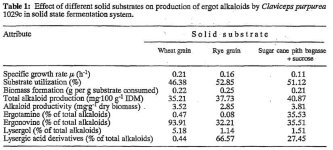
Quote from "Solid substrate mediated changes in ergot alkaloid spectra in solid state fermentation system" (Hernandez, 1992)
Wheat or rye grains were cut into 3 pieces and moistened with distilled water to 50% moisture level for autoclaving at 121 C for 15 min. The lumps formed were broken to separate the grain particles for drying at 60 C for about 24 h. The grains thus processed can be stored upto 6 months without any contamination.
Liquid nutrient' medium which was used for moistening the processed grains or impregnating rocessed sugar cane pith bagasse contained (g*l-I ): ammonium oxalate 9.6, urea 1.73, KH2P04 0.625, MgSO4 * 7 H20 O.O25,ZnSO4 * 7 H20 0.01, and NH4OH to raise the pH to 5.2
The medium was sterilized at 121 C for 20 min and inoculated with spores. Wheat or rye grains (40 g) were mixed with 60 ml of the inoculated liquid medium to get 60% moisture in the moist solid medium.
60 g moist medium was charged in static column fermenter of size 20 cm length x 4 cm diameter. The columns were aerated at a rate of 4 1 humidified airh-l per column and the fermentation was carried out at 26 C for 10 days
...
In contrast to the nearly equal production of total alkaloids by Claviceps purpurea 1029c on three different solid substrates in SSF system, the spectra of alkaloids produced on these substrates differed significantly (Table 1). For example, ergonovine was the major alkaloid formed and accounted for 93.91% of the total alkaloids in the wheat grain medium. The concentrations of ergotamine and lysergic acid derivatives, in this case, were >0.5% while that of lysergol was 5.18% of the total alkaloids formed. In contrast, lysergic acid derivatives and ergonovine together accounted for 98.78% of total alkaloids formed in rye grain medium, their ratio being 1:0.48 (Table 1). Lysergol accounted for 1.14% of total alkaloids while ergotamine was present in traces in the rye grain
medium.
So, what does this mean?
Having almost pure ergonovine instead of the toxic erotamine is VERY nice. We don't have to reflux boil ergotamine with KOH to make LSA, we have hallucinogen with higher potency available from the raw culture.
Take a look at this pdf (Entheogenic Effects of Ergonovine, by Bigwood and Ott).
Erowid.org: Erowid Reference 7691 : Entheogenic effects of ergonovine : Bigwood J, Ott J, Thompson C, Neely P
The Index page for the reference article: Bigwood J, Ott J, Thompson C, Neely P Entheogenic effects of ergonovine J Psychedelic Drugs 1979 11(1-2):147-9
www.erowid.org
And read Tregar's conclusion:
Maybe they just made themselves some grain spawn with C. purpurea sclerotia as the inoculant, and then just made a brew out of that and called it the kykeon. Ergometrine has a high activity level with similar effects to LSD at the 1-10mg level. Much more psychedelic than Lysergic acid amide. I've posited that it is the main psychedelic in MG seeds as well. From that data there would be a full dose of ergonovine (~3-4mg) in every dry gram of wheat seeds.
Crazy eh? That would make a much simpler and more concise explanation for the kykeon than any other I've heard to date.
I fully agree to this. I find this revolutionizing, this can be the true answer to the Kykeon mystery.
Ergonovine is water soluble (ergotamine is not) so a simple CWE and UV light could prove that we have the right alkaloid.
The vasoconstrictive effects might be avoided by the Mentha used by the ancient Greeks, or perhaps there are some better herbs to induce vasodilation to counter the side effects from ergonovine?
Any thoughts on this?
Attachments
Spiritofspice
Rising Star
What about the famed Baghdad battery.
What effect would electrolysis have on say a mix of ergot alkaloids mixed in an electrolyte solution in a battery drawing current.
I picture a beer made from ergot alkaloids being combined with something else then ageing the brew in a battery pulling a current to obtain well something.
I don't think the plants have been lost but a process to make it has.
It's just a thought we know the ancients had the ability to make primitive batteries maybe they did chemical reactions with them.
What effect would electrolysis have on say a mix of ergot alkaloids mixed in an electrolyte solution in a battery drawing current.
I picture a beer made from ergot alkaloids being combined with something else then ageing the brew in a battery pulling a current to obtain well something.
I don't think the plants have been lost but a process to make it has.
It's just a thought we know the ancients had the ability to make primitive batteries maybe they did chemical reactions with them.

My guess is that Kolbe electrolysis would be one of the reactions. A waste of lysergic acid.Spiritofspice said:What effect would electrolysis have on say a mix of ergot alkaloids mixed in an electrolyte solution in a battery drawing current.
I have a book on Eleusis by Károly Kerényi, unfortunately not at hand right now. I remeber reading in it about the myth of Demeter. At some point in the myth, she is putting a baby into the fireplace in order to render it immortal. It made me wonder if that is a cryptic description of a process of heat treatment with caustic ashes. The myth also explicitly mentions clear water from a cold mountain spring.
Spiritofspice
Rising Star
pitubo said:My guess is that Kolbe electrolysis would be one of the reactions. A waste of lysergic acid.Spiritofspice said:What effect would electrolysis have on say a mix of ergot alkaloids mixed in an electrolyte solution in a battery drawing current.
I have a book on Eleusis by Károly Kerényi, unfortunately not at hand right now. I remeber reading in it about the myth of Demeter. At some point in the myth, she is putting a baby into the fireplace in order to render it immortal. It made me wonder if that is a cryptic description of a process of heat treatment with caustic ashes. The myth also explicitly mentions clear water from a cold mountain spring.
Or maybe for making chemical compounds I imagine they could produce chlorine gas with electrolysis and they could extract urea from urine.
I wonder if it's possible to make hydrazine this way.
Wouldn't that be cool.
Similar threads

- Replies
- 0
- Views
- 136

- Replies
- 1
- Views
- 596

- Replies
- 0
- Views
- 487
- Replies
- 2
- Views
- 774