• Members of the previous forum can retrieve their temporary password here, (login and check your PM).

TEK Ethyl acetate approach [CIELO]

This topic contain a TEK
Migrated topic.
Loveall said:
Interestingrly, washing soda does not dry ethyl acetate to the point that the salting reaction is suppressed (unlike MgSO4 or CaCl2)+. Since the solution cannot get too dry it is foolproof.
I've long been a fan of sodium carbonate as a mild drying agent for alkaloidal extract solutions, so it's good to see it coming into its own here.

Question, though - do you mean anhydrous soda, or the hydrated stuff? And an observation: sodium carbonate decahydrate is efflorescent when exposed to the normal indoor atmosphere. This means it loses its water of crystallization quite readily and it is this property which fortuitously provides the moisture-balancing effect.
This leads to a couple of further questions - were you inspired by knowledge of this property to try out this drying technique, and what temperature was it performed at?
 
I believe the arm and hammer washing soda I use is anhydrous. The vendor doesn’t specify it, but I tried drying it in the oven and it did not change. Also, according to photography people it is anhydrous out of the box.

 
Thanks, BW, the drier paste and hand squeezing are substantial improvements Thumbs up Please thank your friend for me!

- Less EA pulls to fully exhaust the paste.
- Almost complete solvent recovery
- Less volume of used EA to wash. I accumulate solvent and will now need to wash it half as often.

BW, this is a significant upgrade to the TEK. Thank you and your friend so much.

Ooooh that sounds cool. I told him now and he was amazed 😁 😁


BW deserves an extra scoop of ice cream for this at the very least Very happy

Well technically I just wrote this stuff up here, but did not come up with any ideas in the first place 😁 😁 That squeeze was from my friend, who is now happy to have made a random contribution and the kitchen mixer for dryer paste was used by Twilight Person, although for the EA pulling step.

The sodium carbonate thing sounds nice, maybe also now you have a hot-fix for people to maybe reduce even the slightest chance of unexpected results? :love:
 
downwardsfromzero said:
Loveall said:
Interestingrly, washing soda does not dry ethyl acetate to the point that the salting reaction is suppressed (unlike MgSO4 or CaCl2)+. Since the solution cannot get too dry it is foolproof.
I've long been a fan of sodium carbonate as a mild drying agent for alkaloidal extract solutions, so it's good to see it coming into its own here.

Question, though - do you mean anhydrous soda, or the hydrated stuff? And an observation: sodium carbonate decahydrate is efflorescent when exposed to the normal indoor atmosphere. This means it loses its water of crystallization quite readily and it is this property which fortuitously provides the moisture-balancing effect.
This leads to a couple of further questions - were you inspired by knowledge of this property to try out this drying technique, and what temperature was it performed at?
K2CO3 used a lot in drying methanolic solutions during imine formation etc too
 
endlessness' NMR result of 94.1% pure mescaline citrate + 6.9% water has been confirmed.

Confirmed in the sense that a sample sent to Altitude condulting was 49.2% mescaline.

That is what one would expect if the product from CIELO is monomescaline citrate x 1.5 H2O2 (= 49.1% mescaline by molecular weight)..

So it all matches up within 0.1%.

I believe we can say with some confidence that the TEK produces this hydrated mescaline salt form with high purity (>99.9% if the 3rd digit from Attitude is significant).

Cheers and happy extracting.
 
Loveall said:
endlessness' NMR result of 94.1% pure mescaline citrate + 6.9% water has been confirmed.

Confirmed in the sense that a sample sent to Altitude condulting was 49.2% mescaline.

That is what one would expect if the product from CIELO is monomescaline citrate x 1.5 H2O2 (= 49.1% mescaline by molecular weight)..

So it all matches up within 0.1%.

I believe we can say with some confidence that the TEK produces this hydrated mescaline salt form with high purity (>99.9% if the 3rd digit from Attitude is significant).

Cheers and happy extracting.


It would be good to test this again by dehydrating in the oven (unsure of the temp needed). Expect a 7% weight drop to produce anhydrous mescaline citrate starting with (monomescaline citrate)3.(Water)2 hydrated crystal from CIELO. Then weigh the anhydrous salt exposed to air over a few weeks to see if it says dry or absorbs moisture.
 
Another option would be to use a vacuum desiccator and calcium chloride (or preferably a stronger desiccant if you can get any). Do we have any melting point data for this form of M citrate yet? BW's Thermogravimetric Analysis and Differential Scanning Calorimetry data does throw a little light in this general direction already:
Brennendes Wasser said:
Here we can see a melting point of Mescaline Citrate with an onset at 102°C and a max at 120°C. The peak is astonishingly broad and not very sharp as other Tryptamines. When observed by eye I could see myself that it first starts liquifying to a sticky blob at around 120°C and not forming a real molten liquid. This may correspond to the unusual melting peak seen in DSC. Still if there is no real reason vaporizing this salt it might not matter at all that it cant be formed into a true liquid easily.
This seems to imply one might need to be a little cautious with oven drying.
 
Loveall said:
Loveall said:
endlessness' NMR result of 94.1% pure mescaline citrate + 6.9% water has been confirmed.

Confirmed in the sense that a sample sent to Altitude condulting was 49.2% mescaline.

That is what one would expect if the product from CIELO is monomescaline citrate x 1.5 H2O2 (= 49.1% mescaline by molecular weight)..

So it all matches up within 0.1%.

I believe we can say with some confidence that the TEK produces this hydrated mescaline salt form with high purity (>99.9% if the 3rd digit from Attitude is significant).

Cheers and happy extracting.


It would be good to test this again by dehydrating in the oven (unsure of the temp needed). Expect a 7% weight drop to produce anhydrous mescaline citrate starting with (monomescaline citrate)3.(Water)2 hydrated crystal from CIELO. Then weigh the anhydrous salt exposed to air over a few weeks to see if it says dry or absorbs moisture.


Good info! I think I'm going to make anhydrous at 90C.
 
Stoooopp hehe I already did it xD

Already wrote it here in the thread, but it did not get much attention, so that info was lost.

Found it here.

Me said:
85,50 mg Mescaline Citrate in Oven @ 50 °C / 0,04 bar for 24 h

weight afterwards ...

84,57 mg Mescaline Citrate

so even hardcore physico-chemical water removal did not do anything, must be totally locked within the crystal grid.


Drying with CaCl2 will not remove any water and even a hardcore removal that will get any adsorbed water did not remove any. Still, the temperature was well below the melting point.

From that experiment I wrote the water is absolutely stuck and therefore absolutely mandatory to get exact those crystals. Once I did the water-dilution row experiment also the 0 % water aliquot gave the expected yield, but simply a powder instead of crystals. So the long "CIELO Needles" absolutely need water to be formed and it is tightly bound inside of the crystal lattice.
 
Brennendes Wasser said:
Stoooopp hehe I already did it xD

Already wrote it here in the thread, but it did not get much attention, so that info was lost.

Found it here.

Me said:
85,50 mg Mescaline Citrate in Oven @ 50 °C / 0,04 bar for 24 h

weight afterwards ...

84,57 mg Mescaline Citrate

so even hardcore physico-chemical water removal did not do anything, must be totally locked within the crystal grid.


Drying with CaCl2 will not remove any water and even a hardcore removal that will get any adsorbed water did not remove any.

Still, the temperature was well below the melting point, but to go absolutely sure I might try to arrange it at double temperature. Don't have access anymore, but maybe can still do it somehow.

From that experiment I wrote the water is absolutely stuck and therefore absolutely mandatory to get exact those crystals. Once I did the water-dilution row experiment also the 0 % water aliquot gave the expected yield, but simply a powder instead of crystals. So the long "CIELO Needles" absolutely need water to be formed and it is tightly bound inside of the crystal lattice.

Thanks! I remember now reading about this. The 0% water result was very interesting. With enough mass resolution that would be the anhydrous form of mescaline citrate I think.

So, the if the extract is fully dried with paitience the powder should form. Originally the normal needle reaction did not happen so we said let's keep the water.
 
Quite possible that a water-free variation would crumble to dust, but upon doing a slow water removal, it might even keep that orientation?

Anyways getting it totally water-free would be probably easier just doing the IPA-rex. I guess it removes all the water - and the resulting white powder is looking like the same 0-% white powder from that test :)
 
Loveall said:
Thanks! I remember now reading about this. The 0% water result was very interesting. With enough mass resolution that would be the anhydrous form of mescaline citrate I think.

So, the if the extract is fully dried with paitience the powder should form. Originally the normal needle reaction did not happen so we said let's keep the water.

Here is the result from the hardcore drying:

A scale with 10 µg steps was used, so should track even smallest weights. 83,20 mg CIELO crystals were subjected to 90 °C at 40 mbar.

Weight after 24 h dropped by -1,81 mg. Apparently the weight then increased by ~ 10 µg every 5 seconds, so water was absorbed back.

BUT then it was realized that this is also happening with only the plastic dish used to hold the CIELO crystals. So the plastic dish absorbed water and not the CIELO crystals themself. Also therefore the dish lost "a lot" of water. The crystals were weight-tracked on their own and only a difference of 0,7 mg was tracked, true weight dropped from 83,20 mg -> 82,50 mg. So apparently the true water-loss was even less.

Conclusion:

Even VERY strong drying conditions did remove nearly 0 water from the CIELO crystals. Also no back-absorption was observed in the very first time after removing from oven. No idea about long-term, but any preocess happening should still have been felt immediately somehow. Just another sign that the water is definetly part of the crystal lattice and therefore (as you have already found out in the beginning) essential to form exactly those long needles. :love:
 
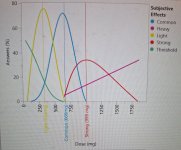
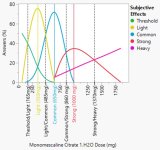
A round of non scientific polling was done on reddit asking users for dosage vs. subjective experience.

As a result the dosage recommendations in the TEK have been updated slightly. The older dosage recomendations where conversion of Mescaline HCl dosage reccomendations found online. The new recommendations are from people in the /mescaline sub on reddit that have been actively extracting mescaline citrate.

TEK has been updared from:

*Threshold: 100 - 200 mg
*Light: 200 - 350 mg
*Common: 350 - 700 mg
*Strong: 700 - 1400 mg
*Heavy: 1400 mg+

To:


*Threshold: 60 - 125 mg
*Light: 125 - 500 mg, typically 333mg
*Common: 500 - 850 mg, typically 666mg
*Strong: 850 - 1350 mg, typically 999mg
*Heavy: >1350mg

Not a big change, raised the light dose by ~60mg and the common dose by 145mg. Decreased the strong dose by 51mg, and began the heavy dose 50mg earlier.

More importantly a the dosage distribution is shown, giving an idea of overlap between possible experiences at different dosages (see image). Note for example that a 666mg dose maximizes the chances of having a common experience and minimizes the chances of a kight, strong, or heavy experience. :twisted:
 

Attachments

  • 20240131_215700.jpg
    20240131_215700.jpg
    3.1 MB · Views: 8
Loveall said:
Did some minor updates.
Awesome, thanks.

Putting the colour key in a logical order, as you have, would have been the one main improvement :thumb_up:

Perhaps the annotations on the x-axis could be placed diagonally, though?
 
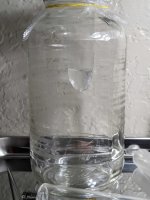
I did a ~20hr test with ethyl acetate vs cheap polyethylene food service gloves, seems all good! I was looking for what gloves could be used for bag squeezing the pulls and didn't have any other gloves that seemed suitable from quick searches on compatibility. Comparatively my dishwashing gloves I've used with EtAc over time slowly stuck together and pulled into pieces after enough exposure... I will definitely double up on poly gloves as they're not the hardiest gloves, but at least ethyl acetate doesn't seem to do anything to them.

Does anyone have any other gloves recommendations for ethyl acetate? I don't think there's anything cheaper than poly gloves ;)

Ethyl-Acetate-vs-Polyethylene-glove

PXL_20240205_044757274.jpg
 
Loveall, on the first page of this thread you mention “compatible with over the counter aquarium 9.6% sulfuric acid for salting directly out of the solvent”

However I don’t see much mention of it thereafter, does it work very well?
 
Loveall, on the first page of this thread you mention “compatible with over the counter aquarium 9.6% sulfuric acid for salting directly out of the solvent”

However I don’t see much mention of it thereafter, does it work very well?
It seemed promising. Problem was a water layer formed on other tests. Tío dilute.

It may be possible to use higher concentration sulfuric, but I worry of metal contamination in battery acid. It is also very corrosive.

Citric acid is much safer and available. The goal of this work is to make a safe, easy, and reliable proces for an avarage person working in their kitchen, so sulfuric salting was dropped. But it should work.
 
Out of simple curiosity, could we extract from fresh blended cactus instead of cactus powder? If we do the freeze rest afterwards, the amount of water could thus be controlled, right?

We would need to adjust the amount of lime, I suppose, but otherwise, it seems rather practical as it would eliminate the drying step and, most importantly, it would avoid the potential problem of controlling the re-humidification of cactus powder.

I suppose this has already been discussed, but I have read a lot (I've yet to try it myself, cactus is drying ATM !) about this technique and I don't remember seeing this information mentioned.
 
Back
Top Bottom