• Members of the previous forum can retrieve their temporary password here, (login and check your PM).

First liberty caps! (2023)

Migrated topic.

the red squirrel

Esteemed member
Joined
Jan 18, 2023
Messages
48
Merits
42
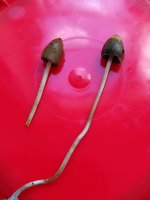
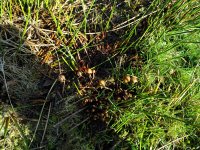
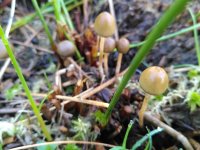
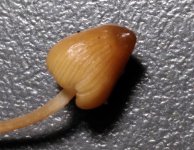
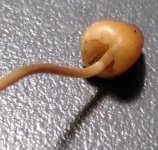
The weather conditions were less than ideal last month, but over the last few days, it finally rained, and today, I finally stumbled upon a fantastic liberty cap patch! Let's hope it's a good beginning for a late-season start
 

Attachments

  • P+semilanceata.jpg
    P+semilanceata.jpg
    89.9 KB · Views: 1
  • P+semilanceata+II.jpg
    P+semilanceata+II.jpg
    247.9 KB · Views: 1
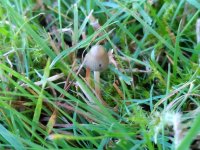
I found one single, dainty lib while out this evening. It seems to have made for a pleasant microdose :)
 

Attachments

  • 20231014_180105.jpg
    20231014_180105.jpg
    4.1 MB · Views: 2
DansMaTete said:
@downwardsfromzero, doesn't seem to be a liberty.
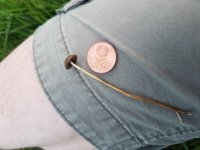
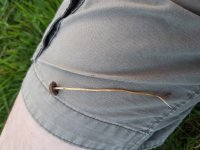
I can assure you it was, it's a poor angle that fails to show the papilla on the cap. Ps. semilanceata is a highly variable species and I have been collecting it for over 28 years.

Here's another angle, I failed to get a decent shot of the papilla entirely but we can see that the stem is wavy, paler beige at the top becoming more reddish towards the base, where there are white, woolly mycelial remnants. There are dark brown spores gathered on the annular, cortinate velar remnants a shortish distance below the stem apex. The gills are purplish brown, evenly spaced, detached and have a pale strip at the edge. We can also see evenly-spaced intermediate partial gills. The cap margin is translucent-striate here in its wet state, the cap appearing a mid olive-brown. The papilla was translucent and a lighter orange-brown.
 

Attachments

  • 20231014_180026.jpg
    20231014_180026.jpg
    4.9 MB · Views: 2
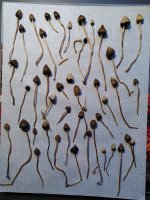
Btw, I added a bit more description just for additional reassurance but here's a shot from a good few years ago that shows some of the variations one can expect with this species. Notice that in the upper right quadrant at about 2 o'clock there is a small specimen with a more broadly opened cap. That is more or less similar to the specimen in the previous picture. This pattern of broad opening occurs in about 2 - 5% of liberty caps depending on the conditions.
 

Attachments

  • IMG_2402.JPG
    IMG_2402.JPG
    3.4 MB · Views: 3
acacian said:
the last picture is some fine art downwardsfromzero..
Thanks!
There's plenty more where that came from but I'll save them for a different thread since posting further dozen-year-old shroom pics would be derailing this thread.
 
downwardsfromzero said:
This pattern of broad opening occurs in about 2 - 5% of liberty caps depending on the conditions.

Wow, I never knew this; lots of thanks for sharing this rare liberty cap variant. Guess I don't want to know how many of these 'broad opening variants' I didn't recognise as P. semilanceata but thought those were some random LBM or Mycena sp. :shock:
 
It's not so much a variant in the sense that it's a consistent trait in a specific group of mushrooms, rather that they occur as part of the natural range af variation. My suspicion is that this form is seen when the stem length to thickness ratio is higher, where the genetic mechanisms behind this 'stretching out' become more strongly activated. There's also a form where this process of cap expansion runs even further, causing the cap margin to become uplifted and even to roll back in on itself - practically the opposite of what might be expected of a 'normal' liberty cap. That form tends to occur more among the stouter and larger specimens.

I ought to make a montage of my liberty cap pics that show many of the variations. The very rarest I've found is the sporeless albino but sadly I didn't manage to photograph it. That one was literally one in a million. One thing I've never seen is the pouch form of libs which is known to occur in Scotland and mirrors the Weraroa pouch fungus of New Zealand.

I seem to recall having posted pics of sporeless libs on here a few years back. If I can't dig them out it'll be more impetus to get on with the thread on lib morphology and other variations.
 
I'm eager to explore the variations of liberty caps & I would love to see your montage downwardsfromzero.

Speaking of strange mushroom phenomena. A few days ago I stumbled on a large patch of some beautiful large liberty caps in a swamp. Originally, I was searching for some nice waxcaps (Hygrocybe) to photograph but suddenly I found this large liberty cap among the peat moss (Sphagnum sp.) & recently cut common rush (Juncus effusus). There were some grasses but the area definitely resembled more a marsh than the typical grassland/meadow where liberty caps grow (the marsh was also very waterlogged as well). I guess that the soil nitrogen content was high enough the let the libs sprout over there...
 

Attachments

  • IMG_20231022_113013.jpg
    IMG_20231022_113013.jpg
    9.1 MB · Views: 1
  • IMG_20231022_113020.jpg
    IMG_20231022_113020.jpg
    4.1 MB · Views: 1
That's a lovely little scene you captured there. :thumb_up: It's the sort of thing that would get me taking hundreds of shots in pursuit of the "perfect" one :lol:
 
There is also a similar mushroom species, Psilocybe strictipes, which could be confused with P. semilanceata.

It could be but I checked the species occurrence records of my region (via GBIF.org) & nowhere near me in a radius of 300 km had any observations of the species. So I guess you can rule out the P. strictipes for my observation
 
the red squirrel said:
I'm eager to explore the variations of liberty caps & I would love to see your montage downwardsfromzero.

Speaking of strange mushroom phenomena. A few days ago I stumbled on a large patch of some beautiful large liberty caps in a swamp. Originally, I was searching for some nice waxcaps (Hygrocybe) to photograph but suddenly I found this large liberty cap among the peat moss (Sphagnum sp.) & recently cut common rush (Juncus effusus). There were some grasses but the area definitely resembled more a marsh than the typical grassland/meadow where liberty caps grow (the marsh was also very waterlogged as well). I guess that the soil nitrogen content was high enough the let the libs sprout over there...
Beautiful. In my area they are hard to find, unlike for instance fly agarics that afe popping up almost everywhere, but i love that once you find a spot you immediately see dozens of them.

 
dragonrider said:
the red squirrel said:
I'm eager to explore the variations of liberty caps & I would love to see your montage downwardsfromzero.

Speaking of strange mushroom phenomena. A few days ago I stumbled on a large patch of some beautiful large liberty caps in a swamp. Originally, I was searching for some nice waxcaps (Hygrocybe) to photograph but suddenly I found this large liberty cap among the peat moss (Sphagnum sp.) & recently cut common rush (Juncus effusus). There were some grasses but the area definitely resembled more a marsh than the typical grassland/meadow where liberty caps grow (the marsh was also very waterlogged as well). I guess that the soil nitrogen content was high enough the let the libs sprout over there...
Beautiful. In my area they are hard to find, unlike for instance fly agarics that afe popping up almost everywhere, but i love that once you find a spot you immediately see dozens of them.

That's indeed completely true; once you see just one you can be almost 99% sure that in your intermediate surroundings, others will be growing as well as they grow in groups

People give two explanations for it; one is more materialistic while the other is more metaphysical. Once you see the mushroom you are looking for, the mind creates an internal image whereby the temporary pattern recognition skills for the specific species are increased. On the other hand, the mushroom only reveals itself when the divine teōnanācatl thinks you are ready and prepared for it
 
The Teōnanācatl were gracious and generous today :)
 

Attachments

  • IMG_20231108_162052.jpg
    IMG_20231108_162052.jpg
    5.4 MB · Views: 2
downwardsfromzero said:
The very rarest I've found is the sporeless albino but sadly I didn't manage to photograph it. That one was literally one in a million. One thing I've never seen is the pouch form of libs which is known to occur in Scotland and mirrors the Weraroa pouch fungus of New Zealand.

Downwardsfromzero, I've think I might found a sporeless albino of P. semilanceata: It fits all the boxes of the typical characteristics (blueish stem, pointed papilla, pale and stiff stem...) but this adult specimen doesn't have the typical dark purple gills. Therefore I might suspect it being a sporeless one as I already have seen a lot of smaller lib caps who are younger and already have the dark gills. I might take it to the lab to have a view on a microscope of it...
 

Attachments

  • lib_cap_2.jpg
    lib_cap_2.jpg
    2.9 MB · Views: 1
  • lib_cap_1.jpg
    lib_cap_1.jpg
    1.8 MB · Views: 1
Aren't they supposed to be lighter colored at the nipple than the rest of the cap? There are lookalikes where the coloring is inverted and the nipple is dark.

They don't grow around me, but I traveled far the other day and found a bunch of them for the first time.
 
Back
Top Bottom