• Members of the previous forum can retrieve their temporary password here, (login and check your PM).

Freeze - Pump - Thaw

Icon

Titanium Teammate
Donator
I want to experiment with recrystallizing in degassed solvents. The freeze - pump - thaw method for degassing sounds the most appropriate for hydrocarbons like heptane that would boil under vacuum. I want to scale it down to the minimum amount of special hardware. I don't think I need a whole schlenk line for example. But I already have a vacuum pump and cryogenic dewars. I believe drying and degassing are prerequisites to crystalizing under inert gas, so I'm looking forward to unlocking that potential.

Here's a couple good videos on the process that helped me understand the concept:


As I was researching, my rough draft plan was to freeze with liquid nitrogen, and back fill with argon. I can't remember why I decided argon might be a better inert gas than nitrogen. But then I came across a video (below) of a lab explosion cause by freeze pump thaw on hexane. They concluded that it could have been from accumulating liquid argon, that expanded when thawed, over-pressurizing the flask. The previous video also mentioned the risk of liquid oxygen.


Safety officer's solution was to use nitrogen instead of argon for inert gas. I guess I'll be following that advice too unless anyone thinks otherwise?

Another alternative would be not freezing in liquid nitrogen. Dry ice can't freeze heptane alone, but I believe it can in a salty IPA bath? And then I could use argon without fear of liquid argon or liquid oxygen.

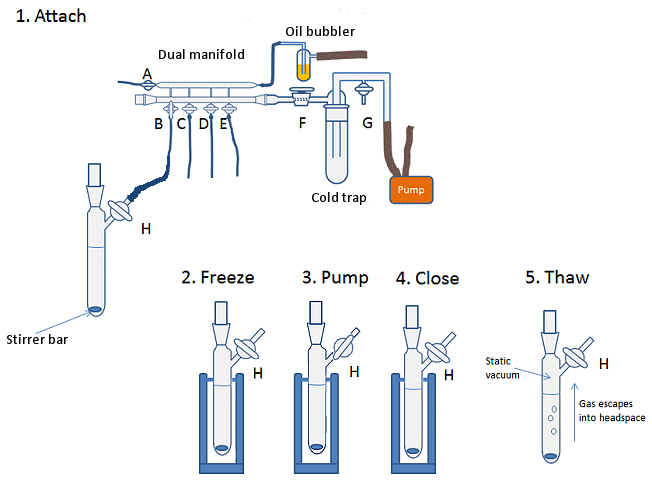
freeze_degas_v2.gif

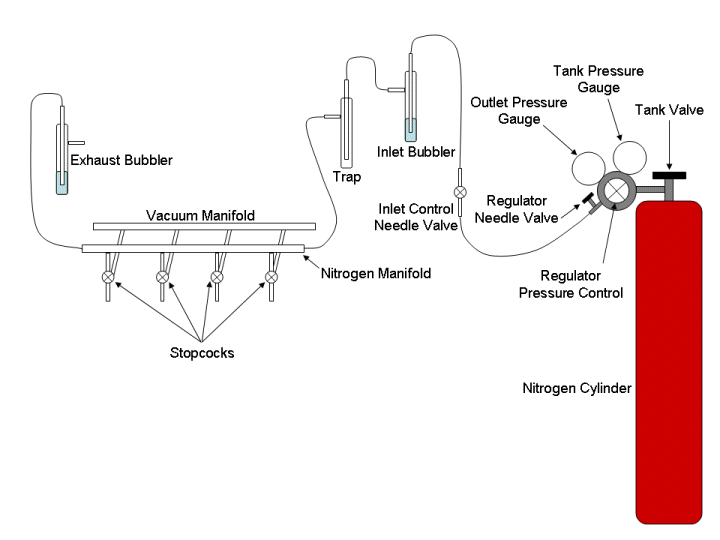
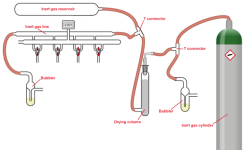
In the videos, they have an oil bubbler on the inert gas line. Is that necessary? I found these in-line drierite desiccators that I plan to use for drying the inert gas stream. Is that what the oil bubbler is for -- to trap water vapor? Or is it just a flow indicator? It has reportedly caused many headaches if oil gets drawn into the schlenk manifold.

And how necessary is the cold trap? Is that just to protect the pump from trace solvent gas that was in the headspace?

I found this great video on preparing inert atmospheres that I'll be following:


That's about as far as I am right now. I'm shopping for schlenk flasks but there seems to be a couple different styles I haven't fully figured out yet. Then I'll probably just connect it directly between the pump and inert gas tank, skipping the manifold, bubbler and trap unless necessary.
 
Last edited:
In the videos, they have an oil trap on the inert gas line.
Are you sure? I suppose I should watch the videos, but there's an oil bubbler on the inert gas line for pressure relief, and a cold trap on the vacuum line to protect the vacuum pump oil from solvents and corrosive vapours. Are you talking about something in addition to those?
 
Are you sure? I suppose I should watch the videos, but there's an oil bubbler on the inert gas line for pressure relief, and a cold trap on the vacuum line to protect the vacuum pump oil from solvents and corrosive vapours. Are you talking about something in addition to those?
Yea I meant the oil bubbler. Wasn’t sure what it is for. Still not sure what you mean by pressure relief. Can I get by without one by opening the inert gas line very slowly?
 
Yea I meant the oil bubbler. Wasn’t sure what it is for. Still not sure what you mean by pressure relief. Can I get by without one by opening the inert gas line very slowly?
You're passing pressurised inert gas into a sealed system, you'll need a bubbler to avoid blowing your joints apart, or even exploding your glassware as a worst case scenario.
 
You're passing pressurised inert gas into a sealed system, you'll need a bubbler to avoid blowing your joints apart, or even exploding your glassware as a worst case scenario.
Oh okay I looked it up a bit and see what you mean. The bubbler is vented to air I guess and relieves over-pressure.

Optionally could I just fill balloons off the tank and use that as my gas supply? Then the pressure wouldn't be hazardous enough to warrant a bubbler?

Hmmm, but then how do I dry and flush a rubber balloon...

Is it even necessary to backfill with inert gas after freeze pump thawing on a volatile solvent? After the final cycle, could I just let the closed headspace become filled with thawed solvent gas? That seems enticing from a molecular mobile physics perspective; then there would be zero non-solvent molecules, not even inert ones.
 
Last edited:
Oh okay I looked it up a bit and see what you mean. It's vented to air I guess and relieves over-pressure.

Optionally could I just fill balloons off the tank and use that as my gas supply? Then the pressure wouldn't be hazardous enough to warrant a bubbler?

Hmmm, but then how do I dry and flush a rubber balloon...

Is it even necessary to backfill with inert gas after freeze pump thawing on a volatile solvent? After the final cycle, could I just let the closed headspace become filled with thawed solvent gas? That seems enticing from a molecular mobile physics perspective; then there would be zero non-solvent molecules, not even inert ones.
For the latter option you'd need to consider whether working at below atmospheric pressure would be desirable, as well as the degree of confidence you'd have of your apparatus resisting leakage of air back into the system. You can probably cobble together a ghetto-style oil bubbler relatively easily if they're commercially out of reach for you for some reason. A gas inlet tube and a sidearm tube, both with ground glass joints, would do it. Copper pipes and fittings would make another alternative.
 
Thanks for the encouraging ideas.

I found this BIBLE for the schlenk line, it's one of the coolest resources on lab procedure I've seen. It's called Schlenk Line Survival Guide. F-P-T is on page 42, but it's all the other procedures you can do that amaze me.

Now I understand why the line has multiple ports. I thought the manifold was just for efficiency so multiple projects could be on the line at once, but beyond that there are some very slick procedures that are probably irreplicable without the full setup. I really want a full schlenk line now. 😭💰🔥⚰️💸

I might bench this for a while or have to settle for ghetto with less than perfect results.

Another reminder of the safety hazards from the survival guide:
Potential causes of explosion
An explosion may occur if the inert gas pressure builds up within a closed system. To prevent this, ensure that there is a source of pressure relief attached to the Schlenk line when the inert gas is open – this is usually in the form of a bubbler (see pages 8-10). Pressure build up can also occur if a reaction evolves a large volume of gas. LiAlH4 workups in particular can evolve a large volume of H2 gas and should be performed controllably with an adequate source of pressure relief. Heating a reaction can also lead to pressure build up within the flask and Schlenk line. Ensure that known exothermic reactions are kept cold and controlled to prevent this from happening.

Reactions that have been cooled to -78 °C or below should be left open to inert gas (and pressure relief) whilst warming back up to room temperature. The inert gas has a lower vapour pressure at lower temperature meaning that the gas pressure will increase on warming back to room temperature. Manipulations that are under a dynamic flow of inert gas should not be cooled with liquid nitrogen since the inert gas will begin to condense at these temperatures.
For freeze-pump-thawing (see pages 42-44) ensure that the flask is sealed before freezing.

It also mentions alternatives to freeze pump thaw degassing: sparging and vacuum boiling.
Other Degassing Methods

Other methods of degassing solvents include: (i) sparging with inert gas; and (ii) the boil-degas method. For sparging, inert gas is simply bubbled through the solvent for an appropriate amount of time to displace dissolved air and oxygen. For the boil-degas method, the solvent is placed under dynamic vacuum for an appropriate amount of time (with a suitable solvent trap) to remove dissolved gases. Both methods can be equally as effective as the freeze-pump-thaw method but do result in significant evaporative loss of the solvent, and therefore is only recommended for bulk organic solvents and should not be employed for degassing expensive deuterated solvents or volatile liquid reagents.

It's hard to believe boiling the gas out could be as effective as freeze pump thaw... but if that's true, then some solvent loss is a lot cheaper than a schlenk line. And all I would need is a cold trap to recapture the loss and protect the pump. But then if you get liquid oxygen in the trap with hydrocarbons... idk.

I have CO2 tanks! I could sparge with CO2 to eliminate O2, then boil out the CO2?

> "For the boil-degas method, the solvent is placed under dynamic vacuum for an appropriate amount of time (with a suitable solvent trap) to remove dissolved gases."

Idk what dynamic vacuum means, but is it even necessary to pull vacuum on a boiling flask for degassing? Could I just create negative pressure with a peristaltic pump? Then the vapors would be contained in-line and the pump is safe. Wouldn't necessarily even need a cold trap if you vent the loss.
 

Attachments

  • the-schlenk-line-survival-guide.pdf
    59.9 MB · Views: 0
Last edited:
Notes dump! ✍️

Solvent Drying


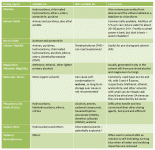
Table_dessicants.gif
Organic Solvents: Physical Properties and Methods of Purification by John A. Riddick, William B. Bunger, Theodore K. Sakano, 1986.

Cooling Baths

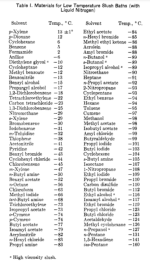
chrome_2025-10-16_19-24-09.png
Temperature should be monitored with a low-temperature alcohol thermometer.
Slush Baths.
J. Chem. Eng. Data 1966, 11, 1, 124


Safety recommendations

The American Chemical Society notes that the ideal organic solvents to use in a cooling bath have the following characteristics:
  1. Nontoxic vapors.
  2. Low viscosity.
  3. Nonflammability.
  4. Low volatility.
  5. Suitable freezing point.


Thermal Shock Tips
  • Solvent shouldn't exceed 45% of schlenk flask volume, especially if there's water content.
  • Top level of solvent should be completely submerged when placing flask in thawing bath. Thaw in acetone/IPA/ethanol bath to avoid ice buildup on flask.
  • Melt the frozen solvent from the top down, never from the bottom up. If you melt the solvent at the bottom first, you have a molten layer which expands relative to the frozen solvent above it. This creates pressure on the frozen layer - if this is still stuck to the glass, then this pressure has nowhere to go and the expansion will break the glass. (Use a blow-dryer, wool, foil to selectively thaw top-down)
https://www.reddit.com/r/chemistry/comments/43zvo1/comment/czm9fix/


Two-Flask Sparging Technique
If you are worried about solvent loss try a two flask technique. Degas the first flask with neat solvent, this one we wont care about but is necessary to build up a stream of gas saturated with your desired solvent. Use a canula needle as a vent and let it go 10-15 minutes. Then insert the other ened of the canula into the solution you want to degas. The incoming gas will be saturated with solvent and prevent loss of solvent from your solution, which i let exit through a disposable syringe needle, you should feel good flow out the vent needle. In terms of flow rate, i let it go pretty vigorously but not to the point where it splashes to any greased joints or septa caps.
https://www.reddit.com/r/chemistry/comments/43zvo1/comment/cznm5lr/


Thermal Regulation
Generally speaking, an aqueous solvent dissolves less gas at higher temperature, and vice versa for organic solvents (provided the solute and solvent do not react). Consequently, heating an aqueous solution can expel dissolved gas, whereas cooling an organic solution has the same effect. Ultrasonication and stirring during thermal regulation are also effective.


Effects of dissolved gas on the nucleation and growth of ice crystals in freezing droplets
The solidification process of water (liquid) can cause an intricate deformation of its structures, from the complex of ice crystals to dendritic frost crystal growth. The dissolved gas in water (liquid) is rejected and accumulated ahead of the ice-water interface during solidification and the resulting bubbles are incorporated into the growing ice crystal. In this study, the bubble formation process and the effect of the dissolved gas on the nucleation and growth of ice crystals in freezing droplets at various gas concentrations were experimentally investigated. The dissolved gas acted as a heterogeneous medium, and promoted the nucleation of the liquid droplets.
This tracks with what I've seen while DMT crystallizes on a microscope slide. Dissolved gas accumulates at the solid-melt interface.


Use of a Titanium Metallocene as a Colorimetric Indicator for Learning Inert Atmosphere Techniques
A method is described to aid the instruction of undergraduate and graduate students in inert atmosphere techniques. A highly oxygen-sensitive organometallic compound, a titanium metallocene, changes color form blue to yellow when exposed to dioxygen contaminant, thereby providing an easily visualized monitor for students learning to manipulate the special glassware and operations typical of inert atmosphere reactions.

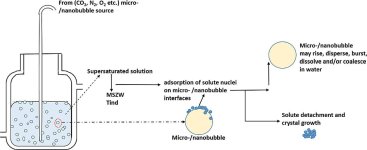
Control of crystal nucleation, size and morphology using micro−/nanobubbles as green additives – a review
nanobubble nucleation.jpg

This review provides a summary of recent studies that addressed the question of whether micro−/nanobubbles provide heterogeneous substrates to impact metastable zone width (MSZW), the nucleation induction time (tind) and solubility, by looking at the influence of gassing parameters (gassing duration, gassing supersaturation and gassing flow rate) during gassing crystallization. Gassing crystallization has emerged as a so-called green technique for inhibiting and/or promoting crystal nucleation and growth by the injection of gas micro−/nanobubbles into saturated solutions to induce heterogonous nucleation. The introduction of a moving gas phase improves the mass transfer in the crystallizing suspension leading to enhanced nucleation and crystal growth. We highlight the physicochemical properties that render gas micro- or nanobubbles as environmentally benign, and the role of gas-liquid-solid interfacial properties in crystal nucleation and growth from solubility, MSZW and tind data. Meanwhile, the scope of research, challenges and future directions on gassing crystallization are also briefly discussed.

Impact of Gas Composition in the Mother Liquor on the Formation of Macroscopic Inclusions and Crystal Growth Rates.
The gas composition of the mother liquor impacts macroscopic inclusions in ciclopirox crystals by influencing crystal morphology and growth rates, and this impact is not limited to thermodynamic effects. Studies show that gas bubbles, or microbubbles, can adhere to crystal surfaces, particularly rough ones, and lead to the formation of liquid inclusions, which are trapped pockets of solution inside the crystal. For ciclopirox, the transition from hexagonal to rod-shaped morphology is linked to a change in the growth rates of specific faces, a change which is influenced by gas presence.

Solubility of Oxygen in Organic Solvents and Calculation of the Hansen Solubility Parameters of Oxygen

The Effect of Dissolved Gases as Impurities on Crystallization

Could be good reads if anyone can get those.


Reactions that Require Degassing:
  • Any reactions heated above 120 oC or heated for a prolonged period over 80 oC
    These reactions are typically performed in a sealed tube and are often run by heating over the boiling point of the solvent. Especially in the case of intramolecular reactions, the formation of a yellowish or brown color in the reaction is indicative of the presence of oxygen. High temperature reactions are extremely sensitive to oxygen and even the act of opening the reaction to take a sample for TLC analysis can introduce enough oxygen to destroy or damage the reaction
  • Organometallic reactions
    For many organometallic reactions, it is essential to provide an oxygen free (and sometimes N 2 free) environment. It is not uncommon to see strict procedures prescribing 10 cycles of freeze-pump-thaw (see below) degassing for the use of sensitive catalysts.
  • Radical and photochemical reactions
    Unless oxidation is the desired product, radical reactions, for obvious reasons, must be degassed.
  • Substrates containing thiols, thioethers, phosphines, electron-rich aromatic, etc
    Heating, solvents, or the presence of other reagents can often induce the oxidation of such substrates even when otherwise stable.
 
Last edited:
Attaching four papers.

Purification of Laboratory Chemicals, Sixth Edition
Haven't read much of this yet, but it's a 750-page overview.​
Solubility of Gases in Liquids
Not very motivated to decipher this paper since I want to remove all gas, but it might come in handy.​
Drying of Organic Solvents: Quantitative Evaluation of the Efficiency of Several Desiccants
A good study comparing desiccants. Generally, 3A molecular sieves were best, reducing water content to less than 5ppm. Activated alumina was a close second.​
Ketyl Radical Test Solution
A recipe for a ketyl radical solution that can be used as a qualitative test for water and oxygen content in hydrocarbon solvents.​
 

Attachments

  • Purification of Laboratory Chemicals v6.pdf
    13.6 MB · Views: 1
  • Solubility of Gases in Liquids.pdf
    15.3 MB · Views: 0
  • Drying of Organic Solvents.pdf
    1.8 MB · Views: 1
  • Ketyl Radical Test Solution.pdf
    80.2 KB · Views: 0
Last edited:
Back
Top Bottom