• Members of the previous forum can retrieve their temporary password here, (login and check your PM).

Help - made mistake during CIELO

caxx6

Rising Star
Help with cielo

I made a mistake during my first try doing Cielo and need help on how to fix it.

Used 100g cactus powder, 25g lime, had good paste consistency, collected 726g of dark green ethyl acetate in first jar and 502g of light green ethyl acetate in second jar. I added washing soda to both jars. The first jar instantly all went to very small clumps. The second jar produced two large clumps in the middle and the rest was not clumping. I put both in the fridge for a few hours. I was unsure of what to do with the jar that all clumped so I filtered out the washing soda and added more. None of it clumped. I rested in fridge for an additional hour, then added 0.25% water.

Here's where I made a mistake. In the dark colored jar I added 5g citric acid before filtering out the washing soda. I panicked and poured the whole jar through a filter as fast as I could but I didn't have a filter set up so it sat for about a minute. Then I added an additional 4.5g citric acid. My light colored jar I did not make the same mistake with. My citric acid is fairly coarse. The grains are like the size of those sugar in the raw packets.

Both jars looked like the citric acid did not dissolve so I shook them for a good while, but that didn't do anything. It's been a few days now. The dark jar is cloudy and the light jar is transparent. I dont see any crystals, just the same citric acid sitting on the bottom.

I'm guessing the citric acid reacted with the sodium carbonate and formed some sodium citrate? Partially in the crystals at the bottom of the jar and possibly in the cloudy suspension? Can I separate this from mescaline citrate?
 
Did you add the 0.25% water before or after filtering out the soda? There's no point adding water with the soda still present.

It sounds as though you won't have produced much sodium citrate. Did you notice any bubbling? There won't have been much of a reaction with so little free water present, and sodium carbonate is essentially insoluble in EA.

Do you have any idea of the potency of the cactus that you used? Low potency could be a reason for the lack of crystals, especially in the light jar if it's the one with the later pulls. If the cactus was particularly weak - which is potentially commonplace - the first couple of pulls would more or less exhaust the pasts. Would it be right to guess that the dark pulls were the first few? The clouding that you're observing is most likely your mescaline.

Since it's not entirely clear around the circumstances of how you added water back into your pulls after SC drying, it may be worthwhile to consider that a lack of water could be preenting crytallisation too.
 
Did you add the 0.25% water before or after filtering out the soda? There's no point adding water with the soda still present.

It sounds as though you won't have produced much sodium citrate. Did you notice any bubbling? There won't have been much of a reaction with so little free water present, and sodium carbonate is essentially insoluble in EA.

Do you have any idea of the potency of the cactus that you used? Low potency could be a reason for the lack of crystals, especially in the light jar if it's the one with the later pulls. If the cactus was particularly weak - which is potentially commonplace - the first couple of pulls would more or less exhaust the pasts. Would it be right to guess that the dark pulls were the first few? The clouding that you're observing is most likely your mescaline.

Since it's not entirely clear around the circumstances of how you added water back into your pulls after SC drying, it may be worthwhile to consider that a lack of water could be preenting crytallisation too.
Thank you for responding! I'm a bit anxious about this at this point and haven't had anyone reply who understands the chemistry enough to help.

I did notice bubbles and pressure at one point, but honestly I can't remember exactly when. It very well could have been what triggered me to realize that I had both citric acid and washing soda in the jar at once. If this is the case I surely must have added the water while the washing soda was still in the jar. I was panicking.

This was intended as a test run. I used American PC, but I only used the dark green outer layer of flesh. After discarding all white flesh I had 35% remaining of the initial weight.

So what are my best steps moving forward? Loveall seems to think that as long as you're under the solubility limit of Citric acid, which I believe I am, that after a few days any citric acid that appears to never dissolve and sits in the bottom of the jar has likely been converted to mescaline citrate. There's a fair amount sitting in the bottom of both of my jars. I never saw it dissolve.

I should probably also mention that my citric acid was monohydrate rather than anhydrous.

Should I add a few drops of water to the dark, cloudy jar and see if anything else crystalizes and if the cloudiness dissipates? Then just filter out all product, assume there is a small amount of sodium citrate in it which would make the product safe but make yeild math and dosing inaccurate?

No way to separate sodium citrate and mescaline citrate?
 
Last edited:
No way to separate sodium citrate and mescaline citrate?
There's always a way - in this instance you could just chuck it back into the next extraction. If it seems to be a worthwhile amount, I'd be tempted to try recrystallise it as the sulfate using cold water and a source of sulfate ions. More sensibly, one could recrystallise the mescaline citrate from boiling IPA. You would probably need to decant the solution off any insoluble material, like sodium citrate, before allowing it to cool and recrystallise.

Use of PC pach is highly likely to be the main reason behind your low yield. This variety has a strong reputation for being weak.

Mescaline citrate is so insoluble in EA that you might not notice anything happening after adding coarse citric acid acid crystals without stirring. It may be worth crushing the crystals just in case there's a layer of M citrate on the outside trapping undissolved citric acid.

Have you added any more water since filtering off the soda? The reaction between SC and citric acid does produce water as a byproduct, even discounting the fact that you used CA monohydrate. For that reason, I'd be reluctant to add any more water just yet.
 
Please forgive me for asking for more clarification. Like I said this is my first time attempting an extraction and I'm not super proficient in chemistry.

First, no I have not added any more water.

There's always a way - in this instance you could just chuck it back into the next extraction.

Would this not just put me right back in the same situation I'm in now? I have clouds in a jar that I'm not sure if are mescaline citrate or sodium citrate or a mix of both, and I have "crystals" (look more like grains the same size as the citric acid I added) sitting on the bottom of the jar that are most likely some combination of mescaline citrate, sodium citrate, and citric acid. If I add the liquid only to the next extraction I would have to basify it first correct? And then anything in suspension would crash out during this step which would mix with relatively higher volumes of sodium citrate.

I have no idea what you mean when you're talking about boiling IPA and sulfates. Im not aware of any sulfates as a product or ingredient in this tek. Could you link me to somewhere I could learn more about this process?

Yes I fully expected low yeild from PC. This was intended as a learning experience to familiarize myself with the process before trying this on a cactus that means more to me. I read that low potency cactus can cause issues crystalizing which is why I discarded all the white low potency flesh. My napkin math tells me to estimate roughly 0.83g mescaline from 100g dark green flesh only of PC - assuming a minimum of 60% of its mescaline in the dark green flesh, using measured dark green flesh weight being 1/3 of the whole raw plant weight, and a whole plant potency average from others tests of 0.5%.

I have more to try again. It would be nice to separate out what mescaline citrate I can but at this point I'm considering just cleaning the EA with a water wash, a sodium carbonate basification, and a freeze and ice filter to try again and discarding anything that precipitates.

If you or anyone else has any ideas of clear direct steps I can take that aren't too far outside of the scope and material list of the tek I'd be happy to give them a shot, otherwise I'll probably scrap this and start over within the next few days.

Right now I will give crushing up the "crystals" or grains on the bottom of the jar a shot to attempt to release citric acid as you mentioned.

Edit: These grains pulled from the jars taste like citric acid to me. No bitter note at all. I have 480g ethyl acetate in the lighter colored jar and added 3.8g citric acid monohydrate to it. After several days I've got a couple grams of undissolved citric acid here. Why would these not dissolve after 3 + days? Something is wrong here. I've crushed up the grains to a very fine consistency and added them back to the jars with a shake with the intent to aid dissolving. It does not appear to have significantly changed the amount of powder in the bottom of the jars.
 
Last edited:
Would this not just put me right back in the same situation I'm in now?
No, returning the crystals to the very start of an extraction would free up whatever mescaline freebase that there is to get pulled by some more EA.
These grains pulled from the jars taste like citric acid to me.
They may well be mostly citric acid - coated with a thin layer of insoluble salt, which you would be unable to taste, but would nonetheless prevent them from dissolving.
It would be nice to separate out what mescaline citrate I can
In which case, recrystallising whatever you can from boiling 99% IPA (isopropanol) will get you there.
I have no idea what you mean when you're talking about boiling IPA and sulfates. Im not aware of any sulfates as a product or ingredient in this tek. Could you link me to somewhere I could learn more about this process?
Since you've made an error in your methods the suggestion is to use a different technique in order to recover whatever mescaline citrate there may be. This is done by taking advantage of its limited solubility in isopropanol, aka IPA (from "Iso Propyl Alcohol"), aka rubbing alcohol [but check the label and/or data sheet in this last instance] - along with the corresponding temperature-solubility gradient. Mescaline citrate dissolves in boiling IPA to some useful extent, whereas in the same solvent at room temperature it is practically insoluble. This allows us to separate it from citric acid, which is readily soluble in IPA even at room temperature, and sodium citrate, which I anticipate to be insoluble or very poorly soluble [you'd best look that one up] in both room temperature and boiling (79°C) IPA.

By exploiting these kinds of differential solubilities through control of conditions like temperature and pH we can separate single substances, or groups of more or less similar substances, from mixtures.

Mescaline sulfate crysallises readily and beautifully from cold (~0°C) water. By adding a source of sulfate ions, possibly in the form of sodium bisulfate ('pH down' pool chemical), one would be able to induce this crystallisation process from a solution of the mescaline citrate if the mescaline were present in a high enough concentration [plus a few other factors which I won't go into here].

Whatever you end up doing, you can keep your EA and use it again for the next extraction after a bit of a clean up using your old friend, sodium carbonate 😁 .


My napkin math tells me to estimate roughly 0.83g mescaline from 100g dark green flesh only of PC - assuming a minimum of 60% of its mescaline in the dark green flesh, using measured dark green flesh weight being 1/3 of the whole raw plant weight, and a whole plant potency average from others tests of 0.5%
I suggest you go back and check your workings, since this looks completely wrong without even bothering to check the figures myself. So, you used 100g of dried, powdered, dark green cactus flesh?

Incidentally, some tests have shown that it's somewhat imprudent simply to discard the white inner flesh; it can still contain a worthwhile amount of alkaloids given that it's the majority of the bulk of the cactus.

Finally, always remember the golden rule of extracting - never throw anything away until you're sure you've got the goods.

Nil desperandum!
 
They may well be mostly citric acid - coated with a thin layer of insoluble salt, which you would be unable to taste, but would nonetheless prevent them from dissolving.
Correct me if I am wrong, but I believe I have disproved this by filtering these grains out, drying, crushing them up, confirming they are not bitter but sour, then putting them back in their respective jars with no perceivable additional dissolving. They're in both jars meaning also in one no error was made in. It looks to me like I have a high amount of citric acid here that's simply not disolving. I've checked my math and still believe I'm well below solubility limits. This is concerning to me because it's happening in both jars and is a significant hurdle to the tek for me if it happens again in the future even without my error. If indeed the issue is monomescaline citrate forming on the outside of citric acid grains, sealing them off from EA and preventing all of the CA from dissolving, I need to learn how to mitigate this. However I feel like if this were the case that many others would have had this issue by now and I have not seen it?

Thank you for clarifying the IPA seperation. I may give this a go. Seems straightforward.

I suggest you go back and check your workings, since this looks completely wrong without even bothering to check the figures myself. So, you used 100g of dried, powdered, dark green cactus flesh?

Incidentally, some tests have shown that it's somewhat imprudent simply to discard the white inner flesh; it can still contain a worthwhile amount of alkaloids given that it's the majority of the bulk of the cactus.
I have double checked my math here and think it's correct. Expected yield of PC whole plant dried - 0.5%, which for 100g of powder is 0.5g. This low of contentration is reported to have issues crystalizing. However inner white flesh is 2/3 of plant by weight and contains only 15%-40% of total whole plant mescaline. Isolating only the most potent parts of the plant I believe I have produced a powder with a high enough concentration to crystalize. PC is not valuable to me so I don't care about discarding the white flesh and I had enough volume to produce 250g of powder containing only dried dark green flesh to practice and learn this tek on. In the future if I have a plant with expected higher mescaline concentration I would absolutely include the white flesh in the powder. Not only not to waste, but also because I'm interested in comparing potency of individual plants, and using whole plant seems to be the easiest way to produce directly comparable yeild results.
 
Last edited:
Solved - after fridge rest with washing soda produced no clumps, I had added in water to reach 2.3% while the washing soda was still in the jar. The washing soda absorbed the water and left the EA in a dry state after filtering. Added water to the jar the mistake was made in 0.5g (0.1%) at a time with shaking and rests between until cloudiness dissipated. Citric acid in jar dissolved and crystals are now visibly forming on jar walls.
 
What excellent news - it's great to hear that's it's worked out for you, and thank you in particular for sharing how you want about solving it.

It will be interesting to hear how the yield turns out for a PC cactus. I would have said 0.5% seems quite… hopeful but it would also be nice for me to be wrong about this! Incidentally, your calculations were probably fine - I was rather sleep-deprived and found their presentation confusing, so please accept my apologies for any off-tone remarks on that front. It's clear that you referred to a previous test that registered a 0.5% yield for that batch of cactus and I have no idea how I managed to overlook that.

Now that you appear to have honed your CIELO method, it may still be worth checking the relative potency of the green and the white flesh separately, perhaps on a smaller scale, if you haven't already.

And once more, well done for working this one out.
 
It will be interesting to hear how the yield turns out
I ended up adding water to attempt to dissolve citric acid until I got goo, then adding ethyl acetate to recrystallize, doing all sorts of extra unnecessary stuff. Spilled here and there a long the way. I wouldnt expect to get a good or accurate yield from this extraction. After this is done and I reclaim I intend on doing a second extraction with a second portion of the same starting material, hopefully much faster and without errors. When that's done I'll report back with yield
 
To this point I have been unable to find actual sources for tempurature solubility gradients of the various possible contaminants in 99ISO. Any help with this would be greatly appreciated.

Tried the alcohol seperation on 2.8g of product from my light colored 2nd pull jar. Was unable to bring to a rolling boil with my equipment working outdoors for ventilation, no ignition source, safety, ended up with a near-simmer with agitation . Lot of product did not dissolve after over half hour in a whole pint of 99 ISO but due to the fact I was unable to bring to a real boil I did not separate out the undissolved product. After a 24h freezer rest I collected and dried to 1.7g of product. I'm sure some was lost in transitions but I doubt a whole gram. Suspicious that I might have actually pulled out some citric acid. Product tastes void of sour citric acid notes, tastes...dry. concerned now with contamination from sodium citrate or sodium carbonate. Plan on getting a proper boiling flask to redo seperation with a proper boil and removing undissolved product.

From my first run first pulls Dark jar i filtered out 4.3g. Compared to the ISO seperated product the taste is not only more sour but noticably more bitter. I also plan on doing the ISO seperation with this product and strongly suspect it's contaminated.

Meanwhile I've begun my second run. Decided to leave sodium carbonate out of the water seperation step and just go with fridge rest and decant instead. In caution against undissolved CA, I crushed it up a bit more than it comes out of the bag, I lightly heated the EA, and put in a mag stir on low speed. After adding 5g CA to 800g EA it did not immediately dissolve at all. Sank straight to the bottom and can see little piles in corners and grains flying around from the stir rod. Light cloudiness appeared after 3 or 4 minutes.

I reported this to someone helping me on reddit and they showed me multiple threads of people who did not have their CA dissolve. All seem to be using lab grade monohydrate CA. Several reported success when switching to standard food grade products like milliard brand, that it came out of the bag significantly finer ground, for one.

The product I was using for CA was from Amazon -

"99+% Purity Citric Acid Monohydrate Citric Acid Powder,Citric Acid Food Grade,Citric Acid for Bath Bombs,Household Cleaner,CAS NO.: 5949-29-1(500g)"

Video of adding CA attached
 

Attachments

  • 20241011_151611.mp4
    29.7 MB
Last edited:
As a test I just attempted to dissolve 1g of this citric acid monohydrate in 50g bottled water. I still have undissolved CA 15 minutes later. I plan on doing another run next week with standard milliards brand CA but all other variables the same to attempt to isolate this as the issue and confirm.
 
Loveall - No, not all of it.

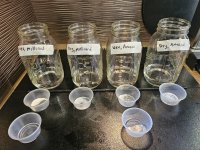
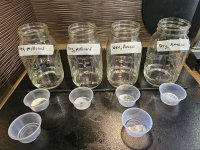
Just ran an experiment as we discussed with four jars. Used 100g fresh EA "ACS Reagent grade" per jar. Used 2.3g bottled purified water in 2 jars. Used 1g milliards anhydrous CA in two jars. Used 1g "east chem lab" Amazon monohydrate CA in two jars. Added water and CA into all four jars within 30 seconds of each other.

20241015_113242.jpg

Results:

T+8: Milliards CA is completely dissolved in wet EA. No signs of droplets, grains, or crystals in jar or during filtering out after this point. The two dry EA jars have some dissolving that initially happened - probably less than half of the CA, but no noticable change after this point. Amazon brand CA in the wet EA is mostly dissolved but clear grains are visible lining corners of the jar.

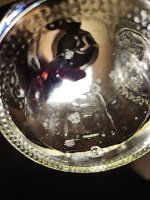
T+32: Examining the Amazon wet jar, I initially thought it was all dissolved but upon closer inspection found just few white fluffy crystals larger than a grain of the CA sitting in the bottom of the jar. Also noticed a couple droplets (water, most likely) rolling around the bottom of the jar.

20241015_133536.jpg

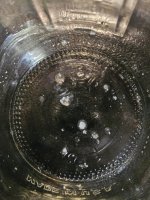
T+50: Examining the Amazon wet jar, droplets now visibly contain grains or crystals.

T+120: No noticable changes in any jar since T+50. Upon filtering out, the crystals left behind in the droplets within the Amazon wet jar were more than expected, visibility within the clear liquid has been reduced. All other jars as expected - no crystals or grains clinging to walls or in filter of wet Milliards jar.

20241015_134548.jpg

I wanted to weigh the product collected from each jar but most of it stayed within the jars while pouring into filters, and rinsing the jar would contaminate the sample and not be 100% effective, so I just scrapped that idea. I think the results are fairly evident without weights.

Conclusion:

Several possibilities as to the Amazon brand CA not dissolving. One would be a different optimal moisture content of the EA for monohydrate vs anhydrous CA. A different one would be possible contamination in the product. I have seen others report this issue (non dissolving CA) who were also using supposed high purity CA monohydrate from Amazon, though those users did not list the particular brand of product listing. I can not confidently conclude that the issue is monohydrate or a bad brand, but I can conclude there is an issue here.
 

Attachments

  • 20241015_113242.jpg
    20241015_113242.jpg
    9.9 MB · Views: 1
Last edited:
Yes, insoluble residue from random Amazon CA does strongly suggest a contamination issue. Not all chem sellers on large marketplaces are reputable or scrupulous! Does it leave a residue when dissolved in water too?
Yes. I bought it because it was labeled 99%+ purity. I suppose a 1% contamination is actually a serious issue. It looks like more than 1% to me though.

I was able to borrow a borosilicate boiling flask and bring the product from my first two runs to a boil with a stir rod in a pint of 99% ISO for over a half hour, filtered out the solids poured straight from boiling through a filter. Liquid put in flat bottomed dish in freezer for two days. Suspended clouds formed in the ISO, then sometime after 24h they started to settle lower toward the bottom but they never fully crashed out. Filter was able to collect all the fine suspended crystals leaving clear ISO on the other side. After drying the filter Im left with a cakey, flakey white powder that tastes bitter but not sour or dry. My feeling is this is a high purity product but that I lost a lot in the hot filter step. I did notice crystals forming in the filter while the liquid slowly dripped through. I removed 45% of starting product in undissolved solids during the hot filter (which should be a mix of sodium citrate, sodium carbonate, mescaline citrate) and then I recovered only 6% of starting product during the cold filter at the end. Not too sure on how to improve separation but I wasnt really satisfied with this procedure and dont think I would do it again. If I had suspected sodium citrate or sodium carbonate contamination in the future I would try to find a different way to separate.
 
Last edited:
Back
Top Bottom