• Members of the previous forum can retrieve their temporary password here, (login and check your PM).

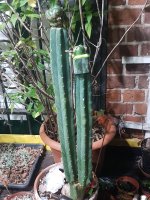
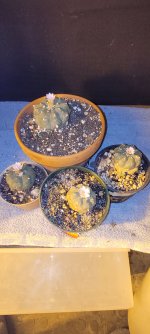
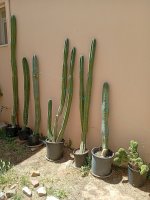
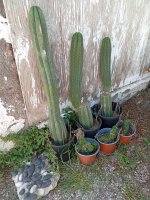
How does your cactus garden grow? (Cactus pic thread)

Migrated topic.
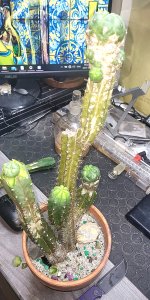
I don’t understand how people manage to get such thick growth. It must be the natural sun at the right latitude — like a billion-watt HPS lamp — that makes it happen. Up here in the north, you can only get narrow growth, which does widen as it grows toward the light, but for example, you just can’t get thick growth from a thick cutting.

I’m at 60.2° N. I live in an urban environment, and sunlight reaches my balcony for only about 4 hours at best, due to the geometry of the surrounding buildings. [...]


That said, my cacti never really live long enough to reach two years of age, since I tend to cut them into cuttings and for consumption.

From my experience thick or etoiliated growth is a convergence of multiple factors. Those factors, just my observations not gospel, are how large the base cacti is, age, how large of a pot it's in, frequency of watering, length of direct light per day, intensity of that light, and nutrient regime.

Big mid cuts and several year old established cacti in large pots ( 3 gallon and above ) produce big pups for me. Excess nitrogen in cacti nutrient regimes I feel can make them want to grow vertically too fast to maintain thickness if others factors align. Watering too frequently I believe can have the same effect. If both or one of those combine with low duration / intensity of light equates to skinny etoiliated growth.

Reason I came to those observations is I have a friend who had around fifteen trichocereus cacti. He only got 3-4 hours of low intensity sun in the morning and would water his cacti everyday. He would supplement an even NPK, like 13-13-13, regularly like you would a potted house plant. His entire collection was all setup to grow vertically fast and it did. But with the limited duration and light intensity that translated to rapid etoiliated skinny growth. I took over several of his cacti when he downsized. I cut the etoiliated growth off and increased the pot size on as many as I could. All the new columns are happy, green, and thick a few years later.

Yours with all the pups look happy :love:. They sure are light hungry like marijuana though. I'm sure they wouldn't whine with a 600w led cause they sure aren't buying the light and paying the electric bill.

I can't wait for my trichs to eventually flower one day. :love:
 
From my experience thick or etoiliated growth is a convergence of multiple factors. Those factors, just my observations not gospel, are how large the base cacti is, age, how large of a pot it's in, frequency of watering, length of direct light per day, intensity of that light, and nutrient regime.

Big mid cuts and several year old established cacti in large pots ( 3 gallon and above ) produce big pups for me. Excess nitrogen in cacti nutrient regimes I feel can make them want to grow vertically too fast to maintain thickness if others factors align. Watering too frequently I believe can have the same effect. If both or one of those combine with low duration / intensity of light equates to skinny etoiliated growth.

Reason I came to those observations is I have a friend who had around fifteen trichocereus cacti. He only got 3-4 hours of low intensity sun in the morning and would water his cacti everyday. He would supplement an even NPK, like 13-13-13, regularly like you would a potted house plant. His entire collection was all setup to grow vertically fast and it did. But with the limited duration and light intensity that translated to rapid etoiliated skinny growth. I took over several of his cacti when he downsized. I cut the etoiliated growth off and increased the pot size on as many as I could. All the new columns are happy, green, and thick a few years later.

Yours with all the pups look happy :love:. They sure are light hungry like marijuana though. I'm sure they wouldn't whine with a 600w led cause they sure aren't buying the light and paying the electric bill.


I can't wait for my trichs to eventually flower one day. :love:
Thanks for sharing that information. I can get around 6 cm thick growth even with my current lighting, but it’s mostly at the tops as they grow taller. The reason might be that they’re closer to the light, but if the distance drops below 10 cm, the tips start to yellow.

I can’t really say much about species variation in thickness, since all of mine come from the same unknown clone. I do have some new species and clones on the way, though.

I’ll have to stick with my 200 W light since my tent is only 60 × 60 cm (a bigger one would totally mess up the feng shui of my 30 m² studio), and more powerful LEDs are just too large. Plus, the electricity bill from a 600 W setup would be way too much just for cacti. I’d rather settle for cheaper and slimmer growth — I’ll make up for the lack of thickness with quantity instead.

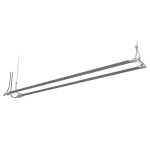
That said, I’ve been thinking about setting up this little 80 W rig (see picture) on the windowsill to supplement natural light, so I can free up some space in the tent for the new clones — if they ever arrive in the mail.
 

Attachments

  • COM2X40-ASSEMBLY-02-600x600.png
    COM2X40-ASSEMBLY-02-600x600.png
    60 KB · Views: 1
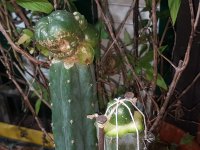
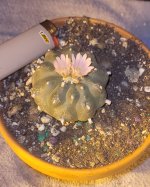
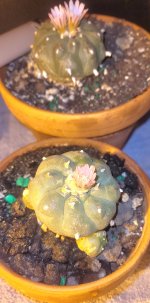
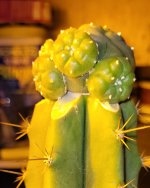
So, already having posted the double graft over here, I thought I'd put a bit more context to what's going on. Basically, the idea is to compare the same loph grafted onto two separate columns on the exact same bit of PC rootstock, except one has an "interscion" (or whatever it should be called) of T. bridgesii, since I happened to have a lump of it lying around, as you do. A kind of graft-on-a-graft, if you will.

The PC rootstock already proved to boost the growth of a loph scion quite phenomenally, to the extent of a fat pup bumping up against a neighbouring stem. This is just an experiment to see what effect the intermediation of a chunk of bridgesii might have, since it seems like a lot of factors are controlled for - the stock and (terminal) scion are practically identical, above all else.

Here's a view of the double graft (right), alongside the original one (left):
20251119_184108.jpg
20251119_234528.jpg
 
Its always fun to play with grafts. I'm interested in the hypothesis your poking a stick at. As I stated over in that same thread, a friend and I have tossed the idea back and forth a few times.

Did you graft the PC + T. bridgesii + lophophora all the same time or did you let the PC + T. bridgesii get a brief headstart?
 
Its always fun to play with grafts. I'm interested in the hypothesis your poking a stick at. As I stated over in that same thread, a friend and I have tossed the idea back and forth a few times.

Did you graft the PC + T. bridgesii + lophophora all the same time or did you let the PC + T. bridgesii get a brief headstart?
I just decided to go for it and assembled the whole graft sandwich in one set of operations. Maybe stepwise would be wiser, but I'd want to use a third conjoined column for that and it wasn't available here.
 
Any thoughts on trying to graft in the winter when temps are coller and you've cut water way back?
I take cuttings in the winter since they have little to no water and hardly ever rot.
 
The scion takes best when the cactus is actively growing. Grafting in late summer or early autumn gives poorer results—at least in my experience. What are your winter temperatures like? I wouldn’t graft if the cacti are dormant or close to dormancy. Humidity is also important, as it’s usually higher during that time of year. Not to say it can’t work, especially if your technique is perfect, but the chances of success are lower.

When you say ‘hardly ever rot,’ what do you mean by that? Why would the cutting rot in other parts of year?
 
The scion takes best when the cactus is actively growing. Grafting in late summer or early autumn gives poorer results—at least in my experience. What are your winter temperatures like? I wouldn’t graft if the cacti are dormant or close to dormancy. Humidity is also important, as it’s usually higher during that time of year. Not to say it can’t work, especially if your technique is perfect, but the chances of success are lower.

When you say ‘hardly ever rot,’ what do you mean by that? Why would the cutting rot in other parts of year?
Midwestern winter, bay window (and other windows). So, lower light and maybe 60(?) degrees or a little cooler in the winter.

I have a bunch of PC which has "sentimental value". I've been replacing it with cuttings which should be better. I'd like to keep some of the PC and doing some grafting seems like the best of both worlds.

To root cuttings, I just make the cut, stick it directly in dirt, water, and then don't water for at least a month. So, quick and dirty relying on the very dry conditions.
I take cuttings early winter and they are rooted by spring to be put outside. Outside cactus harvested for consumption in the fall.

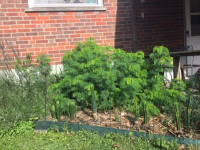
My outdoor garden in the spring a few years ago. I had about 15 going last year. Desmanthus illinoensis in the background.

des.png
 
60°F is about 15.6°C, and I’d say that’s around the dormancy threshold. It may grow a little if there’s some light, but very slowly. The scion might take a month or two to take (instead of the usual week), but the bigger issue is relative humidity. If it’s –5°C and 100% RH outside, you’ll end up with around 25–30% indoors. If you can keep the humidity at 60–80%, the scion won’t dry out, so the odds will be higher.
 
Back
Top