Jees said:
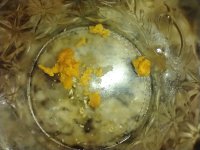
We've had several persons here getting crystals from former goo by lowering the ionic strength in the acid solution. The goo and the yellow oil are related to each other I reckon.
A/B extraction soups from plant material are usually heavier based (ionised) than a backwash.
With a backwash you only need to get a high enough pH, no more.
Extraction soups from plants often have much more base (ions) than needed for a high enough pH: for lysing the plant cells and for dodging emulsions. No such things are as present in a backwash.
Exactly that is why a backwash delivers better crystals imho, the lower ionic strength, also because nobody really adds NaCl-salt (cfr max ion tek) as an extra ionic parameter in a backwash.
Connecting the dots with this theory.
I second this.
Backwash details that could minimize DMT polymerization:
- Stir in dilute acid overnight. With time, the most stubborn DMT polymers seem to be broken up. Like Jess said, don't use a lot of acid to minimize ionic strength in the next step.
- Add Naphtha before basing
- Add base slowly while shaking with Naphtha and sample the water pH. Target a pH of 10.7, to finish up (water will also stop clouding as base is added). I think we want to avoid cloudy water sitting around to minimize DMT polymer.
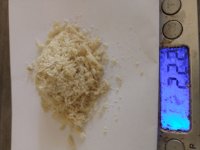
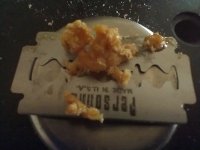
Not sure which of these matter more, but combined they turn yellow goo to white xtals.
Yellow goo and white xtals seem the same to me effect-wise. Advantages of white xtals: seem more soluble in naphtha during the pulls, easier to handle, and more reliable vaping on e-mesh (goo seems to need higher temperature that can be variable).
Also during extraction, it helps to not get too crazy with pH and ionic strength. Jees is right, that some aggressiveness is needed to fight emulsions and the plant matrix. I think good targets when battling plant matter are pH~12 and ~2.5M ionic strength (as used in the max ion tek). Naphtha can also be added before basing, but this time the pH is increased until the plant emulsion is broken up. With more aggressive conditions DMT polymerizes making it more difficult to go into naphtha, which then requires heat, which also makes contaminants more soluble in Naphtha. With gentler conditions, impossible emulsions can form. Therefore, there is an optimal range (which I think max ion tek found).
Edit: also during the plant extraction when at high pH (~12) having dilute DMT (<0.5%) may help minimize polymer formation (again, a condition used in max ion).
In summary,
Conditions that may cause DMT to aggregate into goo:
- High ionic strength
- High pH
- High DMT concentration
- Time in alkaline water (more is worse)
Back salting conditions that may break up DMT goo into white DMT:
- Don't back salt at a very high DMT concentration (~1% or less seems ok)
- Time in dilute acid (more is better, overnight with stirring seems sufficient). Dilute acid could be 1 in 5 parts vinegar. Note: in the past, some people may have confused this acidic polymer break down with a false DMT "oxide" reduction and even added zinc unnecessarily)
- Low ionic strength (skip salt)
- Time in alkaline water (less is better, so add naptha before basing and shake while basing to minimize time water is cloudy).
- Low pH target ~10.7 (stop ~ after white clouds stop forming)






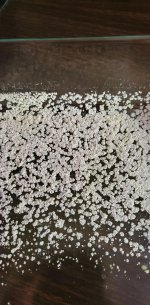

 . Think I'll end up at ~2.5% and be happy with that.