Hmmm... I've been thinking about this for awhile, and from my last few experiences, I'm sure it's true:
While with mimosa, freeze precipitations worked very nicely in retrieving all the spice, large snow-globes would coat the sides of containers, and they were very easy to retrieve.
With acacia, though crystals would be forced out as the temperature went down, the crystals would come out as fine as flour, and impossible to retrieve. Either due to the rate of cooling, or otherwise, he would try evaporation, and inevitably end up with goo.
found, however, just leaving glasses of thoroughly saturated (I made the pulls on hot basified acacia) naptha out over night, 12-18 hours, would result in spectacular jars of crystals!
I got no goo on my previous extraction, except when I evaporated out. Room temp precipitations only yielded crystals.
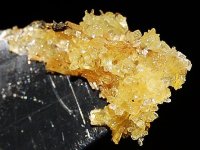
The largest would be a 100 milligrams or more, massive beautiful white crystals. Lower towards the bottom of the jars, the crystals would be pinker/dirtier colored, as a small amount of basified material inevitably seems to get swept up in the naptha pulls. I found leaving the jars to sit, and decanting while still warm aided with this, though.
BUT, it was the leaving the jars to cool from 80-90 F to room temperature or a little cooler (perhaps 50? it was a cold room, not heated) that allowed the crystals to fall out. I didn't attempt to freeze the solvent after decanting from the crystals. I wonder if another portion of crystals still remained, but I did reuse the now-yellow naptha with great success, mind you.
I achieved a yield of .75 to 1% in this manner, and if I ever need to dabble with Acacia again, I feel relatively confident. I actually wonder if slower crystallization, in this manner, would have yielded purer results with mimosa as well.



 Better a little extra than not enough. I haven't seen a solution so saturated that it wouldn't dissolve more lye...