I've been researching different ways to tackle oiling out, which is a phenomenon that probably everyone experiences when freeze precipitating DMT. When DMT congregates densely in solution, aka supersaturation, it precipitates. But in addition to crystals there's almost always an oily coating, sticky film, nodules of goo, or entire zones of slushy material. This could be due to oiling out, aka liquid-liquid phase separation.
I think we see it a lot with freeze precipitation because we're taking big steps from room temperature when we put the non-polar solution in the fridge or freezer. It's a quick and dirty way to squeeze the spice out, but a rapid cooling rate can push the supersaturation too high, where I think oiling out becomes a regular occurrence.
Another issue is leaving the solution stagnant. Leaving it in a cupboard to slow evaporate, or in the fridge / freezer. The solvent can develop zones of supersaturation, particularly around crystals as they grow. It happens when the crystals create deadzones around them, where natural diffusion isn't keeping up with the traffic of solute molecules. When traffic gets too congested the system can collapse into a liquid droplet.
The liquid separation causes secondary issues, like dissolving small amounts of solvent and impurities. These contaminant molecules can lower the freezing point of the DMT liquid droplets, so that even if they appear solid when frozen, they melt at room temp and take a long time to dry. The liquid droplets can also coat growing faces of the crystals, halting crystal growth (potentially accelerating liquid separation).
Generally the strategy has been to keep things as still as possible, to try not to disturb the delicate process. But perfect stillness seems to enable oiling out, so where can we compromise? We must introduce some kind of circulation. I read that even just keeping half of a flask on a warm surface and the other half off is enough to create a gentle circulation across the temperature gradient.
What about quartz?!

I found a suggestion on reddit to try a quartz clock mechanism with continuous motion. I was really excited to try this because it's such a simple $10 device. It measures the vibration of tiny quartz crystals to track time and "ticks" sixteen times per second, creating a visibly smooth motion. I bent the second hand sweep into the ugliest and lightest stir rod, and connected it to the mechanism through a hole I drilled in a canning jar lid. It sweeps through the solution much more slowly and gently than other mechanical stirring methods I'm aware of. And I think it actually made a difference!
View attachment IMG_1478.mp4
I really want to decant the jar, evaporate the solvent residue, and look under the microscope to see how much liquid DMT there is relative to other extractions. But I noticed the solvent is evaporating through the hole I drilled for the mechanism, so I'm doubling down to see if the perceived effect persists while more DMT comes out of solution. In theory I should be past the danger zone and growing slow enough, with enough circulation, to precipitate the rest without oiling out.
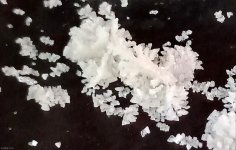
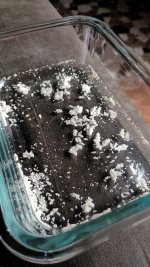
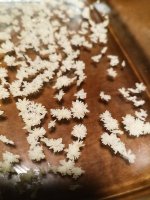
So far I'm basing my excitement on the fact that a lot of DMT has crystallized already at room temp, and the crystals look well formed. I'm not entirely sure how I'm getting crystals out of solution without lowering temp, but it's been happening for me lately even before this quartz trial. Previously, I got less crystals and a good amount of oiling out by this point. More crystals this time, with everything else being the same, is a good sign that the extra crystals I'm seeing are from DMT that was prevented from oiling out. If this holds up during evaporation, or during rapid cooling, this could be a game changer for home extractors.
I think we see it a lot with freeze precipitation because we're taking big steps from room temperature when we put the non-polar solution in the fridge or freezer. It's a quick and dirty way to squeeze the spice out, but a rapid cooling rate can push the supersaturation too high, where I think oiling out becomes a regular occurrence.
Another issue is leaving the solution stagnant. Leaving it in a cupboard to slow evaporate, or in the fridge / freezer. The solvent can develop zones of supersaturation, particularly around crystals as they grow. It happens when the crystals create deadzones around them, where natural diffusion isn't keeping up with the traffic of solute molecules. When traffic gets too congested the system can collapse into a liquid droplet.
The liquid separation causes secondary issues, like dissolving small amounts of solvent and impurities. These contaminant molecules can lower the freezing point of the DMT liquid droplets, so that even if they appear solid when frozen, they melt at room temp and take a long time to dry. The liquid droplets can also coat growing faces of the crystals, halting crystal growth (potentially accelerating liquid separation).
Generally the strategy has been to keep things as still as possible, to try not to disturb the delicate process. But perfect stillness seems to enable oiling out, so where can we compromise? We must introduce some kind of circulation. I read that even just keeping half of a flask on a warm surface and the other half off is enough to create a gentle circulation across the temperature gradient.
What about quartz?!
I found a suggestion on reddit to try a quartz clock mechanism with continuous motion. I was really excited to try this because it's such a simple $10 device. It measures the vibration of tiny quartz crystals to track time and "ticks" sixteen times per second, creating a visibly smooth motion. I bent the second hand sweep into the ugliest and lightest stir rod, and connected it to the mechanism through a hole I drilled in a canning jar lid. It sweeps through the solution much more slowly and gently than other mechanical stirring methods I'm aware of. And I think it actually made a difference!
View attachment IMG_1478.mp4
I really want to decant the jar, evaporate the solvent residue, and look under the microscope to see how much liquid DMT there is relative to other extractions. But I noticed the solvent is evaporating through the hole I drilled for the mechanism, so I'm doubling down to see if the perceived effect persists while more DMT comes out of solution. In theory I should be past the danger zone and growing slow enough, with enough circulation, to precipitate the rest without oiling out.
So far I'm basing my excitement on the fact that a lot of DMT has crystallized already at room temp, and the crystals look well formed. I'm not entirely sure how I'm getting crystals out of solution without lowering temp, but it's been happening for me lately even before this quartz trial. Previously, I got less crystals and a good amount of oiling out by this point. More crystals this time, with everything else being the same, is a good sign that the extra crystals I'm seeing are from DMT that was prevented from oiling out. If this holds up during evaporation, or during rapid cooling, this could be a game changer for home extractors.