
Hello, apologies in advance if this might be an unnecessarily complicated and unefficient method of separation and visualization.
I'm looking for insights on people having experience, or recalling relevant publications, about quantitative separation of plant extracts individual components using either agarose gel electrophoresis or paper electrophoresis (or any other method).
I imagine phytochemicals migrating order on different media might be comparable if using the same solvents, but again I wouldn't be too keen to assume without further testing.
Would agarose gel electrophoresis potentially allow for the following?
a. visualize different bands directly in the gel matrix as they migrate from anode to catode, using any non-chemical method (example: UV)
b. slicing away the gel containing the DMT band, with reasonable separation away from the gramine band
c. be inexpensive and efficient (due to the potential reusable agarose gel, by maybe discarding the gramine band for safety, and melting it again), to work with large extraction batches
Thank you
https://en.wikipedia.org/wiki/Agarose_gel_electrophoresis
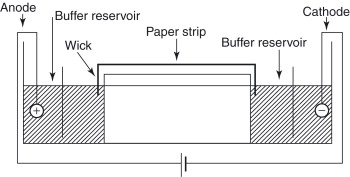 (image source: https://www.sciencedirect.com/topics/medicine-and-dentistry/paper-electrophoresis)
Book (Paper and thin layer chromatography & electrophoresis, Paper and thin layer chromatography & electrophoresis : Feinberg, Joseph George : Free Download, Borrow, and Streaming : Internet Archive)
I'm looking for insights on people having experience, or recalling relevant publications, about quantitative separation of plant extracts individual components using either agarose gel electrophoresis or paper electrophoresis (or any other method).
I imagine phytochemicals migrating order on different media might be comparable if using the same solvents, but again I wouldn't be too keen to assume without further testing.
Would agarose gel electrophoresis potentially allow for the following?
a. visualize different bands directly in the gel matrix as they migrate from anode to catode, using any non-chemical method (example: UV)
b. slicing away the gel containing the DMT band, with reasonable separation away from the gramine band
c. be inexpensive and efficient (due to the potential reusable agarose gel, by maybe discarding the gramine band for safety, and melting it again), to work with large extraction batches
Thank you
https://en.wikipedia.org/wiki/Agarose_gel_electrophoresis
Book (Paper and thin layer chromatography & electrophoresis, Paper and thin layer chromatography & electrophoresis : Feinberg, Joseph George : Free Download, Borrow, and Streaming : Internet Archive)
Last edited:


