• Members of the previous forum can retrieve their temporary password here, (login and check your PM).

Kash's Advanced LSA Extraction

Migrated topic.
Why not decrease pH at this step to help with extraction like it is done in the equivalent first steps of DMT extraction?

Well also not sure but just a general thing is that if molecules get bigger, then they are less likely to exhibit a true ionic behaviour. For example NaCl salt is really small and has a high density of charges. But if you have a pretty big LSA molecule just 1 charge will not count in so heavily. Because of that bigger molecules in general have a better solubility in non-polar solvents when having the same amount of charges.

Of course for bigger molecules they could also contain more Nitrogen which can get also charged via H+. But then again chance for multiple charges is decreasing more and more as it is not favored energetically. That's also a reason why citric acid has a different pKa for every of its 3x H+, making it less likely to detach for every other H+ that has already detached / been deprotonated and thus reducing acidity for every next deprotonation step.

As also the anion of those LSA will be big (and not like Cl-) it's quite likely that those salts just have a good solubility in acetone in general.

Now not sure if that was the initial thought, I guess it was more empirically tested and seemed fine. But that could be an explanation?

A reason to not directly use pH 3 water for extraction might be that this catches up all Alkaloids, while Aceton will only dissolve the big ones and not small ones, where aceton would be too unpolar?


Another question: At which step the blue fluor of LSA pops out under UV? Seeds don`t seem to have any blue and the green fluor in the 2nd step doesn`t look like LSA at all.

Sadly I dont get what step this is in the TEK. Step 2 at first page tells to just use seed powder in acetone for initial extraction? In general any extract should have some fluorescence as it would not matter if you mix non-fluorescenting and fluorescenting substances, as long as some are fluorescent they will always give a glow in black light. And as you hopefully carry some Ergot alkaloids right from the first step over into your liquids, they should always glow.


Also when now reading that TEK:

8]Quickly add 50 ml toluene or DCM to the solution and mix well for 15-20 minutes.

Mixing 15-20 minutes seems pretty overkill. As this step is not concerning exxtraction from a complex matrix like crushed seeds but instead just regular liquid-liquid you would be done in 2 minutes with hand shaking or even 30 seconds if you could use a magnetic stirrer at 500 RPM+.

Ethyl Acetate would be a good solvent which evaporates speed-wise inbetween and is completely non-toxic. Also no adduct-formation like with DCM, but probably it evaporates so fast that adduct formation is not a thing. Still evaporating Ethyl Acetate with a fan will make you get some water into your product, so you would need a drying agent to calculate your yield.


PS:

At this moment I really need to point out how crazy it is that this guy still is a new member since 2008 and still has made 1200 posts :lol: :lol: :lol: But how is he even allowed to post here, as this is not open for 'new members'?
 
Hellow Twilight.

So you are saying this extraction from seed pulp with acetone by itself grabs LSA as well as possible and adding acid doesn't increase solubility of it in acetone anyways? But adding it would grab more junk?

Sadly I dont get what step this is in the TEK. Step 2 at first page tells to just use seed powder in acetone for initial extraction? In general any extract should have some fluorescence as it would not matter if you mix non-fluorescenting and fluorescenting substances, as long as some are fluorescent they will always give a glow in black light. And as you hopefully carry some Ergot alkaloids right from the first step over into your liquids, they should always glow.

They might give always give a glow but other things might quench its fluorescence. Also, other abundant or more efficient pigments or fluorescent things might catch the UV and prevent it from exciting LSA. And the other things might catch that LSA blue glow for them. Then we won't see the LSA blue glow.

Experimental data here to answer my own question: very clear blue glow shows up starting at step 6 - defatting. Aqueous acidic fraction turns greenish blue (another fluorophere giving yellow? Yellow plus blue equals green), then after a couple of washs with nonpolar the aqueous fraction, gets clear blue. After basification (step 7) it remains clear blue. At step 8 - nonpolar pull - blue glow jumps to nonpolar fraction, succeeding 2 pulls continued to get blue. Heating up mixture of polar-nonpolar to 42 Celsius during pull makes the blue nonpolar a bit more greenish (pulling the yellow fluorophore?), certainly stronger fluor so probably pulling more. Also, it proves an obvious point: it glows blue whether freebase or salt.

Using a very simple UV light like the one used to check bills works very well for this. It is a pretty good way to track where LSA is assuming the blue glow is strictly from it at the point it becomes obvious. Pretty helpful during phase separation.

Anyone has fluorescence spectra for LSA and other ergotamines??
 
I'm quite convinced that LSA + it's counter ion is so big that they will exhibit less of 'classic salt' behaviour and thus be more soluble in a semi-polar liquid like Aceton. But of course I have 0 experimental data for this and I even think Kash has no analytic proof, I guess this extraction was more like an empiric process? So as long as it seems to indeed catch it up, I would go this way because the pH 3 water method could indeed catch up more stuff.

THX for the fluorescence explanation and indeed that sounds like a good way to keep track. Indeed many things change it's colour based on being freebase or salt (like pH indicators), but seems for LSA it's not the case. It does not have many double bonds apart from the original indol ring at the bottom. So I would not expect any absorption past 350 nm. Fluorescence emission might be then around 390 - 450 nm which will make it glow blue.
 
Kash could explain his reasoning on the switch on acetone before defatting.

Yes, harmalas switch fluorescence on and off like that. LSA's blue seems to be quite weak, as it is easily occluded by the junk... Also perhaps the blue emission may be more excitable absorbable to by other molecules.

I am very curious about the green fluor... It might be anything causing it of course... LsA itself might form excimers, which are fluorophores that shift their emissions when in high concentrations so maybe the green happens when it's concentrated (green is just below blue in spectra so it's kind of backwards, excimers usually give higher energy emissions)?? If so this would help assessing how much is in there. Just speculation though.
 
I have two questions:

1) Kash says that the product is LSA. Has this been verified by anybody?

2) Does anybody have dosage ranges based on mg of the final product as opposed to the number of seeds used?
 
I don't think there's been any formal LC MS testing.

Dose wise Albert Hofmann I think took 500mcg IM and noted only threshold effects. I think it's generally thought to be one tenth to one twentieth as strong as LSD. Meaning 1 tab equivalent in LSD would be approx 1-2mg of LSA. (If LSA is in citrate form this dose would be higher again). IIRC I think Loveall in a previous posted noted a paper that stated 6mg was a normal dose.

There's also a big difference in trip reports when comparing HBWR to MG. This is something that needs further investigation as there is likely a difference in the profile of actives between the two (especially fresh MG which may contain more LSH). Although this is not confirmed.
 
_Trip_ said:
I don't think there's been any formal LC MS testing.

Dose wise Albert Hofmann I think took 500mcg IM and noted only threshold effects. I think it's generally thought to be one tenth to one twentieth as strong as LSD. Meaning 1 tab equivalent in LSD would be approx 1-2mg of LSA. (If LSA is in citrate form this dose would be higher again). IIRC I think Loveall in a previous posted noted a paper that stated 6mg was a normal dose.

There's also a big difference in trip reports when comparing HBWR to MG. This is something that needs further investigation as there is likely a difference in the profile of actives between the two (especially fresh MG which may contain more LSH). Although this is not confirmed.
Thanks for the reply. So this tek is useful for extracting from either HBWR or MG? Also, which of the two seeds contains more “actives”, by weight?
 
HbWR is way better by weight but fresh MG should contain more LSH (which degrades to LSA I believe hence the difference in trip reports).

IIRC, HBWR for a trip requires only a few seeds, MG is hundreds.
 
_Trip_ said:
I don't think there's been any formal LC MS testing.
Thanks. The reason why I asked is that I saw in a white paper that HBWR seeds were found to have 0.3% of total alkaloids by weight, but LSA accounted for only 1/8 of the total alkaloids. So I’m curious, how is it that this tek supposedly only extracts the LSA and leaves behind all the other alkaloids.
 
Certain compounds can be selectively crashed out of solvents etc with certain acids (salts). The cielo tek is a good example of this with mescaline. But as mentioned no formal testing as far as I'm aware for Kash's LSA tek.
 
Hello all.

Here is a contribution to the tek:

After acetone xtraction and filtration, put it in the freezer, let the clouds of fat form and settle. Collect acetone avoiding fats quickly while acetone is cold (Ice bath helps, fast pipetting too) and set it aside for drying or reuse it into mush to load more LSA into it, followed by more freezing and separation. This reduces fats in the initial acetone extract considerably and speeds up washing and basification by reducing emulsions.

Fat Clouds seem to completely lack fluorescence which stays in cold acetone. Emulsion is a major hindrance without some serious defatting. as it is, it takes too much nonpolar solvent on the acid washes, it's a waste. After freeze defatting everything else flows far better.
 
put it in the freezer, let the clouds of fat form and settle

That's indeed true. I ran that also some time ago, but the product got lost on the way :((

Wanted to get some pure LSA as a solid, but as prices for these seeds have gone up so much in the last 5 years you can now only buy 100 seeds instead of 100 g. As definite LSA (not other inactive ergotamines) content seems to be not much higher than 0,1 % obtaining some pure LSA seems a hassle, especially as the TEK calls 50+ seeds equivalent strong, even though if that would be eaten it would rather feel like an intoxication :twisted:


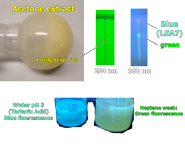
Here is just a summary of also some pictures.

First picture is the stuff directly derived from the Acetone extraction. Mostly yellow stuff, I think it was quite a lot, but therefore only traces of active components inside there. And this stuff indeed was not easy to dissolve again in room temperature Acetone, so a freezing step may get rid of a lot of this prior to extraction.

Next step would be collecting all the Alkaloids with pH ~ 3 Tartaric Acid (aq). But at this step you mostly leave the fat layer intact. Then I was afraid I might loose too much LSA still inside this big layer of beige fats.

Therefore another tweak could be adding pH 3 tartaric acid (aq) AND ALSO heptane. This did not dissolve the fat, but made it release from the glas. Then I could shake the flask quite well and hopefully break up more of the fat layer to take up more of the LSA potentially hiding inside.

Also attached is the TLC of the crude Aceton product. A blue fluorescence spot at the top and a green one below. The beige fats will form a pretty big line all along the TLC (Methanol + 1 % Ammonia). As LSA is reported to be blue it would rather be the upper spot, but it is running surprisingly upwards. Would have expected it to run more at the spot of the green substance?

Anyways later when doing the defat the Heptane got the green fluorescence and the water stayed blue. So like Ruffles told the green one seems not what we are after. Here I indeed had some emulsions with all those fats. They did not even get removed pretty well by the Heptane and I had to cut off a sacrificial layer between both phases. In cases like this with DMT Toluene pretty nicely destroyed any emulsion for me, but I think a more polar solvent has a higher chance of also dissolving LSA salts, as big salts tend to migrate more into NPS than small ones.

Then the last step failed for me: Basify to pH 9,5 - 10,0 and extract with solvent of choice (DCM). I used a freshly calibrated pH electrode and still got a colour change at pH 9,6 from yellow to green-blue. Then extracted what should now be freebase LSA, but my NPS stayed completely white, while the water stayed blue. Just out of fun I basified to 10+ and extracted with DCM and also Toluene. The colour never made it into the NPS ... Evaporation of NPS yielded 0 product.

So maybe it got lost on the way or I just had too less seeds, if the alkaloid content really is that low. Did not grant me anything at the end, but maybe pictures can be a reference.


A question which still arose back then:

It was told to not overshoot on pH as at > 10 it would induce creation if Iso-LSA. But I read in a paper they found even more Iso-LSA than LSA already in the plant. Probably would not favor the creation of even more Iso-LSA, but both are Diastereomers (only 1 out of 2 chiral site is changed) and so one could be sterically favored. But as I see it it should be the regular LSA as the Amide is in Cis position to a Hydrogen (small residue). Maybe then this problem would only arise when you already start with a pure Lysergamide, like what you would have on a LSD Blotter?

In any way still it seems at this step it screwed things up for me and then did not want to buy more seeds :(
 

Attachments

  • Picture+L.png
    Picture+L.png
    610.4 KB · Views: 2
Great work Mr. Wasser!

Considered doing a nonpolar wash to get some fat out as a first step before acetone extraction. But like you indicated, apparently some blue and green fluors stay in nonpolar regardless of pH and solvent so we might lose some with this first wash.

Very concerned that acetone might not hold too much magic, probably because other things like fats prevent it to. It takes too much solvent all around.

Following Kash tek also got final nonpolar freebase rather cloudy. Overall phase separation in steps was problematic. End product was gooey light brown with white-blue-greenish fluor, distinctive indole smell if there is such a thing. Yield was 0.27%, from 5 g fresh HBWR (like picked in the day). Did not allow it to fully dry, resuspended in 75% ethanol with fumaric (actually fumaric water first, good shake then etoh). Took a while to dissolve. Result is white-blue fluor liquid. Beautiful. Spent seed mush in acetone continues to give out fluor. continues

A previous extraction did the acetone freeze and feedback that acetone into more extraction repeatedly seems to have pulled more fluor and formed little emulsion in separation steps. End product was similar to before. Similar yield, less solvent spent, less of a hassle.

Some blue and green fluor stays in the aqueous and nonpolar phases at every step, it's just masked by each other and other junk. Wouldn't mind overshooting the pH to quickly pull it to nonpolar if it increases yield. Wasn't there a discussion with getting white instead of jungle dmt doing the pH up with the nonpolar mixed? did you do tlc on the solvent fractions in the other steps? There is a paper on the hbwr seed extraction content and their tlc also showed two spots, they ran it with lsd as standard.
 
Here's the paper: Barone, Elisabeth, "Analyzing the Lysergic Acid Amide Content Extracted from the Seeds of Argyreia nervosa via the Use of LC-MS" (2021). Forensic Science Master's Projects. 5.

What you showed in your tlc fluor is that the top spot is most likely lsa, whatever the green one is, it is also an indole according to the paper.
 
What you showed in your tlc fluor is that the top spot is most likely lsa, whatever the green one is, it is also an indole according to the paper.

Thanks for the info! It seems it really runs much higher on a TLC than most other alkaloids, but the blue colour is then still a proof :surprised

Regarding your other idea about doing a Defat first: Seems also pretty smart as this seems to be also the go-to method for home chemists.

I had this paper dug up after I got no product during the extraction and here they also try a "Street Method". I put it into the collection and then overwrote this file from another one, now I cannot find the original one online again, as I'm in a hurry :(((

Maybe will search tomorrow, but interestingly the "Street method" and their compared method was not too much different.

I think it was not a scientific paper / communication but rather a lab project with 40+ pages that was simply uploaded on their institution webpage.


Both ways that by

1. Curshing seeds to fine dust
2. Defat with Naphtha (so first catching up the oils seems smart)
3. Extraction with Acetone BUT already add small amounts of tartaric acid here.

No idea how it continued, but maybe it's also smart to try that way.

In any way it was a mix of alkaloids and LSA was only 0,13 % of whole seed weight, but that seems about right. Guess that's why I had nothing left based on a 100x seed starter pack. But regarding having a mix of Alkaloids, guess it does not matter as there will be no easy way of separating them. Also same amount of Iso-LSA already inside the plants present with their analysis.
 
the project document is still up online.

Can you elaborate further on...

It was told to not overshoot on pH as at > 10 it would induce creation if Iso-LSA. But I read in a paper they found even more Iso-LSA than LSA already in the plant. Probably would not favor the creation of even more Iso-LSA, but both are Diastereomers (only 1 out of 2 chiral site is changed) and so one could be sterically favored. But as I see it it should be the regular LSA as the Amide is in Cis position to a Hydrogen (small residue). Maybe then this problem would only arise when you already start with a pure Lysergamide, like what you would have on a LSD Blotter?

You mean an extraction is getting iso from the seeds and not converting lsa to isolsa?
 
Hey everyone.

I've been trying this for about 3 years now, on and off. I'm really hoping someone can help me nail where this may be going wrong.
I've been a fan of these seeds for over 5 years, they've given me many the profound experience when I used to eat them with wine, but I am never doing that to my body again :sick:

I have been successful in following all the steps Kash has laid out, though I get slightly different results at different stages and my yield is always much poorer than their pictures showed.
My result is definitely psychoactive, though VERY faint effects with 35 seeds worth ingested. Colors are vivid, slightly euphoric bodily sensations and mild sedation, though I hardly believe this is a "common" dose's effects.

Over the years I've increased the quality of my glassware and tried to get the best solvents I can get my hands on.

Seeds are absolutely demolished into a dust finer than that of the moon itself.
I am using all the same materials listed, my naphtha consisting of Xylene, Ethyl Benzene and >10% mineral spirits.
I am using concentrated DCM and aqueous ammonia dropwise for the freebase section.
Separation is done through a glass separatory funnel.

Solution fluoresces green throughout the process, getting blue after the DCM / Water separation.
  • After multiple acetone pulls and evap, I am left with a very sticky, horribly oily reddish yellow/brown goo. This goo sticks to my plate, and suspending it fully in the distilled water is near impossible even after adding citric acid. Goo is left stuck to the plate, and I fear there is a lot of LSA left in there, not transferred into the water.
  • This goo under blacklight is slightly green, unsure if that means anything about potential desirables being left behind.
  • The color change when I add the ammonia basically doesn't happen. It's a very VERY slight change to a yellow tinge but nothing very notable. I fear there could be something going wrong here.
I don't know if anyone can help me with this info, but I'm really willing to try and get to the bottom of this, any input is greatly appreciated.

Thank you!

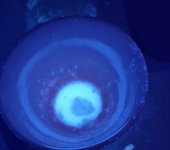
P.S Attached is my recent yield of 100 seeds, it's slightly wet and not fully evapped. Still, as you can see this is much less than what Kash has showed in their yield.

436656439_437927055606112_725101184632416721_n.jpg

(Edge of the dish is a reflection, specs are dust and the stuff outside the dish is shampoo I SWEAR)
 
Last edited:
Hey everyone.

I've been trying this for about 3 years now, on and off. I'm really hoping someone can help me nail where this may be going wrong.
I've been a fan of these seeds for over 5 years, they've given me many the profound experience when I used to eat them with wine, but I am never doing that to my body again :sick:

I have been successful in following all the steps Kash has laid out, though I get slightly different results at different stages and my yield is always much poorer than their pictures showed.
My result is definitely psychoactive, though VERY faint effects with 35 seeds worth ingested. Colors are vivid, slightly euphoric bodily sensations and mild sedation, though I hardly believe this is a "common" dose's effects.

Over the years I've increased the quality of my glassware and tried to get the best solvents I can get my hands on.

Seeds are absolutely demolished into a dust finer than that of the moon itself.
I am using all the same materials listed, my naphtha consisting of Xylene, Ethyl Benzene and >10% mineral spirits.
I am using concentrated DCM and aqueous ammonia dropwise for the freebase section.
Separation is done through a glass separatory funnel.

Solution fluoresces green throughout the process, getting blue after the DCM / Water separation.
  • After multiple acetone pulls and evap, I am left with a very sticky, horribly oily reddish yellow/brown goo. This goo sticks to my plate, and suspending it fully in the distilled water is near impossible even after adding citric acid. Goo is left stuck to the plate, and I fear there is a lot of LSA left in there, not transferred into the water.
  • This goo under blacklight is slightly green, unsure if that means anything about potential desirables being left behind.
  • The color change when I add the ammonia basically doesn't happen. It's a very VERY slight change to a yellow tinge but nothing very notable. I fear there could be something going wrong here.
I don't know if anyone can help me with this info, but I'm really willing to try and get to the bottom of this, any input is greatly appreciated.

Thank you!

P.S Attached is my recent yield of 100 seeds, it's slightly wet and not fully evapped. Still, as you can see this is much less than what Kash has showed in their yield.

View attachment 98535

(Edge of the dish is a reflection, specs are dust and the stuff outside the dish is shampoo I SWEAR)
You might want to go easy on that blacklight - it could be eating into your yields. These alkaloids are very light sensitive (if you've ever looked into the lighting recommendations - or, more like, lack of lighting - for LSD synthesis that should give you the picture). Only use UV for the briefest time for confirmation and tracing.

You could also simply have weaker seeds.
 
Back
Top Bottom