

Hey everybody, I accidentally ran out of harmaline when trying to do a THH conversion which failed and decided I would increase my margin for error significantly by doing a 1kg extraction my recently written tek
It was relatively simple and laid back as far as 1kg extractions go, especially because I decided not to get all the harmalas from the seeds, being satisfied with just a 2-3% yield
You can refer to the full tek above for more specific details of the procedure, but I'll just note the differences when using large quantities of seeds within the cliff-notes of the tek below. Also, details on the material and liquid volume needs are listed below the cliff notes.
== Procedure Cliff-Notes ==
_________________________________________________________________________________________________________________
==Volume needs for your containers for each step==
_________________________________________________________________________________________________________________
Freezing requirements:
For 100g of rue seeds - freezer-safe vessel(s) holding ~800ml water
For 500g of rue seeds - freezer-safe vessel(s) holding ~4000ml water
For 1kg of rue seeds - freezer-safe vessel(s) holding ~8000ml water
Simmering requirements:
For 100g of rue seeds - stove-safe vessel(s) holding 1600ml water
For 500g of rue seeds - stove-safe vessel(s) holding 8000ml water
For 1kg of rue seeds - stove-safe vessel(s) holding 16000ml water
FIRST-WASH bucket requirements:
100g
800ml-1000ml - ONE simmer
1400ml - 1750ml - TWO simmers
2000ml - 2500ml - THREE simmers
500g
4000ml-5000ml - ONE simmer
7000ml-9250ml - TWO simmers
10000ml-13500ml - THREE simmers
1kg
8000ml-10000ml - ONE simmer
14000ml-17500ml - TWO simmers
20000ml-25000ml - THREE simmers
While an equal volume bucket as the first batch is useful to catch the carryover losses, with adequate settling time 50-60% of the liquid should be able to be poured off or siphoned and discarded with minimal losses, so roughly half of the first-wash volume container is actually needed.
Washes 2 through 7 vessel requirements:
This one is a little complex, but using a too-small vessel will not reduce yield, rather just make you need to do over 7 washes to create a pure product.
A one-simmer batch will typically result in 2-3.5% yield - E.g. 1kg could result in 20-35g harmalas (estimate based on my tests)
A two-simmer batch might yield 3.5-4.5% - E.g. 1kg could result in 35-45g harmalas (estimate based on my test)
A three-simmer batch might yield 4-5.5+% - E.g. 1kg could result in 40-55+g harmalas (estimate based on TransistorBass's test)
You can do the math and find your expected yield and corresponding volume below:
For ~5g of harmalas, 500ml minimum tall-narrow washing vessel(s) recommended
For ~10g of harmalas, 1000ml minimum tall-narrow washing vessel(s) recommended
For ~20g of harmalas, 2000ml minimum tall-narrow washing vessel(s) recommended
For ~40g of harmalas, 4000ml minimum tall-narrow washing vessel(s) recommended
Carryover loss bucket requirements:
For ~5g of harmalas, 2000ml minimum bucket(s) recommended
For ~10g of harmalas, 1 gallon minimum bucket(s) recommended
For ~20g of harmalas, 2 gallon minimum bucket(s) recommended
For ~40g of harmalas, 5 gallon minimum bucket(s) recommended
==Pictures==
_________________________________________________________________________________________________________________
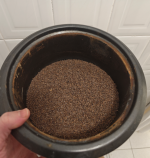
500g (half of my 1k batch) in my freezer vessel
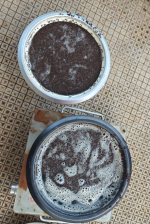
~250g in each cooking vessel, one simmering
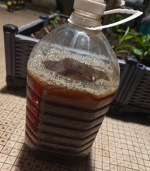
Cooled harmala tea from 1-simmer of 500g in a 5500ml jug
(wife is using our only 5-gallon bucket for garden fertilizer)
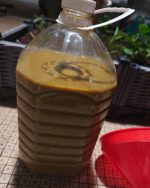
After adding sodium carbonate solution
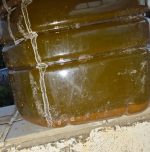
Harmalas settled in the morning
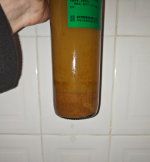
All the harmalas from the 1-simmer of 1kg in my too-small washing vessel
(wife is still finishing the wine in another identical bottle we bought as a washing vessel)
Resource icon

No filtering, not messy, easy harmalas for all
It was relatively simple and laid back as far as 1kg extractions go, especially because I decided not to get all the harmalas from the seeds, being satisfied with just a 2-3% yield
You can refer to the full tek above for more specific details of the procedure, but I'll just note the differences when using large quantities of seeds within the cliff-notes of the tek below. Also, details on the material and liquid volume needs are listed below the cliff notes.
== Procedure Cliff-Notes ==
_________________________________________________________________________________________________________________
- Freeze-Thaw Prep: Soak whole Syrian Rue seeds in water. Freeze solid. Depending on the size of your freezer, you may have to freeze the seeds in 2+ batches of water. Thaw the frozen seed-water. This step significantly increases initial yield. (An optional 2nd freeze-thaw cycle can be done).
- Initial Simmer: Place the thawed seed mix in a pot, add a splash of vinegar, and sufficient water to double the volume of water. Lightly simmer (DON'T boil) for 40 minutes, maintaining the volume by adding water as needed. In my case, my freezing vessel was my largest pot. After thawing I removed roughly 50% of the seeds to another container then simmered. For most households with standard size pots, several simmers will need to be done for the seeds to be in enough water, Using less water decreases yield and is not recommended!
- Strain & Re-Simmer: Strain the liquid through a mesh strainer into a heat-safe collection container. Return seeds to the pot, add vinegar and enough water to cover the seeds and a bit more. Simmer for 20 minutes, strain, and cool all the liquid before transferring it into a bucket. (An optional 3rd simmer can be done).
- Basify: To the liquid in the bucket, add a saturated sodium carbonate (or dilute lye/caustic soda) solution a little bit at a time to the cooled tea until precipitation stops increasing—indicated by a color change to sand-colored and the formation a cloudy precipitate.
- Settle: Allow the mixture to sit for 3+ hours until precipitate is fully settled.
- FIRST Wash Cycle: After settling, carefully decant or siphon off about 60% of the liquid and discard it.
- After letting fully settle again, carefully decant or siphon off about 50% of the remaining liquid into a bucket.
- Strongly stir/agitate the muddy liquid to make all the harmalas float and transfer the liquid to one or more tall-narrow washing vessels. Refill the vessel(s) with fresh water and put it in the fridge to fully settle. If your bucket/bottle is too small, you can always settle and discard 50% of liquid then add more of the harmala tea (after cooling) as many times as you'd like during the process to make it fit.
- All other Wash Cycles (6-8x): After the tall-narrow washing vessel has settled in the fridge, carefully decant ~90% of the liquid into a bucket. Refill the vessel(s) with fresh water and return to the fridge to fully settle. Repeat to 6-8 times to dilute and remove residual base.
- Dry: After the last decanting, pour the final light-brown sludge into a heatproof dish. Evaporate at low heat (e.g., low oven with door ajar, or on a warm surface like a wood stove) until completely dry. Scrape the powder for storage and optional weighing.
- Recover "Losses": Allow the bucket of decanted wash water to settle for several hours. Pour off enough water to fit it in your tall-narrow washing vessel then process the settled sediment with 3-4 more wash cycles and dry as above to recover finer particulates.
==Volume needs for your containers for each step==
_________________________________________________________________________________________________________________
Freezing requirements:
For 100g of rue seeds - freezer-safe vessel(s) holding ~800ml water
For 500g of rue seeds - freezer-safe vessel(s) holding ~4000ml water
For 1kg of rue seeds - freezer-safe vessel(s) holding ~8000ml water
Simmering requirements:
For 100g of rue seeds - stove-safe vessel(s) holding 1600ml water
For 500g of rue seeds - stove-safe vessel(s) holding 8000ml water
For 1kg of rue seeds - stove-safe vessel(s) holding 16000ml water
FIRST-WASH bucket requirements:
100g
800ml-1000ml - ONE simmer
1400ml - 1750ml - TWO simmers
2000ml - 2500ml - THREE simmers
500g
4000ml-5000ml - ONE simmer
7000ml-9250ml - TWO simmers
10000ml-13500ml - THREE simmers
1kg
8000ml-10000ml - ONE simmer
14000ml-17500ml - TWO simmers
20000ml-25000ml - THREE simmers
While an equal volume bucket as the first batch is useful to catch the carryover losses, with adequate settling time 50-60% of the liquid should be able to be poured off or siphoned and discarded with minimal losses, so roughly half of the first-wash volume container is actually needed.
Washes 2 through 7 vessel requirements:
This one is a little complex, but using a too-small vessel will not reduce yield, rather just make you need to do over 7 washes to create a pure product.
A one-simmer batch will typically result in 2-3.5% yield - E.g. 1kg could result in 20-35g harmalas (estimate based on my tests)
A two-simmer batch might yield 3.5-4.5% - E.g. 1kg could result in 35-45g harmalas (estimate based on my test)
A three-simmer batch might yield 4-5.5+% - E.g. 1kg could result in 40-55+g harmalas (estimate based on TransistorBass's test)
You can do the math and find your expected yield and corresponding volume below:
For ~5g of harmalas, 500ml minimum tall-narrow washing vessel(s) recommended
For ~10g of harmalas, 1000ml minimum tall-narrow washing vessel(s) recommended
For ~20g of harmalas, 2000ml minimum tall-narrow washing vessel(s) recommended
For ~40g of harmalas, 4000ml minimum tall-narrow washing vessel(s) recommended
Carryover loss bucket requirements:
For ~5g of harmalas, 2000ml minimum bucket(s) recommended
For ~10g of harmalas, 1 gallon minimum bucket(s) recommended
For ~20g of harmalas, 2 gallon minimum bucket(s) recommended
For ~40g of harmalas, 5 gallon minimum bucket(s) recommended
==Pictures==
_________________________________________________________________________________________________________________
500g (half of my 1k batch) in my freezer vessel
~250g in each cooking vessel, one simmering
Cooled harmala tea from 1-simmer of 500g in a 5500ml jug
(wife is using our only 5-gallon bucket for garden fertilizer)
After adding sodium carbonate solution
Harmalas settled in the morning
All the harmalas from the 1-simmer of 1kg in my too-small washing vessel
(wife is still finishing the wine in another identical bottle we bought as a washing vessel)
Last edited:


