Fwiw, after a bit of looking into it, one example of a reaction between isovaleraldehyde and an amide (albeit a sulfonamide) is in the synthesis of butizide:

en.wikipedia.org
In that instance, there's also a neighbouring amino group which contributes to driving the reaction through the formation of a highly stable six-membered ring.
Lysergic Acid Isovaleraldamide, Lysergic Acid Valeraldamide, and Lysergic Acid Crotonaldamide for a triple psychedelic combination just as powerful as LSD,
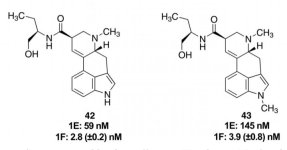
I've said it before and I'll say again now, that nomenclature is absolute trash - there's every possibilty that any adduct would be the α-hydroxy compound analogous to LSH, so the "-aldamide" terminology equates to misinformation, even before we get to the "better than LSD" kind of puffery.
A biological miracle for a bulky, mono-substituted amide to ignore decades of SAR data and magically outperform LSD.
The thing is though, LSD itself is something of a biological miracle in how it has just the right sterics going on for its substituted amide group to click into a small sub-pocket of the 5-HT₂ₐ receptor like a key in a lock. This affords the molecule a remarkable potency only exceeded by one enantiomer of LSZ (the conformationally restricted 2,4-dimethylazetidine analog of LSD), where the tip of the key is essentially pinned into an even more optimised configuration with an additional bridging methylene group.
This is of course a prime example of the peak research that Prof. Dave Nichols and his team have carried out, so if any group is capable of producing experimental results that bring us nearer to some firm conclusions about what might be going on here, it's those folks. We shouldn't exclude the possibility of there being another 'magic pocket' in the 5-HT₂ₐ receptor where some of these α-hydroxyalk(en)yl-substituted lysergamides might perform a similar miracle.
If that turns out to be the case, we should expect to see a difference between some aspect(s) of the activity of the
E- and
Z-crotonaldehyde adducts., but that's starting to get a bit ahead of itself.