• Members of the previous forum can retrieve their temporary password here, (login and check your PM).

TEK Manske Query

This topic contain a TEK
Great, thanks for this - and purity wise, it'll be the same as the other Tek's posted here? How much ammonia would be needed?

Re the dried freebase left now, just wondering re dosing... not sure if it'd be base heavy?
 
The purity depends on how many times you recrystallize. If you go from freebase to salt just once, you’ll likely remove most of the unwanted alkaloids. If I’m not mistaken, there’s a post about this somewhere on the Nexus, but I don’t remember exactly where, otherwise, I’d have looked it up for you.

If you’re unsure about the purity, you can always repeat the process of basing and converting back to salt. However, this method should already result in a fairly pure fraction, because if it wasn’t pure enough, it wouldn’t crystallize properly in the first place.

As for the amount of leftover base in your product, that’s a bit unknown. But since you used bicarbonate, it’s generally not a big issue. One way to check is to take a small sample of your product, put it in a few drops of water, and measure the pH. If the pH is very high (strongly basic), something went wrong, because harmala freebases aren’t soluble in water. That would indicate that there’s still a lot of base in your product. However, I suspect it’s not really a problem in your case.

Next time, you could try using ammonia instead. You just add ammonia until the solution turns completely milky. Once you see it starting to settle, you can add a bit more and see if you get the same milky reaction again. You could also measure the pH to confirm.

 
Last edited:
The purity depends on how many times you recrystallize. If you go from freebase to salt just once, you’ll likely remove most of the unwanted alkaloids. If I’m not mistaken, there’s a post about this somewhere on the Nexus, but I don’t remember exactly where, otherwise, I’d have looked it up for you.

If you’re unsure about the purity, you can always repeat the process of basing and converting back to salt. However, this method should already result in a fairly pure fraction, because if it wasn’t pure enough, it wouldn’t crystallize properly in the first place.

As for the amount of leftover base in your product, that’s a bit unknown. But since you used bicarbonate, it’s generally not a big issue. One way to check is to take a small sample of your product, put it in a few drops of water, and measure the pH. If the pH is very high (strongly basic), something went wrong, because harmala freebases aren’t soluble in water. That would indicate that there’s still a lot of base in your product. However, I suspect it’s not really a problem in your case.

Next time, you could try using ammonia instead. You just add ammonia until the solution turns completely milky. Once you see it starting to settle, you can add a bit more and see if you get the same milky reaction again. You could also measure the pH to confirm.
Great, thanks for all of this.

So, in essence, if I got some strips, if the PH wasn't too high, it would indicate this is fairly pure harmalas and suitable to dose normally? What sort of PH level would you be looking for?
 
Yes, unless you've added something with additives or things like that, if you get a relatively neutral pH it will be harmalas almost only. That's a pH < 8 (and no less than 7, if it's acidic for any reason you'll be turning the freebase into salt form again, and salt form is water soluble).

By the way the harmalas not being pure is not necessarily a problem if the impurities are other rue alkaloids, that depends on the intended use. In my case, for the moment I prefer to get rid of the other stuff in rue for Ayahuasca experiences as it makes nausea more likely. But at lower, day to day doses, the other alkaloids aren't a problem for me. You may have read that they are "toxic", but that's not the case: some are uterotonic and thus to be avoided by pregnant women, but that's it. They may even have some health benefits. You can read more about the alkaloids in rue and their potential health effects in Harmal: the Genus Peganum (I can send you the PDF if you're interested).
 
Last edited:
Yes, unless you've added something with additives or things like that, if you get a relatively neutral pH it will be harmalas almost only. That's a pH < 8 (and no less than 7, if it's acidic for any reason you'll be turning the freebase into salt form again, and salt form is water soluble).

By the way the harmalas not being pure is not necessarily a problem if the impurities are other rue alkaloids, that depends on the intended use. In my case, for the moment I prefer to get rid of the other stuff in rue for Ayahuasca experiences as it makes nausea more likely. But at lower, day to day doses, the other alkaloids aren't a problem for me. You may have read that they are "toxic", but that's not the case: some are uterotonic and thus to be avoided by pregnant women, but that's it. They may even have some health benefits. You can read more about the alkaloids in rue and their potential health effects in Harmal: the Genus Peganum (I can send you the PDF if you're interested).
Ahhh thanks, so a PH between 7 and 8? The freebase was left to dry overnight last night, so is now dried in a coffee filter... what would you recommend to test this?

The PDF would be interesting, thanks!
 
The freebase was left to dry overnight last night, so is now dried in a coffee filter
Well, now you would need to mix it again with water (to get any potential leftover base to dissolve), test and decant and filter again. Just mixing it with water again will lower the pH if there was leftover base. If you are going to consume them orally you don't really need to worry about that, you can just mix it with water with lemon or vinegar before drinking it and any base will be neutralized.

The PDF would be interesting, thanks!
Sent!
 
The easiest way to extract harmalas is to simmer the seeds material several times with a bit of vinegar. Collect the liquid each time, combine it, and store it in a large bottle in the refrigerator. Let it sit for a few days until the solution becomes completely clear. There is no need to filter or reduce your brew.

Carefully pour off the clear part, keep this, leaving any sediment behind. Then, add ammonia to the clear solution. This will cause the harmala alkaloids to precipitate out as freebase. This step will reduce the volume and save you the hassle of filtering significantly, and the alkaloids will settle.

Let this mixture stand for a couple of days without disturbing it. After settling, pour off the liquid on top (dispose). What remains at the bottom are your crude alkaloids.

Dissolve these again in a little bit of water with a bit of vinegar. This time, filter the solution properly to remove any insoluble material. Finally, add a saturated salt solution to help the alkaloids precipitate more cleanly.

You can easily extract large quantities of seeds without much effort.
Was hoping you could help with a few questions? With this process, what would the ratios be?

- How much ammonia should be added to the water left behind? Or what PH should be sought?

- When re-adding vinegar, is there an amount/PH to be aimed for?

- Saturated salt solution is presumably the same as before - 10%?

Thank you!
 
How much ammonia should be added to the water left behind? Or what PH should be sought?
As with other bases, you need to add it slowly while stirring until you see the liquid change color (due to the harmala freebase precipitating), and then a little bit more. In my experience it's around 11 pH, but the color change will guide you.
When re-adding vinegar, is there an amount/PH to be aimed for?
Once it becomes acidic (pH under 7) there will be a point where harmalas will go from freebase to salt and dissolve, so as long as they dissolve it will be a good pH. There's no need to get the pH very low, but there's no harm in it either, other than it being wasteful (you spend more vinegar and you will need more base if you basify again).
Saturated salt solution is presumably the same as before - 10%?
Yes.

In general, when extracting harmalas you don't need to worry too much about getting to an exact pH value as long as the expected change happens. But if you can, measure the pH and every step and write it down. That way, you have a record and can see what works best for your specific materials.
 
Great, that clears things up a lot - thank you!

So would you say that the method you described will give just as clean crystals as the one posted here? I.e. Just as clear as doing daily filters (cheese cloth, then cotton balls, then coffee filter), then multiple manske steps?

Happy to put more work in if needed, but if yours is just as good for less effort, that is obviously ideal!
 
Great, that clears things up a lot - thank you!

So would you say that the method you described will give just as clean crystals as the one posted here? I.e. Just as clear as doing daily filters (cheese cloth, then cotton balls, then coffee filter), then multiple manske steps?

Happy to put more work in if needed, but if yours is just as good for less effort, that is obviously ideal!
If you mean the method @Varallo recommended, yes, it should. Filtering that much is only needed when you use ground seeds, but there's no real reason to do so. You will see how after the first manske the extract becomes very clearly colored. You can repeat it until it's as clear as you want (it will be white with a pinkish hue if freebase, bright yellow if salt). But it's not necessary to reach that color, once the color is light tan (for the freebase), it's already very pure.

I use harmala freebase for ayahuasca (and soon changa) and to take in lower doses as a kind of supplement. For the first use I like to get it to become white. For the latter I just add base once and not even bother with the manske step, I get a coffee colored extract that I suppose still has many of the other alkaloids in rue, which is what I want when having it as a supplement.
 
If you mean the method @Varallo recommended, yes, it should. Filtering that much is only needed when you use ground seeds, but there's no real reason to do so. You will see how after the first manske the extract becomes very clearly colored. You can repeat it until it's as clear as you want (it will be white with a pinkish hue if freebase, bright yellow if salt). But it's not necessary to reach that color, once the color is light tan (for the freebase), it's already very pure.

I use harmala freebase for ayahuasca (and soon changa) and to take in lower doses as a kind of supplement. For the first use I like to get it to become white. For the latter I just add base once and not even bother with the manske step, I get a coffee colored extract that I suppose still has many of the other alkaloids in rue, which is what I want when having it as a

The easiest way to extract harmalas is to simmer the seeds material several times with a bit of vinegar. Collect the liquid each time, combine it, and store it in a large bottle in the refrigerator. Let it sit for a few days until the solution becomes completely clear. There is no need to filter or reduce your brew.

Carefully pour off the clear part, keep this, leaving any sediment behind. Then, add ammonia to the clear solution. This will cause the harmala alkaloids to precipitate out as freebase. This step will reduce the volume and save you the hassle of filtering significantly, and the alkaloids will settle.

Let this mixture stand for a couple of days without disturbing it. After settling, pour off the liquid on top (dispose). What remains at the bottom are your crude alkaloids.

Dissolve these again in a little bit of water with a bit of vinegar. This time, filter the solution properly to remove any insoluble material. Finally, add a saturated salt solution to help the alkaloids precipitate more cleanly.

You can easily extract large quantities of seeds without much effort.
Will it be obvious when the water is clear from looking at it from the top, if not in a clear jar? Only thing that is big enough to hold the tea is a Dutch oven!

Alternatively, it could be reduced to fit into a clear mason jar. Though, would reducing it significantly alter the process described above?
 
IME from the top it's not easy to see if it's clear or not. Definitely reduce the brew so it fits in your clear container, it doesn't affect the process at all. I always reduce, as it's better to use generous amounts of water when boiling the seeds in order to extract more alkaloids.
 
IME from the top it's not easy to see if it's clear or not. Definitely reduce the brew so it fits in your clear container, it doesn't affect the process at all. I always reduce, as it's better to use generous amounts of water when boiling the seeds in order to extract more alkaloids.
Awesome, thanks. So essentially reduce the liquid, put into a clear container, then follow Varollo's method? I.e. once reduced, leave for a few days until clear water, decant top liquid, basify with ammonia, leave that for a few days, dispose of water, re-dissolve freebase in liquid, filter, manske step and done...?!

I know in the first step the point to add ammonia is when the water is clear. But for the next step after adding ammonia, is there a trigger, or is it simply waiting 2-3 days?
 
So essentially reduce the liquid, put into a clear container, then follow Varollo's method?
Yes. I forgot to mention that if you can avoid reducing it will decant faster (the more liquid, the faster it decants), but it doesn't matter if you need to reduce. I need to and it causes no problems.
But for the next step after adding ammonia, is there a trigger, or is it simply waiting 2-3 days?
Basically the same, you need to wait for the precipitated alkaloids to decant completely. You will see how most decant in the first hour or so, but there will be many small particles still suspended in the liquid. Once the liquid is clear without any particle in it, you can go to the next step (but this time you discard the liquid and keep the sediment).

As I said before, there are always tradeoffs between time, yield, purity, and number of cycles. The method suggested by Varallo uses long decanting times in order to minimize loss (e.g. the loss caused by discarding alkaloids that were still suspended) and number of A-B and manske cycles. After you have performed it successfully once, you'll be able to adjust it in whichever way suits you more. For example, I prefer to wait less, but then I have to either do more cycles or sacrifice purity. And I lose some alkaloids in the process.
 
A faster and more efficient way to reduce it is to freebase it with a minimum amount of base, let settle and decant, reacidify with minimum amount of acid, top with water to desired level.
 
Last edited:
The easiest way to extract harmalas is to simmer the seeds material several times with a bit of vinegar. Collect the liquid each time, combine it, and store it in a large bottle in the refrigerator. Let it sit for a few days until the solution becomes completely clear. There is no need to filter or reduce your brew.

Carefully pour off the clear part, keep this, leaving any sediment behind. Then, add ammonia to the clear solution. This will cause the harmala alkaloids to precipitate out as freebase. This step will reduce the volume and save you the hassle of filtering significantly, and the alkaloids will settle.

Let this mixture stand for a couple of days without disturbing it. After settling, pour off the liquid on top (dispose). What remains at the bottom are your crude alkaloids.

Dissolve these again in a little bit of water with a bit of vinegar. This time, filter the solution properly to remove any insoluble material. Finally, add a saturated salt solution to help the alkaloids precipitate more cleanly.

You can easily extract large quantities of seeds without much effort.
Out of interest, what sort of time frame should I be looking at for the liquid to go clear? The tea wasn't actually reduced that much, however, it's still not turned clear at all after three days...
 
Out of interest, what sort of time frame should I be looking at for the liquid to go clear? The tea wasn't actually reduced that much, however, it's still not turned clear at all after three days...
In my experience, it usually clears up reasonably well in three or four days. I normally do this in a large 10L jerrycan that I leave outside during winter, which probably helps since it’s really cold. You can just proceed as usual, decant now, and filter if you really want to. But you could also go ahead and base it, then remove most of the liquid, then add vinegar again, dissolving everything in the minimum amount, and let it sit in the fridge for a couple of days. If it’s still not clear after that, you can filter again and then base.
 
In my experience, it usually clears up reasonably well in three or four days. I normally do this in a large 10L jerrycan that I leave outside during winter, which probably helps since it’s really cold. You can just proceed as usual, decant now, and filter if you really want to. But you could also go ahead and base it, then remove most of the liquid, then add vinegar again, dissolving everything in the minimum amount, and let it sit in the fridge for a couple of days. If it’s still not clear after that, you can filter again and then base.
Ah right, okay! So if I were to base it, that would be adding ammonia until it hits the right PH? Then, in terms of adding vinegar to re-dissolve, would the minimum amount you mention be a mix of water and vinegar to just cover the base left?
 
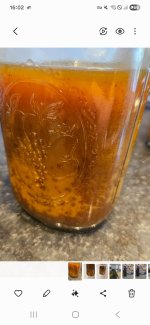
So, the ammonia was added yesterday... is it meant to be looking like this? A touch lumpy almost?
 

Attachments

  • Screenshot_20250604_160250_Gallery.jpg
    Screenshot_20250604_160250_Gallery.jpg
    1.3 MB · Views: 8
Back
Top Bottom