Hello,
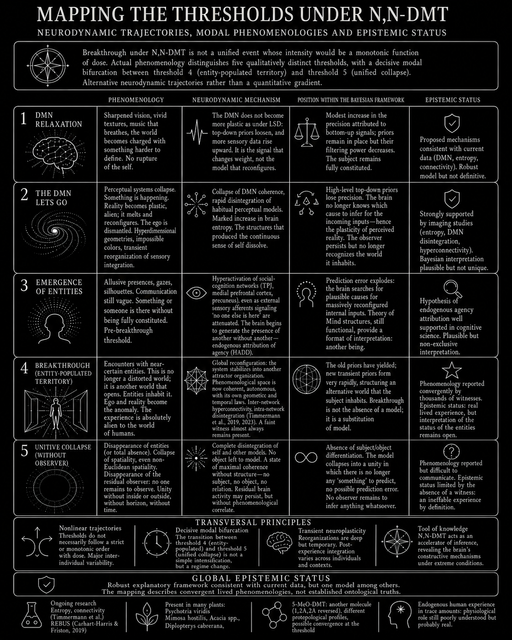
We're working on gathering physiological and subjective experiences related information when it comes to N,N-DMT experiences. I think that, despite the felt uniqueness of the said experience a system, with its own limits and scope could be useful for some when it comes to integration and understanding. Here's an infographic for the ones curious about it :
EDIT
PS: Please don’t mind the visuals for now; focus on the idea of mapping and on the information presented here. To my knowledge, there are several things we can consider as axioms, or at least as working premises, so we can discuss them:
- There are both differences and similarities in the experiences induced by psychedelics and N,N-DMT.
- These similarities, and this is particularly interesting, also extend to entity encounters.
- Current scientific literature still fails to fully explain these encounters, although it has produced a few interesting observations: they are not usual hallucinations or visuals as commonly understood, and they are subjectively experienced by the brain as real encounters. Sometimes, they can also trigger mystical experiences.
- These encounters seem to fit a few archetypes that remain remarkably similar across cultures. Here too, current literature fails to explain why. Grof’s perinatal theories could be relevant.
- A map has limits, but it can still be useful. Please take it for what it is: no more, no less.
- The visual here is a temporary proposal. I am working on a series of several pieces offering an accessible overview of the current knowledge base on psychedelics and party drugs, so that people can engage with the information more easily. This is still a work in progress.
- This work is based on the Bayesian brain theories, therefore it carries its limits and scope.
We're working on gathering physiological and subjective experiences related information when it comes to N,N-DMT experiences. I think that, despite the felt uniqueness of the said experience a system, with its own limits and scope could be useful for some when it comes to integration and understanding. Here's an infographic for the ones curious about it :
EDIT
PS: Please don’t mind the visuals for now; focus on the idea of mapping and on the information presented here. To my knowledge, there are several things we can consider as axioms, or at least as working premises, so we can discuss them:
- There are both differences and similarities in the experiences induced by psychedelics and N,N-DMT.
- These similarities, and this is particularly interesting, also extend to entity encounters.
- Current scientific literature still fails to fully explain these encounters, although it has produced a few interesting observations: they are not usual hallucinations or visuals as commonly understood, and they are subjectively experienced by the brain as real encounters. Sometimes, they can also trigger mystical experiences.
- These encounters seem to fit a few archetypes that remain remarkably similar across cultures. Here too, current literature fails to explain why. Grof’s perinatal theories could be relevant.
- A map has limits, but it can still be useful. Please take it for what it is: no more, no less.
- The visual here is a temporary proposal. I am working on a series of several pieces offering an accessible overview of the current knowledge base on psychedelics and party drugs, so that people can engage with the information more easily. This is still a work in progress.
- This work is based on the Bayesian brain theories, therefore it carries its limits and scope.
Last edited by a moderator: