• Members of the previous forum can retrieve their temporary password here, (login and check your PM).

Mescaline: Kash AB HCl and Cielo Extraction Attempts(update: Extractions Complete) +New extractions

Migrated topic.

Madhattress

Established member
Hi everyone,:)

So I want to attempt to do my first Mescaline extraction. I have ordered the chemical and equipment i need from a lab supply company. So lab grade chemicals CP.

I have been looking through a few extraction recipes but think I will attempt to do the following one i will reference and post below I found on Erowid.

Since it is my first time, i just want to ask the community of the safety of the end product crystals? Is there any chance of these chemicals to leave traces in the salts or is this not possible if the recipes are followed religiously?

I am very good at following instructions and will take the utmost care in the process where safety is concerned.

Any extra safety tips from you guys will be appreciated.

Here is the recipe i am thinking of following. Let me know what you think.

EDIT: I have decided to rather go with Kash's AB extraction Method-
Kash's A/B Mescaline Extraction - DMT-Nexus Wiki

EDIT: I decided to do the kash's AB extraction as well as the Cielo Tek extraction. Both with 105grams of dried cactus.
 
What's the method you prefer, ive been looking at a few different options. Kash a/b or cielo or an alcohol one. Are there other options

As @Transform said, it also depends on what materials you are able to get... but in my opinion, Cielo is the best method for extraction of mescaline and also food safe. You slso get a very pure product from the get go after extraction without a further need for a purification process after the initial extraction.
 
So I just ran the CIELO tek yesterday using some San Pedro I had in my backyard that I processed. I did CIELO using CA and got nothing when i filtered out. I followed all the directions except at the last and final pull I ended up using more EA because I had just a little left and didn't want to leave it behind (220g of EA instead of 160g). Shoot, now that I'm writing this out I'm realizing I shouldn't have weighed the EA out because the weight would not match the ml. So that means I did waay more EA than i should I have. I'm assuming maybe thats why I got nothing out of it? Is there a way I can save this somehow? Add some water or more CA or is my little science experiment toast?
 
So I just ran the CIELO tek yesterday using some San Pedro I had in my backyard that I processed. I did CIELO using CA and got nothing when i filtered out. I followed all the directions except at the last and final pull I ended up using more EA because I had just a little left and didn't want to leave it behind (220g of EA instead of 160g). Shoot, now that I'm writing this out I'm realizing I shouldn't have weighed the EA out because the weight would not match the ml. So that means I did waay more EA than i should I have. I'm assuming maybe thats why I got nothing out of it? Is there a way I can save this somehow? Add some water or more CA or is my little science experiment toast?
If you followed all the instructions other than the weight/volume mix-up (although I thought the CIELO method also states to weigh the EA) and still got nothing, it may simply be inactive cactus. Have you established your material's potency through some other method? Did you age your cactus cuts in the dark at all?

Are you totally sure that you used all the correct ingredients throughout? Is there any possibility that your lime was old or even that you used calcium carbonate by mistake?

The volume of the last EA pull shouldn't be important to the extent of abolishing all yield. One more thing that you can do is to add one millitre of water to the extracts, in case they're too dry for the mescaline salt to form crystals. It requires water of crystallisation. Of course, if you did a fridge rest before adding the CA and water droplets settled out, this shouldn't be necessary.

Including a bit more detail along the lines of all these questions, plus some pictures of the cacti you used, would give a better chance of coming to a suitable conclusion.
 
If you followed all the instructions other than the weight/volume mix-up (although I thought the CIELO method also states to weigh the EA) and still got nothing, it may simply be inactive cactus. Have you established your material's potency through some other method? Did you age your cactus cuts in the dark at all?

Are you totally sure that you used all the correct ingredients throughout? Is there any possibility that your lime was old or even that you used calcium carbonate by mistake?

The volume of the last EA pull shouldn't be important to the extent of abolishing all yield. One more thing that you can do is to add one millitre of water to the extracts, in case they're too dry for the mescaline salt to form crystals. It requires water of crystallisation. Of course, if you did a fridge rest before adding the CA and water droplets settled out, this shouldn't be necessary.

Including a bit more detail along the lines of all these questions, plus some pictures of the cacti you used, would give a better chance of coming to a suitable conclusion.
I have not tested the cactus. I had it as a decorative plant outside and figured why not.

I've added 1ml of water just now and nothing happened. I also tried adding another 5mg of CA and nothing. I didn't do a fridge rest either.
 
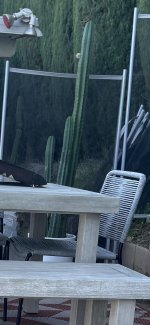
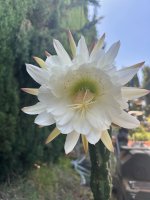
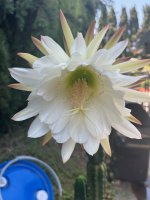
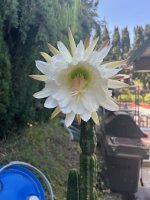
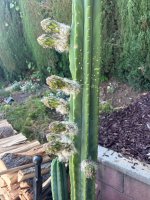
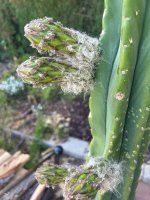
Aha - very much as I suspected, that's what's know as a "PC pachanoi" (for "predominant clone") - or "pachanot" in K. Trout's parlance. These are known for having a low to zero alkaloidal content.

Did you dry the cactus iimmediately after cutting it? There's a technique of storing the cuttings in the dark for several weeks to months, in order to increase the amount of alkaloids. This may or may not work for your specimens, especially not if they're completely inactive.

Do you have any more pictures of the flower bud on the that big column? (The blooms are rather gorgeous once they've opened!) The white fuzz is a fairly clear sign of it being an inactive PC pach, even without a close up of the areoles and their profile.

You'd be best off tracking down some active specimens with which to complement your cactus garden, then have another go in a year or two.
 
Aha - very much as I suspected, that's what's know as a "PC pachanoi" (for "predominant clone") - or "pachanot" in K. Trout's parlance. These are known for having a low to zero alkaloidal content.

Did you dry the cactus iimmediately after cutting it? There's a technique of storing the cuttings in the dark for several weeks to months, in order to increase the amount of alkaloids. This may or may not work for your specimens, especially not if they're completely inactive.

Do you have any more pictures of the flower bud on the that big column? (The blooms are rather gorgeous once they've opened!) The white fuzz is a fairly clear sign of it being an inactive PC pach, even without a close up of the areoles and their profile.

You'd be best off tracking down some active specimens with which to complement your cactus garden, then have another go in a year or two.
IMG_5907 (1).jpgIMG_5906.jpgIMG_5905.jpg
 
Aha - very much as I suspected, that's what's know as a "PC pachanoi" (for "predominant clone") - or "pachanot" in K. Trout's parlance. These are known for having a low to zero alkaloidal content.

Did you dry the cactus iimmediately after cutting it? There's a technique of storing the cuttings in the dark for several weeks to months, in order to increase the amount of alkaloids. This may or may not work for your specimens, especially not if they're completely inactive.

Do you have any more pictures of the flower bud on the that big column? (The blooms are rather gorgeous once they've opened!) The white fuzz is a fairly clear sign of it being an inactive PC pach, even without a close up of the areoles and their profile.

You'd be best off tracking down some active specimens with which to complement your cactus garden, then have another go in a year or two.
As this was my first time, and the write up saying storing for a few months in the dark covered wasn't necessary, I figured I would just try it out.
 
Yeah, they look like they'll be weak at best. Lovely flowers, though (and great for a time lapse…)
And what about the flowers or buds do you see that tell you that? You mentioned the white fuzz? You mean on the buds right when they're about to open up they have that fuzz? Sort of grayish but still. If that's a sign of a weak or nonactive cactus plant, what color should I be looking for?
 
And what about the flowers or buds do you see that tell you that? You mentioned the white fuzz? You mean on the buds right when they're about to open up they have that fuzz? Sort of grayish but still. If that's a sign of a weak or nonactive cactus plant, what color should I be looking for?
The active species have much darker fuzz - check the Trout's Notes website and his book, "Sacred Cacti" (free digital copy available for download). There are a few more things about the appearance of PC 'pachanot' that are quite unmistakable to the (even slightly) trained eye. The areoles (where the spines emerge) point slightly upwards, giving the profile of the ribs a mildly stepped appearance, for example.
 
Note that PC Pachanoi may still have some mescaline, but it will be relatively weak compared to true Pachanoi or other species such as Peruvian Torch or Bridgesii. I recently performed a couple of CIELO extractions on PC Pachanoi. One yielded 0.47% (using the entire cactus, not just the skin). The other yielded 0.6% (using just the outer skin). Is that bad? Well, the PC Pachanoi grows quickly and easily. So, if you’re not constrained by growing space, it’s easy to propagate the PC Pachanoi while you source more potent varieties. And you may be able to increase the mescaline content by storing the cactus in the dark for a few months before drying.
 
Note that PC Pachanoi may still have some mescaline, but it will be relatively weak compared to true Pachanoi or other species such as Peruvian Torch or Bridgesii. I recently performed a couple of CIELO extractions on PC Pachanoi. One yielded 0.47% (using the entire cactus, not just the skin). The other yielded 0.6% (using just the outer skin). Is that bad? Well, the PC Pachanoi grows quickly and easily. So, if you’re not constrained by growing space, it’s easy to propagate the PC Pachanoi while you source more potent varieties. And you may be able to increase the mescaline content by storing the cactus in the dark for a few months before drying.
In my case there was some additional factors that might have made it even less likely to yield anything. The cuttings were stored on a rack under a table outside so not in the dark, and they were already turning a bit yellow and producing pups. And the paste I made was maybe too wet.
 
Back
Top Bottom