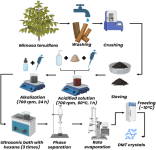
Step aside, root bark. There's a new player in town... stem bark!?! 3.5% yield?!? MORE pure???
Thus, considering the objectives of this investigation in selecting the most viable methodology and plant matrix, the stem bark demonstrates greater potential for the extraction process due to its lower content of catalytic metals and reduced accumulation of minerals that could interfere with the matrix characteristics. These factors, combined with more favorable physicochemical properties such as lower density and ash content, make the stem bark more suitable. Although previous studies have reported relatively high DMT levels in the root bark of M. tenuiflora, this study employed a multifactorial evaluation that extends beyond DMT content alone, aiming to identify the optimal plant portion─stem bark or root bark─for DMT extraction. The results indicate that stem bark is the more viable option, a finding that, while less commonly reported in the literature, corroborates the work of Amariz et al., (51) who developed a factorial design for DMT extraction from stem bark.