• Members of the previous forum can retrieve their temporary password here, (login and check your PM).

MHSB

Icon

Titanium Teammate
Donator
Joined
Mar 9, 2012
Messages
676
Merits
1,060
Step aside, root bark. There's a new player in town... stem bark!?! 3.5% yield?!? MORE pure???

Thus, considering the objectives of this investigation in selecting the most viable methodology and plant matrix, the stem bark demonstrates greater potential for the extraction process due to its lower content of catalytic metals and reduced accumulation of minerals that could interfere with the matrix characteristics. These factors, combined with more favorable physicochemical properties such as lower density and ash content, make the stem bark more suitable. Although previous studies have reported relatively high DMT levels in the root bark of M. tenuiflora, this study employed a multifactorial evaluation that extends beyond DMT content alone, aiming to identify the optimal plant portion─stem bark or root bark─for DMT extraction. The results indicate that stem bark is the more viable option, a finding that, while less commonly reported in the literature, corroborates the work of Amariz et al., (51) who developed a factorial design for DMT extraction from stem bark.
 
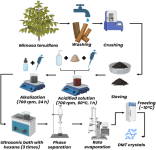
1758611484438.png

I loved this picture. Somehow, it motivates me to play a chemist myself :LOL:
Very interesting news. Maybe it will lead to a more sustainable harvest of mimosa.
 
Tepescohuite, being MH trunk bark, has been around since forever, it's just that people have typically reported far, far lower yields from it than this incredible result. We need to examine what factors may be at play in this perplexing disparity.

We'd best start by reading the paper very carefully several times over, but the diagram already suggest to me that sonication could be important, if it's not solely down to the influence of timing of the harvest or the extra care the researchers may have used in isolating the most active portion of the stem bark.

Tepescohuite is used essentially for its tannin content and not the alkaloids, so this could well have an influence on the 'when' and the 'what' aspects of its harvesting.
 
Here's another aspect that would appear to be highly relevant:

2.2. Raw Material Preparation

The stem and root bark were washed with distilled water and dried in an oven at 50 °C for 24 h. After drying, the material was ground in a knife mill at 10,000 rpm until a fine powder was obtained. The powder was subsequently sieved, and fractions smaller than 150 mesh were selected, in accordance with the specifications of the Brazilian Pharmacopoeia for semifine particles.
Fine powdering will assist in releasing alkaloid from the cellular matrix.
 
There are reports going back to at least late 90’s/early 00’s of people using branch/stem material. There’s an old report in entheogen review I recall where someone grew mimosa in their back yard and was successful making brews with branches and rue.

Why would it be much different from using lower yielding Acacia branches? Isn’t this common practice in Australia anyway?
 
There are reports going back to at least late 90’s/early 00’s of people using branch/stem material. There’s an old report in entheogen review I recall where someone grew mimosa in they’re back yard and was successful making brews with branches and rue.

Why would it be much different from using lower yielding Acacia branches? Isn’t this common practice in Australia anyway?
This is indeed the case - there are reports right here on the Nexus of similar successful experiments, it would just take a bit of search engine ninja skill to unearth them.
 
Tepescohuite, being MH trunk bark, has been around since forever, it's just that people have typically reported far, far lower yields from it than this incredible result. We need to examine what factors may be at play in this perplexing disparity.
The paper doesn't elaborate, but maybe there's a distinction between trunk bark and stem bark? Or as with the root - it's the inner bark that is required?
 
The paper doesn't elaborate, but maybe there's a distinction between trunk bark and stem bark? Or as with the root - it's the inner bark that is required?

if it's not solely down to the influence of timing of the harvest or the extra care the researchers may have used in isolating the most active portion of the stem bark.
(y)
Maybe there's an arcane botanical distinction between 'trunk' and 'stem' - could a qualified botanist clear this one up?
 
Edit: Incorrect. There are quite a few reports of DMT content in Mimosa Tenuiflora tree bark, see this thread. Apologies.

I'm curious what thread Vodsel was linking to. Can the link be fixed?
 

I'm curious what thread Vodsel was linking to. Can the link be fixed?
Got a few results with this search:
Search
but it still needs going through.

One of the reports seems to have been a negative, which was the start of the thread with @Vodsel's quote, so a slightly unhelpful recursion. However, what is perhaps relevant is that some of the other posts appear to confirm a trend that the inactive tepescohuite had been sterilised.

There's also the possibility of fraudulent sales, since in that time they were receiving a pre-powdered tree bark from a foreign country. This of course makes botanical identification virtually impossible for the average home extractor.

I'll take a further look into this at the old forum just in case there's something to be dug out of a hidden corner.
 
Here's another aspect that would appear to be highly relevant:

Fine powdering will assist in releasing alkaloid from the cellular matrix.
It will surely help in the extraction but apart from that i think that if you sieve the smaller dense powder particles from the bigger less dense powder particles you're selecting the most concentrated part of the material already. It's like sieving concentrate the alkaloids before even extracting from my tests (just experience, i'm not a chemist). I guess it could just be becouse of the lower fiber content.
It would be very interesting to chemically analyze 2 powders from the same material, one sieved and one not, to check the numbers in my opinion.
 
Back
Top Bottom