psilocybin
Rising Star
Any questions or problems you may run into during an extraction can be asked to get other members input in this thread.

1. That is what the product is supposedly capable of handling.is that what the readout can show, or what the probe is claimed to be able to handle?
Btw, high pH is referred to as basic or alkaline - maybe it was just a slip-up on your part mentioning "acidic" in that context?
Tbf, I'd personally consider a pH meter to be superfluous for a simple STB extraction like this, especially given the amount of lye you seem to have added.
I'd focus on the heptane - what temperature was the soup at during the pulls? Gently warming things on a water bath (no naked flames!) to about 40°C should help the rather selective heptane to pull more DMT if it's there. If you hadn't added a vast excess of lye, I'd suggest a higher temperature, up to 70°C even, but in this case it would risk harming* the product.
*i.e. producing a large amount of dark polymer.

ok, so if i were to start over, add 1g lye per gram of bark and (if it's black) allow it to cool prior to pulling with heptane?One more thing, I suspect heptane won't be very good at pulling polymer in that temperature range. There's a chance that the high pH has already polymerised most of your DMT. Ideally, you'd switch to pulling with xylene and running those pulls through a mini A/B back into heptane. This takes care of three issues -
Or at least, I hope the lab sprites smile upon you and one scheme or other works out.
- polymer does dissolve in xylene
- freeze precip from xylene is not possible, so you you recover it by washing into dilute vinegar.
- this acidification (low pH) reverses much of the polymerisation
- the solution can be made basic again, this time with the use of sodium carbonate which is gentler that the hydroxide, avoiding further polymerisation - but beware of fizzing from excess acid!
- DMT should separate visibly
- you can collect this with warm heptane and proceed to freeze precipitation for nicer crystals or
- pop it in the fridge and wait for the DMT to solidify into more of a lump before decanting off the aqueous phase.
Ok, what temperature should i be limiting it to?One more thing, I suspect heptane won't be very good at pulling polymer in that temperature range.
Ok, what temperature should i be limiting it to?
Oh...I see maybe....so you are saying that if i had added the correct amount of lye, then it wouldn't have polymerized the DMT, in which case the heptane would likely have done it's thing....
Highly appreciate you taking the time, again, to help with this. That all makes sense and I am feeling confident about my next attempt.Solubility of DMT in heptane increases with temperature - if you have a hot, basic brew proceed directly with the heptane pulls (as long as it's below ~70°C).
Re your question - more or less yes; I'm making the hypothesis that the combination of excess lye and prolonged contact time with it led to increased polymerisation of the DMT. This, indeed, leads to reduced solubility of the target substance in your heptane. Polymeric DMT is somewhat soluble in boiling heptane, but dealing with that is frankly a pain, especially in combination with alkaline sludge. Hence, your best option for rescuing the present extraction would be the aforementioned xylene pulls coupled with a subsequent A/B depolymerisation treatment, etc.
For future extractions get the heptane into the soup mixture as soon as you've added the lye - deprotonation of DMT salts occurs practically instantaneously. Waiting around only messes things up, especially with a more selective solvent like heptane.

Freeze precipitation is pretty much always preferred as it leads to a cleaner product with more ease and is less damaging to our planet.@Transform Hey, I was wondering if you wouldn't mind offering your opinion on this topic as related to the A/B extraction of MHRB:
evaporate the solvent or precipitate DMT crystals by freezing?
Being new to this, I'm looking for the simplest, effective method but I'm also wanting clean results, which i'm guessing is a dynamic.
Also, if you wouldn't mind explaining the steps in simple terms. I've read through a bunch of material but also seeing many conflicting reports....
gratitude!
Understood and thanks. Would you mind (simply) explaining your method or pointing me in the right direction?Freeze precipitation is pretty much always preferred as it leads to a cleaner product with more ease and is less damaging to our planet.
To freeze precipitate, separate the nonpolar solvent from the aqueous phase and place the nonpolar solvent in the freezer (with the temperature setting as cold as it will go), and allow it to sit overnight. Depending on how concentrated the solution is, a good portion of DMT ought to precipitate out as nice crystals. These crystals can be removed but must be dried quickly or in a cold environment, because they will redissolve as the solvent warms up. At this point your best bet is probably to reduce the nonpolar solution to something less than half its original volume, and freeze precipitate again. Repeat until no crystals result or the crystals have significant visible impurities, at which point you can either discard the remaining mess, or evaporate the nonpolar solvent and recover the last shreds of DMT by further purification. In a simple variation on freeze precipitation, some people report success in growing larger crystals by repeatedly transferring the recrystallizing solution back and forth between the freezer and fridge every few hours.
It’s above the part you quotedUnderstood and thanks. Would you mind (simply) explaining your method or pointing me in the right direction?
I'm reading this and elements of it aren't fully clicking:

Naphtha is the most popular solvent. It doesn't pull DMT as efficiently as other solvents, but it's readily available in most countries. The biggest advantage of naphtha is that the solubility of DMT in naphtha is temperature-dependent. DMT is moderately soluble in room-temperature naphtha, but barely soluble in ice-cold naphtha. That means that the naphtha from an extraction can be put in the freezer, and clean DMT precipitates out, providing a pure product and allowing the naphtha to be reused (this is known as "freeze precipitation"Pleased.
Ok, thanks, and when it says: remove crystals and dry quickly. How quickly? What is the recommended process? A fan?It’s above the part you quoted
Already covered in the preceeding posts, but to say that evaporating heptane is a waste of fairly expensive, reusable solvent.evaporate the solvent or precipitate DMT crystals by freezing?

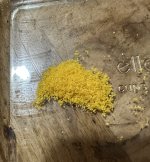
came back more yellow than usual but I got 957mg off first pull from 100g mhrbGREAT EMULSIONS ?
heh
That looks great, yellow is normal enough what with DMT's polymorphism. Respectable yield for just one pull, too.came back more yellow than usual but I got 957mg off first pull from 100g mhrb
Natural extracts will have a variable profile of impurities which hold responsibility for the majority of DMT's odour profile. Variations in extraction method will also lead to a stronger or weaker aroma. Similar parameters apply to synthetic material.Why dimitri has very strange/chemical aftertaste, which feels like shouldnt be? same method used as long time ago, when everything was fine. I thought its because solvent wasnt properly washed, so dissolved everything, rewashed few times, and did evap. Looks like its still the same, the difference is that before rewash it did hit like a truck from even one puff.
No need to double postWhy dimitri has very strange/chemical aftertaste, which feels like shouldnt be? same method used as long time ago, when everything was fine. I thought its because solvent wasnt properly washed, so dissolved everything, rewashed few times, and did evap. Looks like its still the same, the difference is that before rewash it did hit like a truck from even one puff.