• Members of the previous forum can retrieve their temporary password here, (login and check your PM).

Phalaris/other grass types ID thread

Migrated topic.
VIII said:
Found a few local sources of what seems to be P. Aquatica. If anybody can confirm/deny this it would be much appreciated.

Flower:

(Click to Enlarge)

Ligule:

Ligule (size):

I'll update tomorrow with a photo of rhizome and a shot of the full batch.
This is the only real Phalaris on the page! lol Well done VIII.
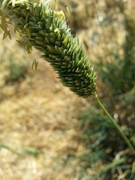
Except for Arundinacea, the confusing one, they all have similar looking flowers. Like developing wheat but denser and shorter length, and fatter in the case of Brachyastachys.

Look carefully at the known pics, like VIII's.

This thread is like a guide to Grasses Which Are NOT Phalaris :lol:
 
^..yeah, the mimosa drought..well, according to an ag paper: " Phalaris has the best 'design features' to survive the stresses of our environment. The drought resistance of phalaris comes from the combination of its unique ..." :)

The Meddling Monk made a very good point on ID of Phalaris..

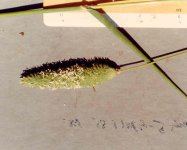
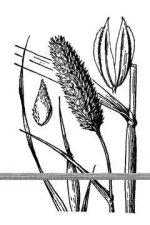
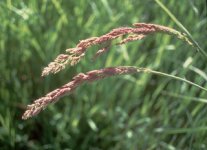
i've attached some images below to help guide..

i) is of Phalaris minor, it has worldwide distribution, including California..and it contains DMT and other alkaloids.
__the flower head is typical in shape of most Phalaris species, especially known 'desireable' strains..other species like Triticum aestivum or Stipa robusta (a common weed) have longer and often slightly narrower flower heads..Phalaris individual flowers (if you zoom up on the 'head' or spike which comprises many tiny flowers) are typically white..

ii) is a botanical drawing of P. minor showing key features, which are typical of the majority of the genus Phalaris..

iii) and iv) are of the 'difficult' species, Phalaris arundinacea..it has many variant forms..it's flower spike (head) begins more upright then spreads outwards, then often resembling many other kinds of grass which are not phalaris..because arundinacea is a known often 5meo species, and the most variable, it is probably not a good one to begin research on..

& v) is P. minor in the wild, showing typical habit and plant form..
the grass flowers annually for a few weeks..ps. will add some info on P. minor in the big phalaris thread..
 

Attachments

  • Phalaris_minor_April.jpg
    Phalaris_minor_April.jpg
    18.6 KB · Views: 2
  • PhalarisMinor2.jpg
    PhalarisMinor2.jpg
    16.7 KB · Views: 1
  • Phalaris_arundinacea%2CI_TQBH5650.jpg
    Phalaris_arundinacea%2CI_TQBH5650.jpg
    38.6 KB · Views: 2
  • Phalaris_arundinacea%2CI_LJM25581.jpg
    Phalaris_arundinacea%2CI_LJM25581.jpg
    20.6 KB · Views: 2
  • Phalaris_minor_April2.jpg
    Phalaris_minor_April2.jpg
    61.1 KB · Views: 2
seems like brachystachy. collected this summer.
 

Attachments

  • phalaris+flower+1.jpg
    phalaris+flower+1.jpg
    14.5 KB · Views: 1
  • phalaris+flowers+2.jpg
    phalaris+flowers+2.jpg
    18.4 KB · Views: 1
A link for the USDA Plant Profiles for the Phalaris genus. Shows were each of them grow in the U.S.: USDA Plants Database

And when you're on the page of the desired genus there are links toward the top (More Information), and at the bottom (More Accounts and Images) that can give you a lot more detailed information. (i.e. "Adaptation Growth of reed canarygrass begins early in the spring, senescence occurs with summer drought, and limited vegetative growth resumes in the fall if moisture is available."Source)
 
BlackSheep96 said:
A link for the USDA Plant Profiles for the Phalaris genus. Shows were each of them grow in the U.S.: USDA Plants Database
I recall being told that the USDA Plant database info is around a decade old. That said, I have still found the information there useful.

For 2010 maps check out BONAP.org (BONAP's NAPA vs. USDA-PLANTS)
BONAP.org - Phalaris (2010)
They have quite an interesting notice on the front page as well.
BONAP.org said:
NOTICE:

Something new is coming to this website; something so profound and provocative that it will likely change the way we think about wild plants and wild places. Indeed, it could influence and perhaps alter many of the existing natural history websites from those of federal government agencies to those of private groups, scientific institutions and nurseries. Once online, this addition could clearly establish a new paradigm for the way we analyze, interpret and view nature. It will offer a wholly innovative and novel method for understanding, sorting and identifying our natural resources. For those of you who share our passion and want to help build a better understanding of our North American biota, jump on board, otherwise get out of our way. PLEASE KEEP WATCHING. -JTK

nen888 said:
i've attached some images below to help guide..

i) is of Phalaris minor, it has worldwide distribution, including California..and it contains DMT and other alkaloids.
__the flower head is typical in shape of most Phalaris species, especially known 'desireable' strains..other species like Triticum aestivum or Stipa robusta (a common weed) have longer and often slightly narrower flower heads..Phalaris individual flowers (if you zoom up on the 'head' or spike which comprises many tiny flowers) are typically white..

ii) is a botanical drawing of P. minor showing key features, which are typical of the majority of the genus Phalaris..

iii) and iv) are of the 'difficult' species, Phalaris arundinacea..it has many variant forms..it's flower spike (head) begins more upright then spreads outwards, then often resembling many other kinds of grass which are not phalaris..because arundinacea is a known often 5meo species, and the most variable, it is probably not a good one to begin research on..

& v) is P. minor in the wild, showing typical habit and plant form..
the grass flowers annually for a few weeks..ps. will add some info on P. minor in the big phalaris thread..

nen888, thanks for the extra info on P. minor. Excuse my terminology but I believe P. minor has a shorter leaf(? the part protruding ~halfway up) and as mentioned is a bit more narrow flower heads. Do you have any more tips for differentiation between P. minor and other species such as P. Aquatica?

I also wasn't aware that P. minor had DMT in it, I had mentally marked it off as not worth pursuing. Do you know what percentage it has been found at? Or a source for alkaloid content in P. minor? Edit: just read your post in the other Phalaris thread
I would be interested to know if it is also a worthwhile source when looking for wild Phalaris.
 
The Meddling Monk said:
I'm interested in P. canariensis, there was a little info in there.

A little table in Festi&Samorini paper shared by endlessness suggested DMT in p. canariensis. In smaller amounts though. I grew some and made an extraction, you can see a little report here if interested.

I think there were tryptamines in the extract (not sure if N,N... although the reagents did not disagree) but not enough for a positive bioassay, at least with the small amount I grew.

I would also be interested in any further information about canariensis, since I have a virtually unlimited supply of seed.
 
..hey Vosdel..(the monk passed on that 'document btw, but it's not in there..but we both remember it in original!)

..there was a mention by Johnny Appelseed, if i recall, in an E.R. of P. canariensis having large amounts of DMT in the Seed..the heading was 'Psychedelic Birdseed'..(which it is sold as..well, birdseed anyway..)
i just laugh when i think of those canaries tweeting away..:d

P. canariensis is considered by some botanists to be a sub-variety of brachyatachys..
..
 
This is the only reference to canariensis I can find in TER. It's a feedback letter from "Anonymous", so I don't know if Appleseed's mention will be yet another one of the articles mysteriously vanished from the PDF version, or I'm missing something.

MIND-ALTERING BIRDSEED
Maybe we should call this "B.S. DMT" (Birdseed DMT)! So you think maybe this is a joke? A friend of mine recently chromatographed some Canary grass seed and he says some strains checked out quite potent! It's an annual and it must be replanted every time you want to grow some more Ayahuasca, but don't let the birds get to it first! Maybe the U.S. Govt. will outlaw birdseed in Pet Stores! I am sure that some strains are better than others, but anyone wishing to join in on the "Ayahuasca analog research" fun can purchase 3,600 seeds of Phalaris canariensis for only $8.00 from: (...)

The strain I have didn't seem to show potent results in the young grass at all, so I doubt that trying to extract the seeds would make any sense, would it?
 
..thanks for that..yeah i lose track of all Appleseed's works, he did so much, and it's often just cited as or attributed to Trout..
but, as birdseed is so common, it's worth looking at seed-extraction..

i think as time goes on that, like cannabis, select strains of Phalaris will become for common..
 
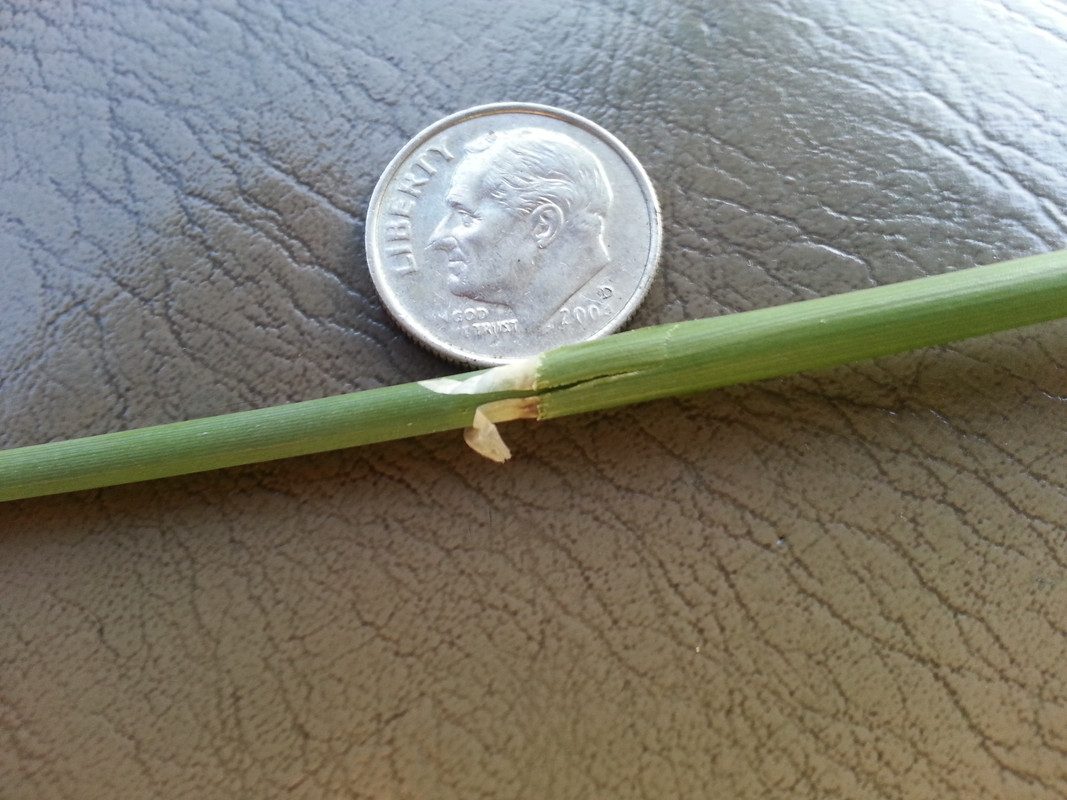
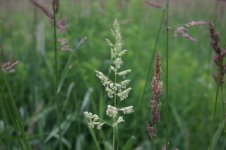
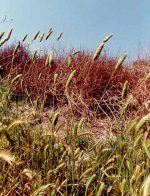
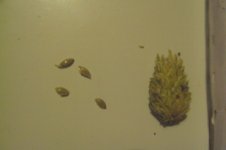
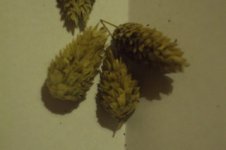
I know this doesnt look pretty much as phalaris but does answere for some requirments for a poositive ID... What is it?
imagezigq.jpg

imagexzqo.jpg

imageitn.jpg

imagexke.jpg


Just bringing this thread back to life:thumb_up:
Thanks!
 
nen888 said:
as birdseed is so common, it's worth looking at seed-extraction..

For the record, I attempted a crude extraction with P. Canariensis seeds (the same strain I used for a grass extraction with poor results overall, report here). Seeds were ground, mixed with lime and hydrated, and pulled with hexane. The oils obtained showed no activity, which is not surprising considering that the seeds were purchased at a dietetic supplements store, but given the high variability in Phalaris strains I don't think that rules out birdseed.

I will try again as soon as I gather elements for TLC.
 
Back
Top Bottom