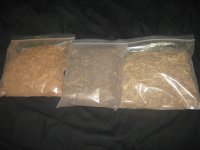
That looks like muricata to me but hopefully some others will chime in to confirm.



AluminumFoilRobots said:I've done some research and am about to do a bit more, but I do have this question: Am I correct in thinking that "caupuri" means "knotted" and "ourinhos" means "smooth"?
AluminumFoilRobots said:I was reading yesterday that in some parts of Ecuador smooth caapi is "Men's" ayahusacsa and curvy (which I assumed meant knotted?) is "women's ayahuascsa".
Thanks guys! I am really glad that the collaborative research area got started!
endlessness said:Look under UV light. Does the brew glow? If not and its too concentrated, dilute and check again. If it shines under UV, its probably B. caapi or related harmala-containing vines, so you should brew considering the normal recomendations for ayahuasca apply. If you get any of the other vines that dont contain harmalas, you're stepping on a more unknown territory.


Imo, sbarret77's post introduced some real confusion into this issue (perhaps not a bad thing, if it means we have been presented with the full magnitude of the "snare" ).Julz said:AluminumFoilRobots said:I've done some research and am about to do a bit more, but I do have this question: Am I correct in thinking that "caupuri" means "knotted" and "ourinhos" means "smooth"?
In the Intro Essay thread,Ayahuasquero Arriving, he mentions both of these in relation to usage in Brazil. I can't find a meaning specific to "caupuri" as it could be of native language origin. Is this name used in Spanish speaking countries too?
"Ourinhos" just means "little gold", like "Goldy"- it does not specifically reference the texture of the bark or vine. I assumed it referenced the color of the brew.
endlessness said:Você também é carioca?
snozzleberry said:Imo, sbarret77's post introduced some real confusion into this issue (perhaps not a bad thing, if it means we have been presented with the full magnitude of the "snare" ).
The sample of ourinhos that the Nexus tested came back with significant amounts of ketotetrahydronorharmine, which is something scarcely mentioned in the literature.
Therefore, his equating ourinhos with tucanaca raises a whole host of questions, unless the tested "ourinhos" was really one of the subdivisions of tucanaca to which he was unable to speak and assuming that the presence of this compound is essentially one of the things that causes it the tucanaca category to be subdivided.
Julz, afaik, you won't find anything on the origin/definition of tucanaca or caupuri as the usage of these two terms in western/industrialized countries stems (apparently) from a 1996 D. McKenna lecture for which there is no information on, other than that is where Ratsch attributes his use of these varietals from (and subsequently, it looks as though others have cherry-picked Ratsch's bibliography, but no one has material from/about the content of that talk).
Kind of. Pretty much all of the citations I have seen for caupuri/tucanaca can be traced back to the McKenna lecture (many indirectly, through citing Ratsch's work), but there's no info on that lecture, so it's a case of "follow the leader" in which western botany does not present any varieties of caapi and the original information that is being cited appears to not exist currently. Add in the relatively esoteric nature of this research, the disparities between nomenclatural systems and the lack of chemical analyses and the reasons for the magnitude of the confusion begins to become apparent.Julz said:Snozz, then is what you're saying that most of the literature and botanical information is coming only through western sources, i.e. McKenna, Ratsch, lectures which we don't actually have access to
I assume you are talking about the Bia Labate stuff? I've been hoping to, but I have not had time recently. She presented on some of the ethical issues enmeshed in ayahuasca use at Psychedemia, but I was unfortunately indisposed during her talkJulz said:Has anyone here read that text that sbarret77 mentioned? Any idea of the content?
 She's also presenting at Psychedelic Science 2013 and once I address some of the stuff currently on my plate I had been planning on emailing D. McKenna over the caapi varieties as well as some of the Nexus' chemical analyses and could probably fairly easily modify the email and send her a similar one to see if she had any insight to share.
Well, one of the potential issues is the morphological/phytogeographic differences between some of these potential species/varieties. Western/industrial botany has very specific definitions and rules for classifying new species and varieties. It's quite possible that there are plants that do not meet our qualifications for classification as unique species/varieties (one of the things I want to ask McKenna is why he never published the caapi varieties...) but that are identified as unique botanical specimens to indigenous groups.Julz said:Guess I am still floored that there isn't more botanical info, but then, I am coming from the total western old school northern hemisphere side of horticulture/commercial floriculture where plants have been well documented for centuries sometimes, not the emerging and/or unknown wealth of as yet unclassified plants of SA.

..well said, and also there are still quite a few plants in South America which have not been named by botanists yet, often due to their 'endemicness', meaning they occur only in single or remote locations..add to that that plants can express different genetic traits depending on geographical conditions..'same species, different variety' is a hazy line in botany..great work thanks Snozz..!Well, one of the potential issues is the morphological/phytogeographic differences between some of these potential species/varieties. Western/industrial botany has very specific definitions and rules for classifying new species and varieties. It's quite possible that there are plants that do not meet our qualifications for classification as unique species/varieties (one of the things I want to ask McKenna is why he never published the caapi varieties...) but that are identified as unique botanical specimens to indigenous groups.
..also very well said..Ah, I get it. The western way just looks at morphology and only functions within its rule set, whereas indigenous society may treat plants with same/similar morphology as different varieties based on their pharmacological content, spirit energy, geographical location.