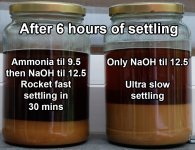
There's something special about using ammonia and basing harmalas. One can see it in situ under microscope, and results on large batches confirm a different kind of crystallization process going on. Observed differences:
Ammonia:
1) makes a transparent initial milk, never becomes really white-ish
2) settling happens fully in 30 mins
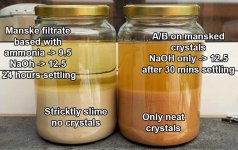
3) filtrate looks a tad darker
Lye:
1) makes a very white-ish milk color that remains very long like that
2) settling takes a lot of hours
3) filtrate looks a tad lighter
Ammonia vs NaOH: seems to affect crystal growth, especially crystal growth speed, and likely final crystal size. When you initially base the acidic tea then extreme small crystals like dust forms, that is the 'milk'. If you filter rapidly then a lot of that milk will eventually go trough the coffee filter, this does not happen when you let it stand overnight. So there is a process that the milk undergoes, the dust becomes bigger crystals and the white color fades. After overnight settling you can filter trough a coffee filter, nothing will fall trough. It is exactly this process that is incredibly speed up with ammonia. A drop in situ under microscope takes like 5 minutes for the 'dust milk' to become recognizable visible crystals with ammonia. Using lye the milk/dust simply refuses to do that so fast and you might suffer from drop evaporation.
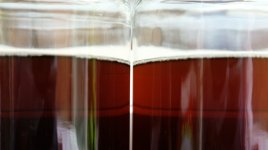
Back to those pots in the picture: basing with ammonia the milk is semi transparent because the immediate crystals forming process eats the fine 'dust' rapidly into crystals that are less a white effect in the pot. With lye this goes very much slower making the milk appear ultra white in comparison and staying longer like that.
The immediate build bigger crystals under ammonia sink a ton faster that the fine 'dust'.
About filtrate color, this is a bit unclear at the moment. The lighter tan in the lye pot filtrate suggest more material has crystallized? Though both pots where topped at same 12.5 pH. I hardly imagine that the ammonia pot missed out on precipitating harmalas at that pH level, and I wager to think less plant dirt was able to attach itself to the crystals in the case of ammonia. If that is so this would be an extra advantage for ammonia.
Rest to note that in the VDS thread it was already mentioned that I could not perceive pH depression effects from lye, unlike ammonia and calcium carbonate. The weak base effect seem to be responsible. So when I based that pot with ammonia I carefully tried to observe any indication for a pH depression, but no. To no surprise because the needed concentration for pH depressions to occur are not met. So in this stage it was not possible to separate harmine using VDS's pH depression method.
To meet same end pH, the ammonia pot got topped up with NaOH til 12.5 and this was done immediately after ammonia got it til 9.5
Ammonia:
1) makes a transparent initial milk, never becomes really white-ish
2) settling happens fully in 30 mins
3) filtrate looks a tad darker
Lye:
1) makes a very white-ish milk color that remains very long like that
2) settling takes a lot of hours
3) filtrate looks a tad lighter
Ammonia vs NaOH: seems to affect crystal growth, especially crystal growth speed, and likely final crystal size. When you initially base the acidic tea then extreme small crystals like dust forms, that is the 'milk'. If you filter rapidly then a lot of that milk will eventually go trough the coffee filter, this does not happen when you let it stand overnight. So there is a process that the milk undergoes, the dust becomes bigger crystals and the white color fades. After overnight settling you can filter trough a coffee filter, nothing will fall trough. It is exactly this process that is incredibly speed up with ammonia. A drop in situ under microscope takes like 5 minutes for the 'dust milk' to become recognizable visible crystals with ammonia. Using lye the milk/dust simply refuses to do that so fast and you might suffer from drop evaporation.
Back to those pots in the picture: basing with ammonia the milk is semi transparent because the immediate crystals forming process eats the fine 'dust' rapidly into crystals that are less a white effect in the pot. With lye this goes very much slower making the milk appear ultra white in comparison and staying longer like that.
The immediate build bigger crystals under ammonia sink a ton faster that the fine 'dust'.
About filtrate color, this is a bit unclear at the moment. The lighter tan in the lye pot filtrate suggest more material has crystallized? Though both pots where topped at same 12.5 pH. I hardly imagine that the ammonia pot missed out on precipitating harmalas at that pH level, and I wager to think less plant dirt was able to attach itself to the crystals in the case of ammonia. If that is so this would be an extra advantage for ammonia.
Rest to note that in the VDS thread it was already mentioned that I could not perceive pH depression effects from lye, unlike ammonia and calcium carbonate. The weak base effect seem to be responsible. So when I based that pot with ammonia I carefully tried to observe any indication for a pH depression, but no. To no surprise because the needed concentration for pH depressions to occur are not met. So in this stage it was not possible to separate harmine using VDS's pH depression method.
To meet same end pH, the ammonia pot got topped up with NaOH til 12.5 and this was done immediately after ammonia got it til 9.5