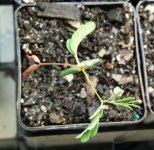
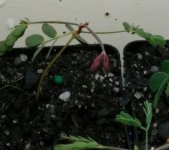
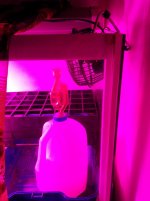
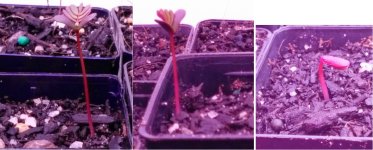
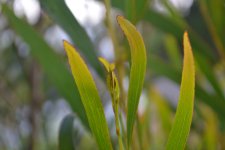
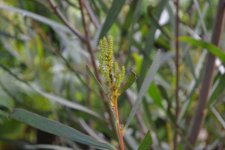
So my Acacia Obtusifolia is pumping out new growth at the moment and associated with this increased growth is a red pigment in the leaves. Now I have heard that this red pigment is an indicator of alkaloids but I've heard nothing concrete. I cannot remember my Acuminata having a red pigment in the phyllodes although I do recall that it could have had some in the juvenile leaves.
So does anyone know how reliable of an indicator the red tips are of alkaloids? Obviously the phyllodes may contain alkaloids and none of them have to be dmt but let's pretend that I found an acacia longifolia that had slight red pigmments would it be likely that it is an active strain? On an old industrial site I believe I have found some A Longifolia var Sophorae which has a red pigment in the new growth, although this ID could be a mis-identification.
On a side note last spring when I sprouted a number of Acacia Floribunda, amungst others, to be wild planted (They were all native to my area). I noticed that some had this red pigment and other did not. With the variability of Floribunda could this be a way to determine the active varieties from the non-active (but still nonetheless just as awesome!) varieties?
Peace,
A.
So does anyone know how reliable of an indicator the red tips are of alkaloids? Obviously the phyllodes may contain alkaloids and none of them have to be dmt but let's pretend that I found an acacia longifolia that had slight red pigmments would it be likely that it is an active strain? On an old industrial site I believe I have found some A Longifolia var Sophorae which has a red pigment in the new growth, although this ID could be a mis-identification.
On a side note last spring when I sprouted a number of Acacia Floribunda, amungst others, to be wild planted (They were all native to my area). I noticed that some had this red pigment and other did not. With the variability of Floribunda could this be a way to determine the active varieties from the non-active (but still nonetheless just as awesome!) varieties?
Peace,
A.

 ..the active