• Members of the previous forum can retrieve their temporary password here, (login and check your PM).

Rf for different alkaloids (TLC/Paper/Column chromatography)

Migrated topic.
Joined
Feb 20, 2008
Messages
13,671
Merits
380
Im uploading an excel table i've been working on (thanks for the help global & doingkermit), with Rfs for different substances on a variety of different solvent systems (150+).

All the table includes references with hyperlink to the full publication for easy source-checking, was quite some work but I think its worth it :)

So far (28/11) the substances added are : NMT, DMT, DMT N-Oxide, psilocin, psilocybin, bufotenine, bufotenine n-oxide, bufoviridine, dehydrobufotenine, 5-MeO-NMT, 5-MeO-DMT, 5-MeO-DMT n-oxide, gramine, tryptamine, harmine, harmaline, THH, DPT, DET.

Ideally this table will grow with more publications I find and help of others around the Nexus.

Please feel free to give any suggestions, comments, or whatever. I hope the file is working well.
 

Attachments

Ok all the publications I could find are uploaded, file updated. I will reupload as more information is gathered, and the filename will have the date of the update, so people can know if they got the latest file or not.

If anybody has any pointers on publications that have Rf of different substances, whether they are tryptamines or any other drugs, feel free to tell me the reference so i can add to the file (or add to the file yourself)
 
Dozuki said:
Funny, I did the same thing this weekend, only on paper... Not sure I have a copy of Exel but will cross reference once I can check out the file.

-D.

I generated a pdf from the exel file for you (i hope this is ok for you endlessness)
 

Attachments

Here is something I found about TLC with Rf's for identifying mescaline which could be useful for the excel.
Maybe it's already posted somewhere here on the forum but I couldn't find it with the search.

It's coming from linked source which also has several other methods of mescaline identification described. According to the pdf it's referenced from
J. "Clarke's Isolation and Identification of Drugs"': 2nd edifion, The Pharmaceutical Press (London) 1986.

The Analysis of Peyote Cactus, Mescal Buttons and Mescaline


E. Thin-layer chromatography
Plates:
Activated silica gel G on glass backed plates; the coating (0.25 mm thickness) contains a fluorescing additive which fluoresces at 254 nm.

Developing solvents:
System A: Chloroform 82 Methanol 17
Concentrated ammonia solution 1 System B: Methanol 100
Concentrated ammonia solution 1.5 Preparation of solutions to be applied to the TLC plate:

a) Peyote cactus, Mescal Buttons:
About 10 mg of a representative sample of the suspected dried and pulverized
plant material is extracted using the method outlined in Chapter B. If using ninhydrin reagent for visualization the extract should be concentrated to approxymately 200 ul under a stream of nitrogen. and 10 ul of the filtered extract are spotted onto the TLC plate.

b) Mescaline powder:
Prepare a solution at a concentration of approximately 1 mg/ml methanol as
outlined in Chapter B. and spot 1 ul of this solution onto the TLC plate.

c) Mescaline tablets and capsules:
Extract the material using method outlined in Chapter B. and spot 10 ul of this
extract onto TLC plate. d) Standard solution:
Prepare a solution of 1 mg/ml mescaline sulfate or hydrochloride methanol and spot 1 ul of this standard solution onto the TLC plate.

Visualization
The plates must be dried prior to visualization. This can be done by air-drying at room temperature or by short use of a hot air blower.

Visualization methods:
1. UV light at 254 nm.
2. Fluorescamine (Fluram) reagent 3. Ninhydrin reagent.
Spray reagents:
(1) Fluorescamine reagent: Prepare a solution of 10 mg fluorescamine in 50ml
dried acetone.
(2) Ninhydrin reagent: Prepare a 10% solution of ninhydrin in ethanol.

Method:
Observe first the plate under UV light at 254 nm. Mescaline will absorb the light
and appear as a dark spot on the fluorescent background. Then spray with reagent(1) or (2). When using reagent (1), the plate has to be dried after spraying by shortly using a hot air blower. Then observe the plate under UV light at 365 nm.
Mescaline gives a bright yellow fluorescent spot. The detection limit is about 10 ng mescaline. The fluorescence can be intensified by exposing the plate to ammonia vapour. When using reagent (2) the plate has to be heated after spraying in an oven at 120°C for at least 15 minutes. A violet spot is given by mescaline. The detection limit is about 1 ug mescaline.

Results

With developing systems A and B, mescaline gives spots at Rf x 100 value
approximating 36 and 24, respectively.

 
Apparently I don't have access to the file... [Edit: Got access, thanks!]

Here is a reference I have on a few of the interesting molecules, with a good number of solvent systems...

-FF
 

Attachments

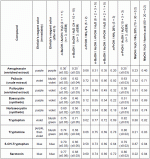
  • TLC_Chart.gif
    TLC_Chart.gif
    63 KB · Views: 0
Bleach is cheap and commonly available. The authors of the below article describe its use as a sensitive TLC stain.

Rapid and sensitive determination of tryptophan, serotonin and psychoactive tryptamines by thin-layer chromatography/fluorescence detection
Noriyuki Kato, Takashi Kojima, Shinji Yoshiyagawa, Hikoto Ohta, Akira Toriba, Hideo Nishimura, Kazuichi Hayakawa
Journal of Chromatography A Volume 1145, Issues 1–2, 23 March 2007, Pages 229–233

Abstract
A rapid, sensitive and selective method for the determination of tryptophan (Trp), serotonin (5-HT) and psychoactive tryptamines (PATs) by thin-layer chromatography (TLC) with fluorescence detection is proposed. These compounds form fluorophores on the developing plate by heating after spraying with sodium hypochlorite, hydrogen peroxide or potassium hexacyanoferrate(III)-sodium hydroxide reagent. Fluorescent spots (vivid blue) were observed by irradiation with ultraviolet light (365 nm). The detection limits of Trp, 5-HT and PATs were in the range from 0.01 μg to 0.06 μg. This method was effectively applied to the detection of confiscated PAT powder and PAT in abusers’ urine samples.

Redirecting
 

Attachments

I know this thread is ancient but seems like a great place to gather TLC Rf values, would be even better if the original spreadsheet was converted to google sheets and shared so that anyone could edit it or at least select people could edit it.

Some additional references:

Thin-Layer Chromatography Method for the Detection of N,N-Dimethyltryptamine in Seized Street Samples
November 2014JPC - Journal of Planar Chromatography - Modern TLC 27(6):477-479
DOI:10.1556/JPC.27.2014.6.13

methanol–ammonia 100:1.5
NN DMT Rf was 0.50 ± 0.01 (using silica gel F254 plates)

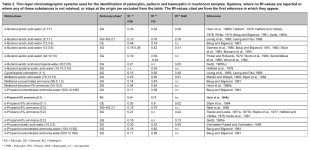
Occurrence and use of hallucinogenic mushrooms containing psilocybin alkaloids
Andersson, et al 2008
n-butanol-acetic acid-water (12:3:5) is reported to give the best separation of psilocybin and baeocystin.

Psilocybin Rf=0.18-0.26
Psilocin Rf=0.42
baeocystin Rf=0.31
Occurrence-and-use-of-hallucinogenic-mushrooms-containing-psilocybin-alkaloids-TABLE3.jpg


A less reliable source:
How To Detect DMT Using Thin-Layer Chromatography
35 ml of 1-Butanol, 25 ml of ethyl acetate, 10 ml of Methanol and 25 ml of trichlorethylene
"Typical experiment data available on the web has revealed DMT to have an average Rf of about 0.29 to 0.35 with this type of solvent mixture"
 

Attachments

  • Occurrence+and+use+of+hallucinogenic+mushrooms+containing+psilocybin+alkaloids+TABLE3.jpg
    Occurrence+and+use+of+hallucinogenic+mushrooms+containing+psilocybin+alkaloids+TABLE3.jpg
    228.4 KB · Views: 0
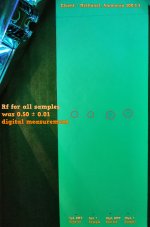
Thanks. FYI I was able to perfectly replicate "Thin-Layer Chromatography Method for the Detection of N,N-Dimethyltryptamine in Seized Street Samples"
November 2014 JPC - Journal of Planar Chromatography - Modern TLC 27(6):477-479
DOI:10.1556/JPC.27.2014.6.13

methanol–ammonia 100:1.5
NN DMT Rf was 0.50 ± 0.01 (using silica gel F254 plates)
 

Attachments

  • UVC+Edited+with+Details+CropAndShrink.jpg
    UVC+Edited+with+Details+CropAndShrink.jpg
    931.3 KB · Views: 1
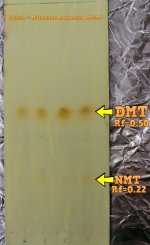
To add to my above post, not mentioned by the authors of the referenced paper, but NMT seems to show up at Rf=0.22 only after applying Ehrlich's Reagent (it is only my educated guess that it is NMT based on Gupta et al 1979, they used a similar but slightly different eluent than I did, of Benzene-Methanol-5% Ammonium hydroxide 10:15:2 with Rf of 0.2 for NMT):
 

Attachments

  • Full+view+30+mins+after+ehrlich+bake+CropScaled.jpg
    Full+view+30+mins+after+ehrlich+bake+CropScaled.jpg
    583.7 KB · Views: 1
Hey GordoTEK, thanks for sharing!

Did you ever check this thread, specially the results interpretation part?

After doing a lot of TLC, I've come to find that even with the same eluent and seemingly similar conditions the Rfs vary a lot. It is better to use relative Rfs using another substance as a comparison, which is why I built the spot height calculator. Maybe you already saw it, but if not, might be of interest.

Be well!
 
Back
Top Bottom