
-
Members of the previous forum can retrieve their temporary password here, (login and check your PM).
You are using an out of date browser. It may not display this or other websites correctly.
You should upgrade or use an alternative browser.
You should upgrade or use an alternative browser.
Rumor that mg seeds are the most potent
- Thread starter Ugx
- Start date

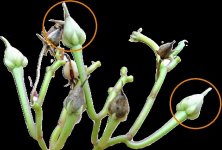




Care to elaborate?




The peak of LSH and tricolorin A is before fruit and seeds are formed.
What are your thoughts on the value of tricolorin A in a human phytomedicinal context?Abstract
Tricolorin A, (11S)-11-hydroxyhexadecanoic acid 11-O-α-l- rhamnopyranosyl-(1→3)-O-α-l-{2-O-(2S-methylbutanoyl)-4-O-(2S-methylbutanoyl)}-rhamnopyranosyl-(1→2)-O-β-d-glucopyranosyl-(1→2)-β-fucopyranoside-(1,3′′-lactone), the major phytogrowth inhibitor isolated from Ipomoea tricolor Cav. (Convolvulaceae) was found to be a potent uncoupler (U50=0.33 μM) of photophosphorylation in spinach chloroplasts. Tricolorin A inhibited H+-uptake and adenosine 5′-triphosphate (ATP) synthesis, and stimulated basal and phosphorylating electron flows. Using a combination of two well-known fluorescent ΔpH probes, 9-aminoacridine and 9-amino-6-chloro-2-methoxyacridine, the uncoupling behavior of tricolorin A was also demonstrated for submitochondrial particles. Polarographic data showed that high concentrations (20 μM) of tricolorin A inhibited photosystem II (PSII) electron flow at the level of plastoquinone B (QB). Chlorophyll (Chl) a fluorescence analysis showed that tricolorin A induced accumulation of QA− and strongly decreased the electron transport capacity, suggesting that the target of this molecule was located at the QB level. The macrocyclic lactone-type structure of this allelopathic agent proved to be an important structural requirement for uncoupling activity since its hydrolysis caused loss of the inhibitory potential.
It should be avoided sublinguallyWhat are your thoughts on the value of tricolorin A in a human phytomedicinal context?

TheGreenPhantom
Titanium Teammate
...so... make a tea from the buds?
I'm not experienced with them to be honest with you. If I had access I would either chew them as soon as harvested or a quick frozen tincture....so... make a tea from the buds?
scopoletin has come to my attention.
lScopoletin has attracted the attention of medicinal chemists and health professionals because of its broad range of beneficial properties, such as antibacterial, antifungal, antiparasitic, anticancer, anti-inflammation, hepatoprotective, antihyperlipidemic, antidiabetic, neuroprotective, antioxidant, anti-angiogenesis, anti-hypertensive, analgesic, anxiolytic, immunomodulatory, anti-osteoporosis, anti-allergic, anti-aging, and anti-gout activities. In addition, scopoletin is an inhibitor of various enzymes, including choline acetyltransferase, acetylcholinesterase inhibitor (Rollinger et al., 2004; Hornick et al., 2011), aldose reductase (Lee et al., 2010),
The results indicate that its antidepressant-like effect is dependent on the serotonergic (5-HT(2A) receptors), noradrenergic (alpha(1)- and alpha(2)-adrenoceptors) and dopaminergic (dopamine D(1) and D(2) receptors) systems.


What's the purpose of this thread?
Many stories about mg seeds. Scopoletin isn't the "tricolorin" of argyreia. These have high molecular weight. Best results I've had are chewing seeds a little while then spitting everything. The green herb is LSH-rich.
Similar threads

- Replies
- 5
- Views
- 455


- Replies
- 6
- Views
- 338


- Replies
- 1
- Views
- 294
