Last night I finished reading
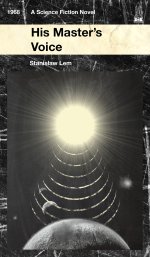
Lem's 1968 novel "His Master's Voice" and I'm feeling so many ways about it. The novel is presented as the memoir of a frontier mathematician that took part in a highly-secretive government project tasked with decoding a repeating pattern spotted within a tight band of the ever-present neutrino emission that is bathing every cosmic body at all times. The pattern is called "the letter/code" and the project assumes the name "His Master's Voice".
One of the defining characteristics of the novel is its incredibly dense and complex prose that takes the form of weaving scientific concepts with those sourced from multiple schools of philosophy, all parsed through the protagonist's own perspective. It seems to me that a lot of the negative reviews from this book come precisely from the difficulty with which one is faced when reading it. It is not an easy read, especially if you're not paying much attention.
In economics and art alike, scarcity creates value. Lem employs this principle by using very carefully calibrated economy of dialogue, foregrounding, and quite masterful use of negative narrative space. The novel breaks away from the standard form so that there are long, dense sections of internal philosophical monologue that also serves as character exposition, followed by brief, potent sections of short dialogue. In this way Lem puts the spotlight on the dialogue and gives it so much more weight. People don't say much, but what they say is instrumental for understanding what's going on, and drives the plot forward. Not a single line of dialogue in this book is pointless or there for simple decoration. Part of this is owed to the format of the novel being that of a memoir, in which one would not expect large swathes of dialogue, but I'm 100% certain Lem purposefully employed this model, and did so quite successfully.
There are spoilers ahead!
The narrative pressure builds up to the point of bursting, at which point the next step in the story unfolds. Following this pattern, Lem masterfully guides the reader through what is ultimately an inconclusive ending, the path to which is heavily laden with exceptionally profound philosophical insights and ideas about life and the Universe at large that gave me shivers and sent my thoughts to very far and bizarre places.
The philosophy concluding the book revolves around the absolute limits of human cognition. Lem dismantles the anthropocentric assumption that the human sciences, namely logic, mathematics, and biology, are universal constants.
Hogarth - the protagonist - uses the analogy of ants crawling over a philosopher's manuscript. An ant might use the ink to build a nest, completely oblivious to the intellectual meaning of the words. Humanity interacted with the neutrino signal exactly like the ants: we extracted what was materially useful to our specific evolutionary needs - biological novelties and potential weapons - while remaining entirely blind to the sender's actual meaning. In this way, the neutrino signal - and the project at large - serves as a mirror. It reveals absolutely nothing about the alien senders, but it exposes everything about human nature. Placed in the context of the Cold War, the scientists and the military immediately assume a posture of paranoia, treating the unknown as an existential threat and attempting to militarize it. The failure to decode the message is ultimately a failure to transcend our own evolutionary baggage.
The broader implications for humanity largely center around a stark reminder that we need to learn humility in the context of the cosmos itself. It suggests that the evolutionary path that led to human intelligence is just one highly specific, isolated trajectory. The cognitive gap between us and an older cosmic intelligence is likely unbridgeable.
Above all, the novel argues that humanity is not yet mature enough to participate in a broader cosmic dialogue. Until we evolve past our instinct to dominate, weaponize, and project our own neuroses onto the universe, any encounter with advanced extraterrestrial intelligence will result merely in a reflection of our own flawed nature.
I am nothing short of impressed by the prose in this novel. Sure, it's very dense and at times quite difficult to read, but overall it represents a massive step up from anything of Lem's I've read so far. The sheer mastery with which complex philosophical ideas are conveyed is admirable. To give a few examples of why I feel the way I feel about this book, here are 5 of my favorite passages from it that made me properly appreciate the caliber of literary genius that Lem possesses:
Humanity is a hunchback who, in ignorance of the fact that it is possible not to be hunchbacked, for thousands of years has sought an indication of a Higher Necessity in his hump, because he will accept any theory but the one that says that his deformity is purely accidental.
As a subject, believing he sees in the colored blotches angels or birds of ill omen, in reality fills in the vagueness of the thing shown with what is 'on his mind,' so did we attempt, behind the veil of incomprehensible signs, to discern the presence of what lay, first and foremost, within ourselves.
Literature, from the very beginning, has had a single enemy, and that is the restriction of the expressed idea. It turns out, however, that freedom of expression sometimes presents a greater threat to an idea, because forbidden thoughts may circulate in secret, but what can be done when an important fact is lost in a flood of impostors, and the voice of truth becomes drowned out in an ungodly din? When that voice, though freely resounding, cannot be heard, because the technologies of information have led to a situation in which one can receive best the message of him who shouts the loudest, even when the most falsely?
The urge to destruction is deducible from thermodynamics. Life is a fraud, an attempt at embezzlement, seeking to circumvent laws otherwise inevitable and implacable; insulated from the rest of the world, it immediately enters the path of decay, and that inclined plane leads to the normal state of matter, to the permanent equilibrium that is death. In order to continue living, life must feed on order, but because there is no order - none highly organized - other than life, it is condemned to consume itself. It must destroy to live, must take its nourishment from systems that are nourishment only to the extent that they can be ruined. Not ethics but physics determines this law.
The Metagalaxy is a limitless throng of psychozoic enclaves. Civilizations deviating from ours by a certain number of degrees, but, like ours, divided, mired in internal quarrels, burning their resources in fratricidal struggles, have for millennia been making - and still are making, again and again - readings of the code, readings as unsuccessful as our own. Just like us, they attempt to fashion the strange fragments that emerge from their efforts into a weapon - and, just like us, they fail. When did the conviction take root in me that this was the case? It is hard to say.
I told only those closest to me - Yvor, Donald - and before my final departure from the compound I shared this private property of mine with the acrimonious Dr. Rappaport. They all - a curious thing - at first nodded with the growing satisfaction of comprehension, but then, after some thought, said that for the world as it was given to us, my idea made too pretty and complete a picture. Perhaps. What do we know of civilizations "better" than ours? Nothing. So perhaps it is not suitable to paint such a panorama, in which we figure somewhere in the frame as a blot on the Galaxy, or as one of the embryos stuck fast in labor contractions that go on for centuries; or, finally, to use Rappaport's metaphor, as a fetus, quite handsome at birth, but strangling on its own umbilical cord, the cord being that arm of culture which draws the vital fluids of knowledge up from the placenta of the natural world.
To conclude, I can confidently say that His Master's Voice is definitely my favorite work of Lem so far. If you read Solaris and you liked it, then this will feel at least equally as good, or in my case - even better. It is not just a philosophical book wearing the thin coveralls of science fiction, because the several interpretations of the code are in and of themselves ideas of enormous creative value that I don't think I have encountered in another book until now. Enormous props to Michael Kandel for what I would assume is near perfect translation as well.
And because I remember
@blig-blug saying he hasn't read HMV - treat this as a hearty recommendation, my friend. Next on the list - Memoirs Found In a Bathtub.
Read on