Woolmer said:
Loveall said:
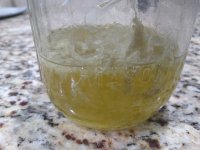
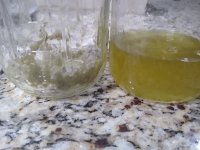
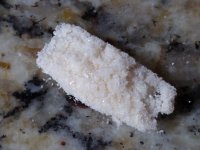
This works with HCl salting (and probably other acids in general I imagine). I used minimal diluted HCl to just titrate. Maybe more acetone is needed vs. sulfuric before cloudiness shows up. The brown/tan color stays in the acetone/water and the crystals come out pretty white. Below is the result after decanting, one acetone wash, dissolving in water and drying slowly. Positive for Marquis

Here is the
general technique as explained by Mindlusion if one wants to try other acids.
Very nice Loveall!
So this is as simple as what you wrote earlier in the thread, just using HCL instead of sulfuric acid?
The process being:
Reduced tea
Acetone to crash gunk
HCL to crash mescaline
Do you think this could be done with acetic acid?
Unfortunately, probably not (but go ahead and try if you want). I tried this exact thing using sulfuric acid but it did not work

. However, sulfuric has the problem of forming HSO4- at low pH which may stop precipitation. HCl does not have that possibility.
It works here after getting to very clean and concentratedwater/mescaline thanks to the limonene step.
What you are saying could work in principle, but like I said, I've run into issues with it, maybe because of too much plant junk. Stuff does precipitate and in one case it was even positive for Marquis, but bioassay and MS analysis by Benz showed no mescaline. After drying what didn't precipitate and doing a standard extraction on that, the mescaline was recovered. Doubledog said the plant stuff from the water extract gets in the way of precipitation, and so far that is what I have found.
I haven't completely given up yet. Maybe I just needed to keep on adding acetone

and gave up to soon. Also, 70% ethanol tinctures of dry powder are said to be clean and active. 70% IPA too, which makes me wonder about 70% acetone. That kind of extract could be reduced in volume, decanted from any junk that crashes during reduction, and then add acetone to see what happens. There may be several clouding/precipitation events at different acetone/extract ratios, one of them hopefully mescaline. Adding an acid (e.g. sulfuric) could change how early mescaline precipitates from the acetone/tincture like you say.
Also, it looks like the natural mescaline salt is
not soluble in acetone. So starting with a water extract and increasing acetone % should make it crash, no? We could start with a cacti water extract, then,
1) Add 50% acetone. We know I'm this condition junk precipitates because of phlux's and other confirmation work.
2) Reduce to say 10ml, and add more acetone (usay up to 200ml). This may have to be done in steps (less aggressive reductions and acetone additions) because if there is a lot of junk, a small water volume is not possible without being overwhelmed by junk.
3) Hang dry epson salt (say ~15g) wrapped in a filter and tied to a thread into the top of the solution to suck up all the water that was left in 2)
After 3) (or before?) the mescaline should have crashed somewhere - I hope.