• Members of the previous forum can retrieve their temporary password here, (login and check your PM).

Some doubts about solvent

Migrated topic.

akafoxx

Rising Star
Merits
42
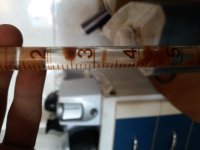
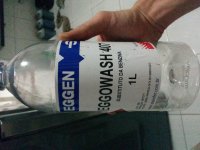
Hello guys, 1 year ago I have been performing the extraction of DMT using MHRB in STB process, always used naphtha but the suggestion of a pharmacist known started testing with benzene (petroleum ether) and the solvent phase separation appeared these emissions in photo below, I wonder how to separate the remainder of the benzene that is in the mix, in case the mixture has 3 layers of separation, only to benzene, the thick brown liquid and black liquid jurema
 

Attachments

  • 20151217_134505.jpg
    20151217_134505.jpg
    2 MB · Views: 0
Hi there (and welcome!)

Firstly, please note the spelling difference between benzene and benzine!!!!!!!!!!!!

Don't worry, this is a common mistake, and I'm guessing English isn't your first language, so I fully understand (most English-speaking folk won't know this either!)

Benzene - with an 'e' (or, rather, three of them and no 'i') is the prototypical cyclic aromatic hydrocarbon of formula C6H6 - nasty, carcinogenic stuff.

Benzine - with the 'i' - is a mixture of lower boiling point liquid aliphatic hydrocarbons and considerably less toxic. The fact that it's also known as petroleum ether only adds to the confusion because, of course, there is potential for confusion with diethyl ether. And hardly anyone can spell 'naphtha' correctly, for that matter... /endrant

Fortunately, you have the latter, benzine. Or chances are 99.9% that you are. Put some of your solvent in the refrigerator. Benzene will solidify as it has a surprisingly high melting point (5.53 °C) due to the highly symmetrical nature of the molecule. Hopefully your sample will not solidify (not even in the freezer).

Now, as far as your main question goes, what you have is an emulsion. Ideally you need to tell us in exact detail what you've done so far. Nonetheless, there are several ways of breaking emulsions. Adding more caustic soda is one, and adding a concentrated brine solution is another.

Have a look at the wiki, it's really useful!

Good luck 😉
 
Hi ! Thanks for your answer, yes, english is not my native language, thanks for your patience 😁

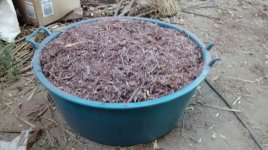
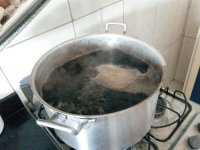
Because I live in a location with easy access to MHRB I decided to do a large-scale extraction and then turn into changa and save for the future, in the case of this mixture I used a pot of 20l which added 10l of water in the ph 4 with phosphoric acid to which took the broth three times and then reduced in the same pan until half (10l), then divide into 3 bottles of 5 liters and added 150 g of caustic soda to 1 liter of cold water which then divide the 3 bottles in then I put 1 liter of benzene in every bottle, shook and left separate 5 times and left separating overnight
 

Attachments

  • IMG-20151216-WA0023.jpg
    IMG-20151216-WA0023.jpg
    157.5 KB · Views: 0
  • 20151216_185038.jpg
    20151216_185038.jpg
    2.4 MB · Views: 0
  • 20151216_153414.jpg
    20151216_153414.jpg
    2 MB · Views: 0
  • 20151216_153426.jpg
    20151216_153426.jpg
    2.4 MB · Views: 0
  • 20151218_000811.jpg
    20151218_000811.jpg
    2.5 MB · Views: 0
downwardsfromzero said:
Lecithin is an emulsifier and would royally screw things up. Do not use it in this instance.

Good Lord! That's what I get for trying to do too many things at once. I guess studying up on old school alum oxidations and reading posts here don't mix.... :p
 
downwardsfromzero said:
Hi there (and welcome!)

Firstly, please note the spelling difference between benzene and benzine!!!!!!!!!!!!

Don't worry, this is a common mistake, and I'm guessing English isn't your first language, so I fully understand (most English-speaking folk won't know this either!)

Benzene - with an 'e' (or, rather, three of them and no 'i') is the prototypical cyclic aromatic hydrocarbon of formula C6H6 - nasty, carcinogenic stuff.

Benzine - with the 'i' - is a mixture of lower boiling point liquid aliphatic hydrocarbons and considerably less toxic. The fact that it's also known as petroleum ether only adds to the confusion because, of course, there is potential for confusion with diethyl ether. And hardly anyone can spell 'naphtha' correctly, for that matter... /endrant

Fortunately, you have the latter, benzine. Or chances are 99.9% that you are. Put some of your solvent in the refrigerator. Benzene will solidify as it has a surprisingly high melting point (5.53 °C) due to the highly symmetrical nature of the molecule. Hopefully your sample will not solidify (not even in the freezer).

Now, as far as your main question goes, what you have is an emulsion. Ideally you need to tell us in exact detail what you've done so far. Nonetheless, there are several ways of breaking emulsions. Adding more caustic soda is one, and adding a concentrated brine solution is another.

Have a look at the wiki, it's really useful!

Good luck 😉


Thank you for your advice, after reading a few pages from the post on emulsions decided to add 50 g of caustic soda and 200 ml of water and then slowly shook, now the mixtures do not present emulsions and are beginning to separate the layers, thank you!


Now that this doubt was resolved we go next :grin:two days ago I put the solution of benzene in the freezer and just checked and realized I have no crystal formation, what do occur? Should I change right back to naphtha?
 
Back
Top Bottom