• Members of the previous forum can retrieve their temporary password here, (login and check your PM).
This topic contain a TEK

StoneyBroski

I have embarked on SpiceX, still drifting through
1. Grind seeds to a powder using a mortar and pestle or a coffee grinder you should got that available. Soak the powdered seed Mass with water with a dash of vinegar or acetic acid.

2. Allow the seedmass to be heated to low temperature for 3 to 6 hours (i used a pot of sand with a timed plant outlet to allow my solution to be heated even while I was away from home.) filter off the liquid into a new container and allowed to settle while adding new aqueous acid to the seedmass.

3. Repeat steps 1 and 2 with the seedmass and acid pulls combining the extracts and allowing settle. (You can optionally filter all of this and Skip to basifying.) decant off the upper layer leaving behind plant sediment and sludge.

4. Slowly add sodium hydroxide in an aqueous solution to the extract until all of the precipitates fall out allowed to settle in the refrigerator for 5 to 10 hours until all of the precipitate falls down and decant or pipette away the upper aqueous layer and optionally you can add more base to it and throw it back into the fridge to see if it precipitates out more.

5. You now have crude extract which I would not consider safe yet but we're getting there. Add water with vinegar slowly to the sediment while still sludgy and wet and filter through two coffee filters, if need be keep two more coffee filters nearby so you can slide underneath a clogged up coffee filter and slip the liquids onto the second set of filters.

6. Once the extract has been filtered add non iodized sodium chloride in an aqueous solution until the precipitates all precipitate out, it's okay to use excess at this point. Allow the sediment to crystallize out in the refrigerator until everything settled about 6 to 12 hours.

7. Decant or pipette away the upper aqueous sodium chloride layer and continue to rinse the hydrochloride salts with more saturated sodium chloride water until the color is mostly clear or at least cleaner. You can save the sodium chloride solutions and basify later to catch excess left over salts. Once the powder at the bottom is a little bit lighter in color and your sodium chloride water stops catching as many impurities move on to the next step and redissolve the salts into fresh water.

8. At this point it doesn't matter too much that everything dissolves because the next step is to go ahead and basify again so now we've salted everything out and we've got most of the stuff we don't want out and we got most of the stuff we do want concentrated. Once you hit the solution with some aqueous sodium hydroxide and precipitate out all of the alkaloids rinse the alkaloids with slightly basic water about 3 to 8 times until your water is mostly clean and clear. Decant away most of the water leaving behind the freebase sediment.


9. Add more acetic acid or vinegar to the alkaloids and redissolve the salts. If using acetic acid that is stronger than household vinegar you should be fine to continue moving on to the next step. (Personally I have quite the stock of glacial acetic acid) if using vinegar go ahead and reduce the volume down to about 1/4 the volume you end up with once all of the salts are fully dissolved.

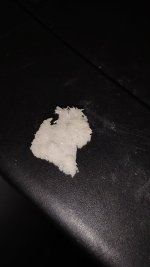
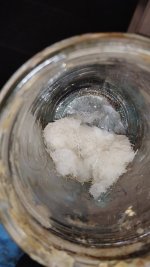
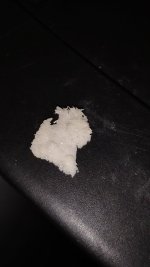
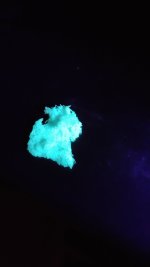
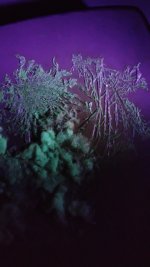
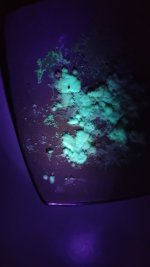
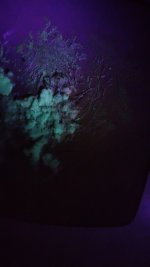
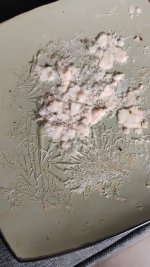
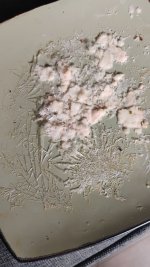
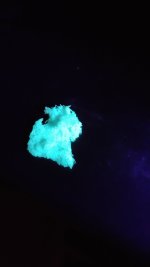
10. Filter the salts quickly through a filter and add everclear or 95% ethanol, absolute ethanol what also work in this case but I have plenty of vodka as well. Once the ethanol sits into the solution you can use a black light to watch all of the fluorescence fall out of solution and toss the beaker into the freezer for three to eight hours until crystals have formed, you should end up with pure clear needle like crystals of harmala acetate salts.
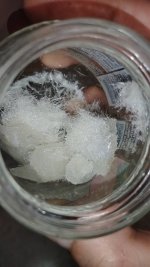
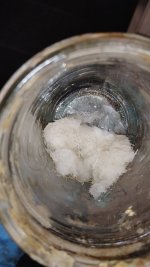






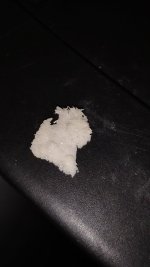
1000001428.jpg1000001427.jpg
 
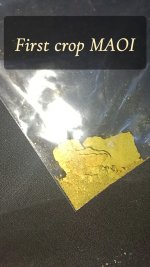
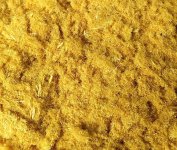
Very nice results! I'm very surprised that the needles are white, I thought harmala salts were yellow. I wonder if it's related to minor impurities when it's yellow. Maybe someone else can shed some light on that.

Have you tried skipping the grinding of the seeds altogether? Most people have found that with enough boiling or by using a pressure cooker, they get similar results as with grinding but are able to skip the filtering.

Also, a side note:
I would not consider safe
Crude extracts from Syrian rue are perfectly safe, and the seeds themselves are safe as well. The idea that the other alkaloids it contains are toxic is a misconception that seems to come from the fact that vasicine and vasicinone are uterotonic. That could be a problem for pregnant women, but that's it, and in fact they have some generally health promoting effects. So the purification is not a matter of safety, just of isolating the MAOI alkaloids.
 
By toxic I meant the weaker maoi Vasicine: which falls under: Uterine stimulants, also known as uterotonics, are medications that cause or increase the frequency and intensity of uterine contractions. These drugs are used to induce or augment labor, facilitate uterine contractions following a miscarriage, induce abortion, or reduce hemorrhage following childbirth or abortion.
Not really toxic, should've specified, but probably don't want to take if you're just looking for MAOI, probably doesn't do much to men.. But realistically no pregnant person wants to take maois anyway.

But I have not tried skipping the grinding step, but am in the midst of a process ATM using a tiny bit of soaked up water into the seeds and freezing/thawing (microwave) repeatedly. So far promising results! (The water and ice are super florescent) I'm trying to fracture cell walls with ice crystals repeatedly expectedly allowing full penetration to pull all alkaloids easily. Just some side stuff.

The yellow is definitely impurities, this is the cleanest harmalas I've ever seen.. and I tossed some crystals onto some Reggie buds and man, that hit like some top shelf. 😎 🌿
 
10. Filter the salts quickly through a filter and add everclear or 95% ethanol, absolute ethanol what also work in this case but I have plenty of vodka as well. Once the ethanol sits into the solution you can use a black light to watch all of the fluorescence fall out of solution and toss the beaker into the freezer for three to eight hours until crystals have formed, you should end up with pure clear needle like crystals of harmala acetate salts
Quick question, do you mean "filter the solution"? And what exactly is "once the ethanol sits into the solution"? Is that a typo for "mixes" or something?

Interesting and useful to know that harmala acetates have such poor solubility in ethanol. Those final crystal pics are lovely and look rather like mescaline sulfate!
 
The filtration before adding alcohol is to reduce any impurity that may have precipitated if you evaporated it down, completely optional if you have clean enough extract. The ethanol mixes with the water and you can watch the harmalas fall from the top to bottom. I meant sits into because the solution is homogeneous once combined but I see I could've phrased a bit better. I know it blew me away noticing the acetate salts were insoluble even in warm solution, the freezer really got the beautiful crystallization though.

Some UV on a bit of crystalline rock:
 

Attachments

  • Snapchat-1372212380.jpg
    Snapchat-1372212380.jpg
    66.1 KB · Views: 6
  • Snapchat-494364150.jpg
    Snapchat-494364150.jpg
    134.2 KB · Views: 6
Interesting, I tried forced precipititation of harmalas tartrate from water solution with isopropanol (it partially worked, but results were not very convincing) but your method seems to be much better. (y)
 
The ethanol mixes with the water and you can watch the harmalas fall from the top to bottom. I meant sits into because the solution is homogeneous once combined
Ah, so the ethanol floats atop the aqueous solution and diffuses into it, without any stirring? Or the pouring mixes it in as it goes? And how quick is this process?

It's rather neat that you've developed this differential solubility process and good that you've been able to outline it in everday language. It also has several advantages over, say, recrystallising from DMSO :LOL:

There's a couple of bits to the alcohol process that would be good to nail down more precisely, to aid with replication:
  • Whats's the minimum proportion of alcohol (as a volume to volume ratio) that gets this process working?
  • Have you compared stirring it in with just floating it on top, and various degrees of agitation between these two extremes?
  • Have you established whether there's any selectivity for harmine versus harmaline in this process?
  • And finally, do the crystals maintain their aesthetic purity on drying?

Based on the information here, seems like purifying until getting white harmalas is mostly for aesthetic purposes, right? As whatever is coloring harmalas after some decanting is almost undetectable, if I understand correctly: Harmala extraction - unneccessary steps?
To this I'd say - if it's this easy, why not?
 
What do you mean? That doesn't necessarily imply that harmala salts aren't yellow, as it could be possible that they are and at the same time the plant has yellow dyes (not saying that that's the case).
Boiling already-boiled seeds creates yellow water, not red water.

I don't know why this matters to anyone, pull EVERYTHING, and clean it up with this tec and it won't have ANY color in the end. There's harmaloids and tannins in the plant extracts for some time so all extractions done regardless of water color likely contains harmalas. Blacklight proves the florescence of red/yellow water. And if you rinse the fb with plenty of distilled water and the HCL with plenty of brine, it should take most of the color, with the ethanol step it makes it pure ASF.
And the harmalas salts are not yellow, most things aren't yellow and are just dirty, this tec proves outdated techniques leave yellow impurities. I've done plenty of online techs to have first hand experience in purity and yellow extracts, this is a step up. 1000000069.jpg1000000023.jpg1000000955.jpg1000000027.jpg
 
Ah, so the ethanol floats atop the aqueous solution and diffuses into it, without any stirring? Or the pouring mixes it in as it goes? And how quick is this process?

It's rather neat that you've developed this differential solubility process and good that you've been able to outline it in everday language. It also has several advantages over, say, recrystallising from DMSO :LOL:

There's a couple of bits to the alcohol process that would be good to nail down more precisely, to aid with replication:
  • Whats's the minimum proportion of alcohol (as a volume to volume ratio) that gets this process working?
  • Have you compared stirring it in with just floating it on top, and various degrees of agitation between these two extremes?
  • Have you established whether there's any selectivity for harmine versus harmaline in this process?
  • And finally, do the crystals maintain their aesthetic purity on drying?


To this I'd say - if it's this easy, why not?


I've noticed a 1/4 alcohol/water ratio gives larger more defined needle crystals, and more, 50/50 gives more hair like needles. It is not selective for either, both go in, both can visibility be seen falling out of solution entirely using UV light.
I have attempted slowly pouring, adding to hot solutions, and allowing to settle at room temp, crystals from better allowing hot solutions to cool before freezing likely to decreased solubility allowing slow formation. Once frozen and decanted away, the alcohol shows no florescence and evaporates to a tiny bit of brown residue/or nothing (in 1 case).
The crystals maintain structure and color, dry to a white solid and don't absorb ambient water in the air. If using a vacuum filtration setup to dry fully you'd definitely get better structures, but tis solid rock not resin.1000000955.jpg1000000953.jpg
 
I've noticed a 1/4 alcohol/water ratio gives larger more defined needle crystals, and more, 50/50 gives more hair like needles. It is not selective for either, both go in, both can visibility be seen falling out of solution entirely using UV light.
I have attempted slowly pouring, adding to hot solutions, and allowing to settle at room temp, crystals from better allowing hot solutions to cool before freezing likely to decreased solubility allowing slow formation. Once frozen and decanted away, the alcohol shows no florescence and evaporates to a tiny bit of brown residue/or nothing (in 1 case).
The crystals maintain structure and color, dry to a white solid and don't absorb ambient water in the air. If using a vacuum filtration setup to dry fully you'd definitely get better structures, but tis solid rock not resin.

And water will always mix with ethanol. Ethanal and water are both POLAR SOLVENTS, they are homogeneous in a solution.
 
I decided to give this a try and started with 6 grams of orange HCl harmalas. I dissolved them in water, filtered the solution, then added ammonia to precipitate the freebase. After allowing it to crash out, I filtered and washed the slightly tan freebase a few times with water.

Next, I transferred the freebase into a clean jar and added a small amount of acetic acid with some water to bring the total volume up to 100 ml. The freebase dissolved immediately into a bright orange solution. I then added 75 ml of 96% ethanol and placed the jar in the freezer.

I’ll update tomorrow with the results.
 
Could the color difference be attributed to having harmala acetate rather than harmala hcl? Although in solution before adding salt "dirty" harmala acetate is yellow.

What about like different crystalline structure due to different crystalisation process/conditions.

I also always found it weird that both harmine and harmaline seem to crystalize in exactly the same way with manske (we only see 1 structure with manske on combined harmala alks). So maybe yellow manske crystals are like a composite crystalline structure of both? Has anybody tried manske on seperated harmala alks?

And i'm curious about the solution color in step 9 after redisolving with acetic acid, is it the typical yellow? Does the washing in step 7 help reduce the yellow coloration? It may be an important step to replicate the results

I just find it hard to believe that the bright consistent yellow color is due to impurities, especially after obtaining white crystalline freebase on some occasions. And does analysis show any significant unknown stuff in extracted haramala alks?

Btw I don't have any real chemistry knowledge/expertise so these are just amateur thoughts and I'd love to hear more about the chemistry even though I won't be able to understand it in detail.

Anyway these are amazing results and I will definitely be trying it. I might as well try it right now, I have some relatively pure harmala freebase and 91% iso on hand.
 
Last edited:
Adding the harmalas to a citric acid solution also causes precipitation of the harmala citrate salts without adding alcohol. Don't know exact concentration needed but 'saturated citric acid' is not required since it becomes a goo/syrup.
Those white acetate needles look amazing.
 
Last edited:
Update: No crystals have formed after 10 hours at -23 °C.

To @StoneyBroski , would you mind sharing the specific weights and volumes you used? That information would be really helpful as I try to troubleshoot what may have gone wrong on my end.

For reference:
  • I used 6 grams of Harmalas HCl as starting material.
  • About 5 milliliters of 96% acetic acid.
  • Added water until the total volume reached 100 milliliters
  • After that, I added 75 milliliters of 96% ethanol.


As a next step, I’m planning to dip a glass rod into the solution, let some of the solvent evaporate to encourage crystallization on the rod, and then place those initial crystals back into the solution to try and seed further crystallization.


Thanks in advance, any details you can provide would be greatly appreciated.
 
Back
Top Bottom