• Members of the previous forum can retrieve their temporary password here, (login and check your PM).
This topic contain a TEK
Update: No crystals have formed after 10 hours at -23 °C.

To @StoneyBroski , would you mind sharing the specific weights and volumes you used? That information would be really helpful as I try to troubleshoot what may have gone wrong on my end.

For reference:
  • I used 6 grams of Harmalas HCl as starting material.
  • About 5 milliliters of 96% acetic acid.
  • Added water until the total volume reached 100 milliliters
  • After that, I added 75 milliliters of 96% ethanol.


As a next step, I’m planning to dip a glass rod into the solution, let some of the solvent evaporate to encourage crystallization on the rod, and then place those initial crystals back into the solution to try and seed further crystallization.


Thanks in advance, any details you can provide would be greatly appreciated.
I would advise starting with freebase material to ensure you dont have any hcl floating around, pretty sure hcl is alcohol soluble, and adding the acid and water into everything is fully dissolved,
Then add in approximately ¼-½ the solution of ethanol I have done personal experimentation noticing that excess ethanol percent in solution leads to thinner more hair like crystals while adding small amounts slowly yields larger more defined crystals.
Also I should note my end mass of crystals is ~10g total.

Acetic acid is a weaker acid (pKa ~4.76) compared to HCl (pKa ~-6.3), so it’s unlikely to displace the chloride ions effectively in a simple aqueous solution. The harmala would likely remain as the HCl salt, as the equilibrium would favor the stronger acid’s conjugate base (Cl⁻) binding to the harmala alkaloid.
harmala HCl salts are more soluble in ethanol than harmala acetate salts. If residual HCl remains in the solution (e.g., from incomplete conversion or excess HCl in the starting material), it could keep some harmala in the HCl salt form, which would stay dissolved in the ethanol, reducing the yield of precipitated acetate crystals.

And a thought, many colorful extracts (yellow) probably have excess nacl and/or tannins. My suggestion would be to base and rinse with distilled water until clean, add acetic to mud after decanting away aqueous from fridge. (If you have enough non iodized salt to salt out and brine rinse the extract a few times that really improves color, ofc you would also have to rebase, rinse excess salts, and acetic the mud again) And then add ethanol, allow to stand a few minutes and toss in the freezer.

I'll do some testing and recrystallization with my pure salts to bend the method and enhance understanding. I'll get back to you soon.
 
I would advise starting with freebase material to ensure you dont have any hcl floating around, pretty sure hcl is alcohol soluble, and adding the acid and water into everything is fully dissolved,
Then add in approximately ¼-½ the solution of ethanol I have done personal experimentation noticing that excess ethanol percent in solution leads to thinner more hair like crystals while adding small amounts slowly yields larger more defined crystals.
Also I should note my end mass of crystals is ~10g total.

Acetic acid is a weaker acid (pKa ~4.76) compared to HCl (pKa ~-6.3), so it’s unlikely to displace the chloride ions effectively in a simple aqueous solution. The harmala would likely remain as the HCl salt, as the equilibrium would favor the stronger acid’s conjugate base (Cl⁻) binding to the harmala alkaloid.
harmala HCl salts are more soluble in ethanol than harmala acetate salts. If residual HCl remains in the solution (e.g., from incomplete conversion or excess HCl in the starting material), it could keep some harmala in the HCl salt form, which would stay dissolved in the ethanol, reducing the yield of precipitated acetate crystals.

And a thought, many colorful extracts (yellow) probably have excess nacl and/or tannins. My suggestion would be to base and rinse with distilled water until clean, add acetic to mud after decanting away aqueous from fridge. (If you have enough non iodized salt to salt out and brine rinse the extract a few times that really improves color, ofc you would also have to rebase, rinse excess salts, and acetic the mud again) And then add ethanol, allow to stand a few minutes and toss in the freezer.

I'll do some testing and recrystallization with my pure salts to bend the method and enhance understanding. I'll get back to you soon.
Ah you missed this post😄
I decided to give this a try and started with 6 grams of orange HCl harmalas. I dissolved them in water, filtered the solution, then added ammonia to precipitate the freebase. After allowing it to crash out, I filtered and washed the slightly tan freebase a few times with water.

Next, I transferred the freebase into a clean jar and added a small amount of acetic acid with some water to bring the total volume up to 100 ml. The freebase dissolved immediately into a bright orange solution. I then added 75 ml of 96% ethanol and placed the jar in the freezer.

I’ll update tomorrow with the results.
Anyway I didn’t start from the HCL form directly. The HCL I used had already gone through several conversions between freebase and HCL, along with multiple washes, and was already very clean. I then converted it once more to freebase and washed it several times until it was a very light beige, almost white. After that, I filtered it dry using a Büchner filter, and used the resulting material as the starting point.

I dissolved the freebase in 100 ml of water with around 10 ml of acetic acid, then added 75 ml of ethanol. I placed the solution in a freezer at -23°C, but no crystallization occurred.

So my question isn’t about the basic process of converting HCL to acetate. I’m familiar with that. What I’d like to understand more clearly are the quantities involved: how much material you dissolve, and in what volumes of liquid, to get crystallization to occur.

Much appreciate your feedback.
 
Ah you missed this post😄

Anyway I didn’t start from the HCL form directly. The HCL I used had already gone through several conversions between freebase and HCL, along with multiple washes, and was already very clean. I then converted it once more to freebase and washed it several times until it was a very light beige, almost white. After that, I filtered it dry using a Büchner filter, and used the resulting material as the starting point.

I dissolved the freebase in 100 ml of water with around 10 ml of acetic acid, then added 75 ml of ethanol. I placed the solution in a freezer at -23°C, but no crystallization occurred.

So my question isn’t about the basic process of converting HCL to acetate. I’m familiar with that. What I’d like to understand more clearly are the quantities involved: how much material you dissolve, and in what volumes of liquid, to get crystallization to occur.

Much appreciate your feedback.
Do you maybe need a little more acetic acid, to drive the crystallisation analogously to the Manske? And 100 mL sounds like there's too much water perhaps?

Yes, I should try this too.
 
Do you maybe need a little more acetic acid, to drive the crystallisation analogously to the Manske? And 100 mL sounds like there's too much water perhaps?

Yes, I should try this too.
Yes, that might actually be an interesting option to try. I used 100 milliliters mainly because that was the smallest volume marked on the Erlenmeyer flask. But of course, I could still add, say, 20 milliliters of concentrated acetic acid and see if that shifts the equilibrium.

I will wait for @StoneyBroski and adjust the volumes accordingly.
 
Last edited:
Ah you missed this post😄

Anyway I didn’t start from the HCL form directly. The HCL I used had already gone through several conversions between freebase and HCL, along with multiple washes, and was already very clean. I then converted it once more to freebase and washed it several times until it was a very light beige, almost white. After that, I filtered it dry using a Büchner filter, and used the resulting material as the starting point.

I dissolved the freebase in 100 ml of water with around 10 ml of acetic acid, then added 75 ml of ethanol. I placed the solution in a freezer at -23°C, but no crystallization occurred.

So my question isn’t about the basic process of converting HCL to acetate. I’m familiar with that. What I’d like to understand more clearly are the quantities involved: how much material you dissolve, and in what volumes of liquid, to get crystallization to occur.

Much appreciate your feedback.
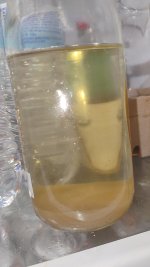
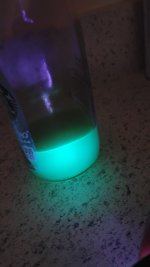
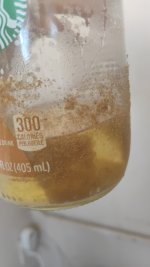
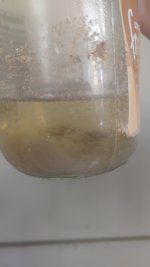
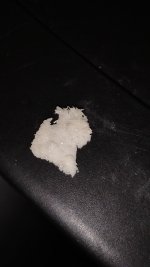
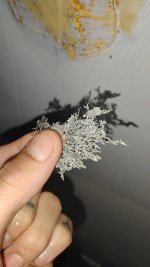
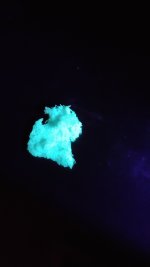
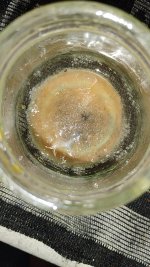
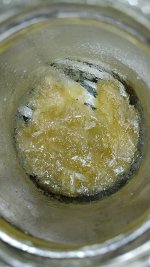
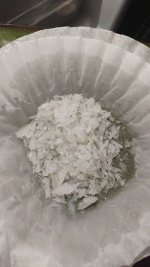
Friend I realize my solution was hot when I added initial ethanol and my reproduced extraction was also hot before ethanol addition. I've attempted with room temp and noticed differing results. And after some tests I realized the acetate salts are not very water soluble at elevated temperatures and my solution may be less than 100ml, depending on how much salt you have predictably you need different amounts of water, personally I have glacial acetic acid and added that to the remaining water I could not pour off from the last fb wash and heat it up, as it heats it slowly precipitates in solution, I add the ethanol while the solution is hot, and magic. After allowing to settle a moment it's moved to the freezer. Check UV and pour off the solution, allow crystals to dry on a filter paper in the freezer, then in open air.

(My last fb rinse)

1000001228.jpg

(After acetic is added, UV)
1000001229.jpg


(After heating the acetate solution *precipitate*)
1000001234.jpg

(Another one (that's literally all of the harmalas acetate precipitated in a hot solution))
1000001238.jpg


I'm doing more tests, I'll keep everyone updated. 😎
 
Last edited:
Yes, that might actually be an interesting option to try. I used 100 milliliters mainly because that was the smallest volume marked on the Erlenmeyer flask. But of course, I could still add, say, 20 milliliters of concentrated acetic acid and see if that shifts the equilibrium.

I will wait for @StoneyBroski and adjust the volumes accordingly.
Try as little solution possible, if you can dissolve all of your salts into 10-50ml do that, less salt less water, shoot for just adding acid to the last fb wash, HEAT IT UP (it only works heated, I've attempted many fill ins without heat, heat is needed, it seemingly precipitates before alcohol is added and crystalizes after.
 
Okay, so if I understand correctly, you take the Freebase and put it in a container. Then you add glacial acetic acid to the Freebase.

So let’s assume we’re starting with 1 gram of Freebase. Then how many milliliters of water, how many milliliters of concentrated acetic acid, and how many milliliters of ethanol would you add?
 
Ah, so the ethanol floats atop the aqueous solution and diffuses into it, without any stirring? Or the pouring mixes it in as it goes? And how quick is this process?

It's rather neat that you've developed this differential solubility process and good that you've been able to outline it in everday language. It also has several advantages over, say, recrystallising from DMSO :LOL:

There's a couple of bits to the alcohol process that would be good to nail down more precisely, to aid with replication:
  • Whats's the minimum proportion of alcohol (as a volume to volume ratio) that gets this process working?
  • Have you compared stirring it in with just floating it on top, and various degrees of agitation between these two extremes?
  • Have you established whether there's any selectivity for harmine versus harmaline in this process?
  • And finally, do the crystals maintain their aesthetic purity on drying?


To this I'd say - if it's this easy, why not?


1. I'm doing tests to find out the best ratio of ethanol, best large crystal formation right now, I'll get back to you.

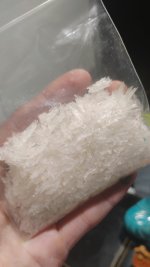
2. I actually stirred when I added ethanol initially with my first processes and didn't with my second (images above, thin hair crystals from microwaving and pouring in ethanol, tossing directly into freezer, larger from reducing volume on a sand bath, adding ethanol, allowing to stand, (I was mesmerized so I stared for a good minute before) move it to freezer.

3. I'd suggest there is no selectivity, all florescence fell out entirely.

4.
fb7acddd-3f92-4781-800a-8e99f2c91202-1_all_943.jpg1000001065.jpg
fb7acddd-3f92-4781-800a-8e99f2c91202-1_all_942.jpg

Depending on how they are dried, yes.
 
1. I'm doing tests to find out the best ratio of ethanol, best large crystal formation right now, I'll get back to you.

2. I actually stirred when I added ethanol initially with my first processes and didn't with my second (images above, thin hair crystals from microwaving and pouring in ethanol, tossing directly into freezer, larger from reducing volume on a sand bath, adding ethanol, allowing to stand, (I was mesmerized so I stared for a good minute before) move it to freezer.

3. I'd suggest there is no selectivity, all florescence fell out entirely.

4.
View attachment 103998View attachment 103999
View attachment 104000

Depending on how they are dried, yes.
That’s fantastic. I’m really looking forward to it. I think having an approximate ratio is especially helpful. I’ll try the same experiment and see if I can achieve the same result. In any case, the photo looks amazing.
 
Update: No crystals have formed after 10 hours at -23 °C.

To @StoneyBroski , would you mind sharing the specific weights and volumes you used? That information would be really helpful as I try to troubleshoot what may have gone wrong on my end.

For reference:
  • I used 6 grams of Harmalas HCl as starting material.
  • About 5 milliliters of 96% acetic acid.
  • Added water until the total volume reached 100 milliliters
  • After that, I added 75 milliliters of 96% ethanol.


As a next step, I’m planning to dip a glass rod into the solution, let some of the solvent evaporate to encourage crystallization on the rod, and then place those initial crystals back into the solution to try and seed further crystallization.


Thanks in advance, any details you can provide would be greatly appreciated.
Friend, 6 grams to 100ml seems a bit excessive, I should've specified a bit better, different weights require different amounts of solvent. Try MINIMAL while still fully dissolved. And it MUST BE HEATED before ethanol addition. The trick is high concentration, anti solvent, freeze precipitate.
I did this as a test without heating it didn't do anything, it is essential!
(You can recover your harmalas by evaporation of the ethanol slowly, basifying and allowing to cool in the fridge, rinse 3-5x with water, pour off most of the water (as much as possible without pouring out fb) and add acid in (if using vinegar you're gonna want to reduce volume a bit before ethanol addition), heat up gently and allow to evap a bit, (if acetate salts precipitate while heating it's fine, weirdly they do that) once volume is reduced to 10-50ml add in ethanol, allow to sit, and put into freezer 3-6hrs, pour away liquid AFTER UV TEST, dry crystals on a coffee filter.
 
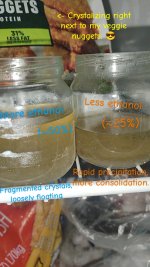
Okay so I've been pretty busy, and unfortunately i ran out of non iodized nacl mid washes, and clearly the washes helped a lot, the crystals came through but the color is a little off.

More ethanol (50%)
1000001324.jpg

(25%)
1000001323.jpg


The crystals are still wet rn so maybe the color will change once dry, I'll try some different crystalization solvents and see what we get. And ipa sounds interesting... Maybe ill scoop some extra alcohols when I get my nacl and run some extra processes on my mass amounts of rue extracts (literally have so many collection containers mid process or recovered)
 
Being afraid of using iodized salt is basically OCD. I would imagine even pink Himalayan salt would work well.
Haha, okay, you enjoy that those iodines, iodates and anti-caking agents in your final product, honestly its your call, mine however is different.

And pink Himalayan salt is primarily composed of sodium chloride, with up to 98 percent of its content being sodium chloride. The remaining 2 percent consists of trace minerals such as potassium, magnesium, copper, calcium, and iron which give the salt its distinctive pink color. More and more impurities, for some "okay" is okay, for me godliness is a start. I will not thanks for the suggestion though.
 
What about all the impurities in the rue seeds, themselves? What exactly is wrong with iodine? Something that you're ingesting anyway (from food). Something that is considered to be a much needed nutrient. And if you're going to bring up the idea of burning it, what about the car exhaust you breathe in when you're next to the road; what about the chlorine you inhale in the shower? Concern about inhaling an anticaking agent, I can understand, but it's not like anticaking agents are specifically coupled with iodine. ChatGPT says it's usually added to refined salt.* Are you sure your salt doesn't have one?

Don’t I get enough iodine in iodized salt?

The notion that refined iodized salt is sufficient is the most dangerous misconception about iodine. From the time iodized salt leaves the factory until it gets on grocery store shelves, half of the original iodide content is lost. Because once iodized salt is opened in your home, the iodine “sublimes” or escapes into the air in varying degrees, depending on humidity.


The Iodine Crisis. Lynne Farrow. 2013. 5. Why Does Your Body Need Iodine? page 85


*At a fraction of a percent, so, maybe it's not a concern…
For someone who does extractions that may be okay but for someone who does real chemistry you don't really want any side products man. Especially if my goal is pharmaceutical grade and not just "look ma I did it!"
 
It's the same rationale as using distilled water instead of tap water. You don't wilfully add impurities to a chemical process without a specific reason for it - and even then, those 'impurities' are more likely to be highly specific ones, like a catalyst or, in the case of semiconductor manufacture, dopants.
 
@bk2492 using salt with impurities in this case would defeat the whole point, no? Given that whatever causes the yellow color is basically undetectable. So it wouldn't make much sense to add other (definitely detectable) impurities in the process of getting rid of it.

More in general, I think it's important to understand that not everyone wants the same out of an extraction procedure, a given ROA, or whatever. Just eating the seeds will work, and yet many of us extract them, right?
 
Back
Top Bottom