A short update:
I have completed the first part of the "theory test." The powdered mix was placed in a funnel lined with coffee filters, ( :thumb_dow :?: I know, I know.... I forgot to order the 11 cm filter paper; I only have the 5 cm quantitative filter paper) with a 5 cm quantitative filter paper between some of the coffee filter to prevent the vacuum from pulling the coffee filters apart.
I measured 100 mL of room-temp acetone, and began to "wash" the powder by slowly pouring the acetone through the mix. At first, there was no need to use the vacuum. The solution freely flowed through the mix, while I used a scoopula to gently stir the powder. After the first 100 mL, I was concerned. There was very little discoloration to the acetone. I am generally used to seeing hints of "greenish-yellow" when I use acetone to pull directly from the plant material. So, I used another 100 mL of acetone, and washed the product once more. Again, very little discoloration. Beginning to question the effectiveness of this method, I flushed one final 100 mL through the powder. This time I utilized the vacuum so that I could remove as much of the acetone from the filters/powder mix.
After I had removed the majority of acetone from the mixture (85% or so) I placed the powder mix back in a jar to soak in acetone over night. (results from this part will come later...)
I reduced the ~300 mL of acetone to about 50 mL, and noticed some slight particulate matter. I assumed it was powdered magnesium sulfate that had managed to slip through the coffee filters, so I used a qualitative filter and vacuum to remove the particulate material. At this point, I felt that even 60 mL (after rinsing the filter paper) was a larger volume than I wanted to work with, so I decided to reduce it down further. As I was transferring the beaker to the hot plate, I managed to spill ~20 mL. I was irritated, but proceeded to carry on. So, now we're at 2/3 the amount that would have been potentially extracted from the three washes.
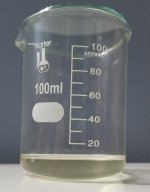
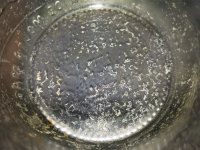
I reduced the 40 mL of acetone down to about 10-15 mL, and noticed that there was that "discoloration" that I was "used to seeing." [SEE 1st IMAGE BELOW] Satisfied, I decided to proceed with the titration. Upon initial titration, I did not notice any precipitation. Disappointed, I covered it with a watch glass, parafilm, and placed it in the freezer to see if any precipitation would occur. My hopes of this procedure were diminishing.
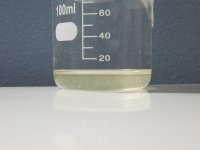
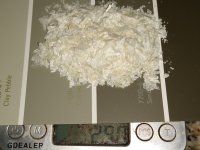
This morning/noon, I decided to check on the experiment. To my surprise, I saw that there was a collection of white precipitation that was suspended and attached to the sides of the beaker! [SEE 2nd IMAGE BELOW]
SO. I am going to allow another 24 hours of precipitation, and then I will filter and analyze to see if it is indeed mescaline sulfate, or just some unexpected side product.
Take Care!
ACY
I have completed the first part of the "theory test." The powdered mix was placed in a funnel lined with coffee filters, ( :thumb_dow :?: I know, I know.... I forgot to order the 11 cm filter paper; I only have the 5 cm quantitative filter paper) with a 5 cm quantitative filter paper between some of the coffee filter to prevent the vacuum from pulling the coffee filters apart.
I measured 100 mL of room-temp acetone, and began to "wash" the powder by slowly pouring the acetone through the mix. At first, there was no need to use the vacuum. The solution freely flowed through the mix, while I used a scoopula to gently stir the powder. After the first 100 mL, I was concerned. There was very little discoloration to the acetone. I am generally used to seeing hints of "greenish-yellow" when I use acetone to pull directly from the plant material. So, I used another 100 mL of acetone, and washed the product once more. Again, very little discoloration. Beginning to question the effectiveness of this method, I flushed one final 100 mL through the powder. This time I utilized the vacuum so that I could remove as much of the acetone from the filters/powder mix.
After I had removed the majority of acetone from the mixture (85% or so) I placed the powder mix back in a jar to soak in acetone over night. (results from this part will come later...)
I reduced the ~300 mL of acetone to about 50 mL, and noticed some slight particulate matter. I assumed it was powdered magnesium sulfate that had managed to slip through the coffee filters, so I used a qualitative filter and vacuum to remove the particulate material. At this point, I felt that even 60 mL (after rinsing the filter paper) was a larger volume than I wanted to work with, so I decided to reduce it down further. As I was transferring the beaker to the hot plate, I managed to spill ~20 mL. I was irritated, but proceeded to carry on. So, now we're at 2/3 the amount that would have been potentially extracted from the three washes.
I reduced the 40 mL of acetone down to about 10-15 mL, and noticed that there was that "discoloration" that I was "used to seeing." [SEE 1st IMAGE BELOW] Satisfied, I decided to proceed with the titration. Upon initial titration, I did not notice any precipitation. Disappointed, I covered it with a watch glass, parafilm, and placed it in the freezer to see if any precipitation would occur. My hopes of this procedure were diminishing.
This morning/noon, I decided to check on the experiment. To my surprise, I saw that there was a collection of white precipitation that was suspended and attached to the sides of the beaker! [SEE 2nd IMAGE BELOW]
SO. I am going to allow another 24 hours of precipitation, and then I will filter and analyze to see if it is indeed mescaline sulfate, or just some unexpected side product.
Take Care!
ACY