DetritusTheEgo
Titanium Teammate
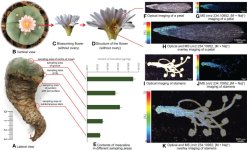
I found a publication that had the best picture I've seen of the distribution of mescaline in both a T. pachanoi as well as a L. williamsii. Notably I've not seen or heard about testing that shows that L. williamsii flowers contain mescaline let alone the topographic distribution showing which parts of the flowers are most concentrated. I found it quite interesting and hope others may as well.
I was not able to locate the article posted here on the Nexus so please let me know if this is a double post.
Natural or artificial: An example of topographic spatial distribution analysis of mescaline in cactus plants by matrix-assisted laser desorption/ionization mass spectrometry imaging is the publication.
Linking the two figure images direclty here but the publication has a larger image broken down into segments that allows for zooming in.
Figure 1 of the T. pachanoi:
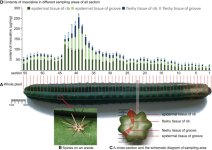
Figure 2 of the L. williamsii:
I was not able to locate the article posted here on the Nexus so please let me know if this is a double post.
Natural or artificial: An example of topographic spatial distribution analysis of mescaline in cactus plants by matrix-assisted laser desorption/ionization mass spectrometry imaging is the publication.
Linking the two figure images direclty here but the publication has a larger image broken down into segments that allows for zooming in.
Figure 1 of the T. pachanoi:
Figure 2 of the L. williamsii: