• Members of the previous forum can retrieve their temporary password here, (login and check your PM).

trying to extract harmalas from syrian rue.. TRYING

Migrated topic.

neb

Rising Star
Joined
Apr 8, 2017
Messages
77
Merits
42
So.. I have spent the last 3 days filtering and watching and playing with some syrian rue..

I have gotten to the point of performing the manske.

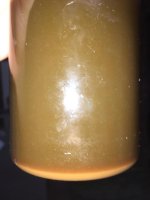
here is a pic of what has happened after dissolving the salt into the solution. (i added more salt and cooled after taking this pic with similar results..)

no nice needle-like xtals. :cry:

is this okay? is it alks?

Please help!

I'm not sure what to do..
 

Attachments

  • 44e9c357-95a0-4eb3-9198-90215241ccac.jpg
    44e9c357-95a0-4eb3-9198-90215241ccac.jpg
    48.6 KB · Views: 2
The crystals are not always long needles.
Assuming the solids in your pic formed after the salt fully dissolved, those are your product.
The length of crystals is effected by many factors. Slower cooling, lower alkaloid content, and salt concentration closer to 10 grams per 100 ml all lead to longer crystals. Rich alkaloid concentration, purer alkaloid, faster cooling, salt closer to 20 grams per 100 ml [or even above that, which is not generally advised] all make shorter crystals.
I've got crops of crystals ranging from 4 cm long needles to microcrystalline powder that looked like yellow baking soda as a result of these variables.
 
The crystals even if very small they should sparkle when you shine a light on the solution.. if there is no tiny sparkly particles floating in the solution then your crystals didn't crash out.. also that's how i know my filtration was good when collecting the crystals, when there is no particles sparkling in the solution.

The layer at the bottom does not seem like harmalas crystals to me, can you give more detail about your procedure.
 
ignore my woes, i know what i did wrong, and have subsequently fixed it! now i have some dank little xtals forming :)
 
But just a note for some people attempting this and stumbling upon this post..

don't add too much lye.. or even lye at all, it is such a strong base and totally not neccisary.

using sodium carbonate is the way to go!
 
neb said:
But just a note for some people attempting this and stumbling upon this post..

don't add too much lye.. or even lye at all, it is such a strong base and totally not neccisary.

using sodium carbonate is the way to go!

I agree, i've always used washing soda, usually made from baking soda in the oven, works like a charm.
 
If you have a pH meter or at least an intuition of how much lye is needed, lye works well. You only need a tiny bit of it compared to the amount of sodium carbonate needed. I like to save my sodium carbonate for when food-grade purity is needed. In the case of the first basic it's not, because vinegar converts lye to the rather harmless sodium acetate, and the subsequent Manske removes most of it anyway. (But these days I don't even use sodium carbonate, I use ammonia instead).

I let my lye-based soup settle, decant off the strongly basic supernatant and dissolve my freebase in vinegar for Manske, and it works like a charm.

My guess is you added too much lye, which resulted in excessive sodium acetate after dissolving in vinegar, which somehow got in the way of Manske crystals forming.
 
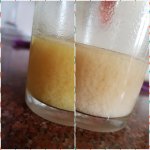
even without a PH meter you can rely on color change to know when to stop adding lye..
the two pictures are only one drop of lye away

it's not as obvious when working with dirty tea but there is a yellow tinge that goes away when you reach the right PH..

sodium carbonate works great though, and you don't need much unless you used a lot of vinegar. if you first do a manske on the acidic rue tea, collect the crystals, then dissolve in hot water(no vinegar), you'd only need few mls of a saturated sodium carbonate solution to properly base it, but with sodium carbonate the yellow tinge doesn't go away immediately, an insignificant amount of the harmalas stays in salt form dissolved in solution giving it a slight yellow coloration, after few hours waiting for the freebase to settle the yellow tinge will go away.

another way to know.. if the solution still has harmalas salt and you let a drop of base run on the side of the jar, you can watch it transforming those salts into freebase as it enters the solution, if there is no harmalas salt left you will see that drop entering the solution leaving a colorless trail that dissipates in few seconds..

once you reach that stage(no yellow tinge with lye, or no visible freebasing with sodium carbonate) add a few more drops.. then do a water wash or 2 and you are good
 

Attachments

  • 20180208_145502.jpg
    20180208_145502.jpg
    69.1 KB · Views: 2
Back
Top Bottom