
-
Members of the previous forum can retrieve their temporary password here, (login and check your PM).
You are using an out of date browser. It may not display this or other websites correctly.
You should upgrade or use an alternative browser.
You should upgrade or use an alternative browser.
Trying to improve Acacia information
- Thread starter nen888
- Start date
Migrated topic.


..hi all,
firstly Spice Sailor, you wrote:
really i think there are 2 or 3 sub-species of maidenii, and at least 2, probably 3, of obtusifolia..
..at the original obtusifolia/maidenii site (a different location) there is a lot of intermediacy between species..the hybrids flower around april OR september (occasionally both)..true obtusifolia in december..the reason that obtusifolia was mis-ID'd as maidenii is because this form of obtusifolia (coastal) the phyllodes are slightly falcate and usually pointed at the tip..it's only really the slightly thicker phyllodes of ob, pod shape, flowering time, and paler flowers of obtusifolia which set them apart..
i guess, quite independently of our scientific attempts to classify these species, they arrange themselves into medicine 'types'..and are obviously all very closely related..
..this 'active' maidenii may have obtusifolia genes, i don't think the northern active one does..
..and Seldom, very interesting work with the mearnsii..! what pH was it at before adding napatha? (if you know) & maybe you could post a pick to be sure it's mearnsii..dead bark of other species usually has no alkaloids after a couple of months from death..
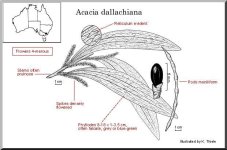
..below, A. dallachiana (1 positive tryptamine report, hybridizes with A. phlebophylla) N. Vic, Aus.,
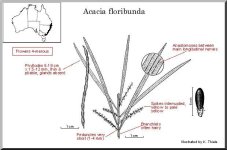
and A. floribunda (to aid with identification, as it is usually avery reliable DMT source, c.0.5% twigs and phyllodes) found Vic.,NSW, S.E. Qld. Australia..known to be grown in France..
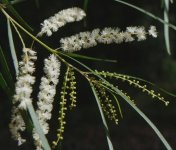
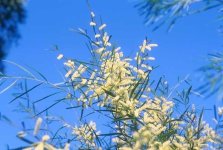
after the drawing are pale flower and yellow flower forms of floribunda..
firstly Spice Sailor, you wrote:
..without being any more specific, the CSIRO high % A. maidenii was collected within 100km of the NSW/Qld. border..in it's natural range, no obtusifolia around, only melanoxylon..Wow nen meeting and speaking to the csiro person is amazing. Do you know if the area in question was populated with obtusifolia or within its natural distribution? In conjunction with that question do you think the particular tree sampled was "straight" maidenii or was a possible hybrid? Also in the post about obtusifolia's accidental discovery did you mean that hybrids of the two ( maidenii - obtusifolia) flower in both April and September or ?
really i think there are 2 or 3 sub-species of maidenii, and at least 2, probably 3, of obtusifolia..
..at the original obtusifolia/maidenii site (a different location) there is a lot of intermediacy between species..the hybrids flower around april OR september (occasionally both)..true obtusifolia in december..the reason that obtusifolia was mis-ID'd as maidenii is because this form of obtusifolia (coastal) the phyllodes are slightly falcate and usually pointed at the tip..it's only really the slightly thicker phyllodes of ob, pod shape, flowering time, and paler flowers of obtusifolia which set them apart..
i guess, quite independently of our scientific attempts to classify these species, they arrange themselves into medicine 'types'..and are obviously all very closely related..
..this 'active' maidenii may have obtusifolia genes, i don't think the northern active one does..
..and Seldom, very interesting work with the mearnsii..! what pH was it at before adding napatha? (if you know) & maybe you could post a pick to be sure it's mearnsii..dead bark of other species usually has no alkaloids after a couple of months from death..
..below, A. dallachiana (1 positive tryptamine report, hybridizes with A. phlebophylla) N. Vic, Aus.,
and A. floribunda (to aid with identification, as it is usually avery reliable DMT source, c.0.5% twigs and phyllodes) found Vic.,NSW, S.E. Qld. Australia..known to be grown in France..
after the drawing are pale flower and yellow flower forms of floribunda..
Attachments
from bits and pieces off you and wira and reading up i think what distinguishes it is the random glands and thin but kind of touching ~.4mm leaves, all pretty much the same length, but it may be wrong
ph was between 11-12, cooled to being just warm, was good to have smaller volume, the mimosa devotees have it easy :d
ph was between 11-12, cooled to being just warm, was good to have smaller volume, the mimosa devotees have it easy :d
^..but they miss the joy of meeting so many nice acacias..
..just a word on the Australian Tryptamine and Psychoactive Acacias list on p.5, i will be tightening and updating it in the near future..to tighten - because i have had no further confirmation of Acacia colei, i will for now relegate it to the In Research list..but i will be adding one more species confirmed by 'JJ'..several promising species in research..i have heard more than one reference to the 'unpublished research indicating the presence of DMT in 150 Australian species', as mentioned by the Society for Growing Australian Plants Acacia Study Newsletter (see p.17)
.
..just a word on the Australian Tryptamine and Psychoactive Acacias list on p.5, i will be tightening and updating it in the near future..to tighten - because i have had no further confirmation of Acacia colei, i will for now relegate it to the In Research list..but i will be adding one more species confirmed by 'JJ'..several promising species in research..i have heard more than one reference to the 'unpublished research indicating the presence of DMT in 150 Australian species', as mentioned by the Society for Growing Australian Plants Acacia Study Newsletter (see p.17)
.

Spice Sailor
Rising Star
Just got around to bio-assessing an extract of Acacia floribunda. Definitely contains DMT. Approx 50 mg of brown/orange oil was vaporised with effects lasting 15 mins. A/B extraction ( outlined in this thread - check the index) with Shellite, evaporated. I will perform a re-x to hopefully get a solid product.
Yield from 500 g of phylodes approx 1 - 1.5 g
.02 - .03 %
The tree was covered in flower spikes but the individual flowers were unopened. I feel that the precence of flower spikes would have attributed to the lower yield.
Yield from 500 g of phylodes approx 1 - 1.5 g
.02 - .03 %
The tree was covered in flower spikes but the individual flowers were unopened. I feel that the precence of flower spikes would have attributed to the lower yield.
..hey thanks for the report Spice Sailor,
..to be more precise on floribunda data i have so far, the phyllodes come in around 0.3-4% usually, the twigs a point or two higher, the total twig/phyllode averaging 0.4-0.5% (usually) , but as you said the flowering can affect the yield..
still, percentages of 0.2-0.3 in leaves should not be seen as disappointing - this is where Chacruna (P. viridis) is at..
ps. here's a thread, from elsewhere, on DMT content/use of A. floribunda..
Acacia Floribunda..
..to be more precise on floribunda data i have so far, the phyllodes come in around 0.3-4% usually, the twigs a point or two higher, the total twig/phyllode averaging 0.4-0.5% (usually) , but as you said the flowering can affect the yield..
still, percentages of 0.2-0.3 in leaves should not be seen as disappointing - this is where Chacruna (P. viridis) is at..
ps. here's a thread, from elsewhere, on DMT content/use of A. floribunda..
Acacia Floribunda..
would be interesting to test frozen/dried phyllode which has been alkalized and mixed in a quid with sublingual harmalas, but you'd really have to know what it is and what was in there..is there a place nen that you can send samples for analysis maybe the csiro? how easy is it to get the alkaloid screening info they already have?
there's studies on preferability of various phyllodes for cattle fodder online, but obv. gob full of cyanogenic glycosides would be no good..i know young phyllodes of cirtain of the black wattle family are fairly nutritious, 15%+ proteins, probably little alkaloids but there may be others that are ok to quid ?
in theory with good material i think it would work
there's studies on preferability of various phyllodes for cattle fodder online, but obv. gob full of cyanogenic glycosides would be no good..i know young phyllodes of cirtain of the black wattle family are fairly nutritious, 15%+ proteins, probably little alkaloids but there may be others that are ok to quid ?
in theory with good material i think it would work

looks promising due to the acuminate ends of the phyllodes and the way they start further up the trunk
but don't take my word.. i'd wait for nen's diagnosis
would be good to test it regardless
but don't take my word.. i'd wait for nen's diagnosis
would be good to test it regardless

We 'could' buy a machine like they have !Seldom said:would be interesting to test frozen/dried phyllode which has been alkalized and mixed in a quid with sublingual harmalas, but you'd really have to know what it is and what was in there..is there a place nen that you can send samples for analysis maybe the csiro? how easy is it to get the alkaloid screening info they already have?
there's studies on preferability of various phyllodes for cattle fodder online, but obv. gob full of cyanogenic glycosides would be no good..i know young phyllodes of cirtain of the black wattle family are fairly nutritious, 15%+ proteins, probably little alkaloids but there may be others that are ok to quid ?
in theory with good material i think it would work
On it....bricklaya said:looks promising due to the acuminate ends of the phyllodes and the way they start further up the trunk
but don't take my word.. i'd wait for nen's diagnosis
would be good to test it regardless
I'm really dying to find a real Floribunda at the moment. there's so many trees around which look just like them but now I'm not sure. I found one yesterday ... phyllodes about 17.5cm long... maximum width (middle of phyllode) 0.5cm. No basal gland. Slightly hairy. There is a barely visible vein that goes down the middle which is just distinguishable by a slight ridge starting at the bottom of the phyllode, though it is hidden when held up to light and looks the same as all the other veins.... some of the leaves its pretty much impossible to spot
flower rods 3.5cm long
pendulous weeping branches
I've seen this in flower the pervious year and it has the same white rod flowers which absolutely cover the tree
here's a few crappy pics I took of my laptop.. sorry about the quality.. the reason they are shiny by the way is because it just starting to rain.. they aren't usually glossy like that... ..hopefully it can give a rough idea:


if it isn't flori what do you think it could be Nen? I was thinking maybe a variety of maidenii... though there's no basal gland and when its in flower it looks more like the Floribunda, where the flowers look more prominent than the leaves. When I have access to a good camera again I'll take close ups of the phyllodes for you.
flower rods 3.5cm long
pendulous weeping branches
I've seen this in flower the pervious year and it has the same white rod flowers which absolutely cover the tree
here's a few crappy pics I took of my laptop.. sorry about the quality.. the reason they are shiny by the way is because it just starting to rain.. they aren't usually glossy like that... ..hopefully it can give a rough idea:
if it isn't flori what do you think it could be Nen? I was thinking maybe a variety of maidenii... though there's no basal gland and when its in flower it looks more like the Floribunda, where the flowers look more prominent than the leaves. When I have access to a good camera again I'll take close ups of the phyllodes for you.
Oh and I am testing 300g phyllodes at the moment. Will post results tonight!
..so a quick overview of last few pages, for those who've been away a few weeks..
what we've seen mainly from mid-way p.24-26 is that, there being so many kinds of wattles, identification requires some practice..in both cases where negative results were reported from known reliable species (acuminata & floribunda) the plant tested was not the right species..
on p.26 we had a confirmed DMT result from A. floribunda S.E. Qld phyllode from Spice Sailor..and A. longissima (not so common) by Seldom..
..on p24#468 i looked at tars (amphoteric resins) which can cause extraction problems, as well as possible salt-form of acacia alkaloids; p24#470 looked at some more Asian acacias..
..on p23 here is a Quick Guide For Newcomers to the thread, and some African species..
INDEX OF THREAD here p.1 ..
................................................................................................................................................................................
..so, the good news is, firstly for Growpen, that your photos at the bottom of p.26 ARE indeed almost certainly the 'typical variant' of Acacia acuminata..it could be good to test the phyllodes and stem/branch bark (if you access any) independently, as the phyllodes of some acuminata's seem to have more ß-carbolines than the stem bark..if, after re-x the extract is still reddy/brown and not fully solid then it probably contains ß-carbs, like the phyllodes sent for testing to endlessness..this particular example (with tetrahydroharman etc.) had shorter and slightly more falcate phyllodes than those in your photos Growpen..looking very promising..
..and bricklaya, good to hear of your enthusiastic further investigations..that latest tree you've posted photos of is really interesting as it looks intermediate between A. floribunda and A. maidenii..the two are genetically related and could interbreed..without pods to see and fully developed flowers, i will say it's maybe floribunda..it does have forms like this with longer, larger phyllodes..floribunda is common in coastal regions, east of the dividing range..as wira said back around p.10 A. floribunda is commonly planted by councils, in parks or on roadsides in urban areas..
..& Seldom, keep up the lateral thought..!
..so onwards researchers of the Acacia light..
and respect to the graceful trees..
.
what we've seen mainly from mid-way p.24-26 is that, there being so many kinds of wattles, identification requires some practice..in both cases where negative results were reported from known reliable species (acuminata & floribunda) the plant tested was not the right species..
on p.26 we had a confirmed DMT result from A. floribunda S.E. Qld phyllode from Spice Sailor..and A. longissima (not so common) by Seldom..
..on p24#468 i looked at tars (amphoteric resins) which can cause extraction problems, as well as possible salt-form of acacia alkaloids; p24#470 looked at some more Asian acacias..
..on p23 here is a Quick Guide For Newcomers to the thread, and some African species..
INDEX OF THREAD here p.1 ..
................................................................................................................................................................................
..so, the good news is, firstly for Growpen, that your photos at the bottom of p.26 ARE indeed almost certainly the 'typical variant' of Acacia acuminata..it could be good to test the phyllodes and stem/branch bark (if you access any) independently, as the phyllodes of some acuminata's seem to have more ß-carbolines than the stem bark..if, after re-x the extract is still reddy/brown and not fully solid then it probably contains ß-carbs, like the phyllodes sent for testing to endlessness..this particular example (with tetrahydroharman etc.) had shorter and slightly more falcate phyllodes than those in your photos Growpen..looking very promising..
..and bricklaya, good to hear of your enthusiastic further investigations..that latest tree you've posted photos of is really interesting
as it looks intermediate between A. floribunda and A. maidenii..the two are genetically related and could interbreed..without pods to see and fully developed flowers, i will say it's maybe floribunda..it does have forms like this with longer, larger phyllodes..floribunda is common in coastal regions, east of the dividing range..as wira said back around p.10 A. floribunda is commonly planted by councils, in parks or on roadsides in urban areas....& Seldom, keep up the lateral thought..!
..so onwards researchers of the Acacia light..
and respect to the graceful trees..
.
westernspice
Rising Star
I have been meaning to post up some pics of what i think is the same species as you have there bricklaya, there's quite a few at my uni and one in my neighbors backyard.
Very interested to hear your results. A friend preparing to try his first extraction of any kind so he's trying to find a species that he can relatively be sure contains some alks.
Very interested to hear your results. A friend preparing to try his first extraction of any kind so he's trying to find a species that he can relatively be sure contains some alks.
westernspice
Rising Star
Nen you mentioned a few pages back that the story of how you, or rather acacias found you is rather long and best for another time...id really like to read it if you feel like sharing at some stage 
wooot so happy for you gowpen! looks like you may just have found your right of passage for a spicey future
Thanks Nen, yeah it does seem to have a lot in common with both the maidenii and the flori... by the way does maidenii have a basal gland? I saw in one of your posts that it did, and another that it didn't..
Just reducing down mixture bout to basify. not long to go! so you reckon just 1 defat before basing nen? I've been doing the double a/b.. haven't done the regular defat in yonks
cheers
Thanks Nen, yeah it does seem to have a lot in common with both the maidenii and the flori... by the way does maidenii have a basal gland? I saw in one of your posts that it did, and another that it didn't..
Just reducing down mixture bout to basify. not long to go! so you reckon just 1 defat before basing nen? I've been doing the double a/b.. haven't done the regular defat in yonks
cheers
westernspice..it's actually quite a 'spiritual' and synchronistic tale..i'll have to summon up the mood, and i quite like the oral tradition..a few friends have suggested recently i should write a book..so maybe i'll start practicing by telling the tale in a nexus thread..
..the pioneer of the chemical/extraction side of modern Acacia research (who inspired my search at an early stage) was 'JG' "maidenii-man '92"..a young student at the time, like me..
so..get back to you westernspice..
..bricklaya wrote:
.
..the pioneer of the chemical/extraction side of modern Acacia research (who inspired my search at an early stage) was 'JG' "maidenii-man '92"..a young student at the time, like me..
so..get back to you westernspice..
..bricklaya wrote:
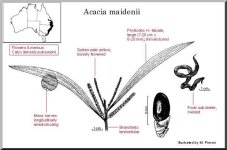
..sorry to be confusing..to answer, this partly why i believe there's at least two distinct sub-species of maidenii..the botanically defined A. maidenii has an 'inconspicuous' gland about 6mm from the base, but it can be very hard to see or sometimes absent..the coiled/spiral pods set it apart from it's close relatives..but i guess plants don't always strictly quite fit the scientific categories made for them..y the way does maidenii have a basal gland? I saw in one of your posts that it did, and another that it didn't..
..in truth i usually don't defat at all, but it's advisable with phyllodes or less-known material..it is safer to defat (when acidic) as once or twice i've seen the need to re-acidify and defat, due to the presence of floral oils (only during flowering - i realize i've only mentioned this once in the thread)..best of luck..!you reckon just 1 defat before basing nen? I've been doing the double a/b.. haven't done the regular defat in yonks
.
Attachments
no cigar on phyllodes.. looked like something was precipitating at first and the solution was very murky.. but nothing would crystallise and after evap it was like a greasy watery substance(same as what I have always gotten with the suspected floribundas) .. the mission for floribunda continues.
I am wondering whether any of the species round here at all are floribunda. the one that I just failed was pretty much identical to the past ones too which are common to the area.. I do remember one which had much softer and paper like phyllodes I wonder if it may be what I'm looking for.
^bricklaya..non-crystalizing does not always mean no dmt..take the acuminata extract in the acacia analysis thread which contained harmalas..what does the extract smell like..? on a first test use lots of heat to be sure you're getting a lot out..shellite requires at least 3 'pulls', some other solvents (e.g hexane) only need one..
floribunda is really only common within 50km of the coast..it doesn't have thick phyllodes like maidenii/longifolia etc..
.
..i'd really like to see some more work with African species [see Africa list here]
..a common species is Acacia nubica (of which Acacia oerfota is now considered a sub-species), and which has been renamed Vachellia nubica (most african acacias are now vachellia, for some pendantic botanical reason)
Khalil & Elkheir 1975 found DMT in the leaf, bark not tested..
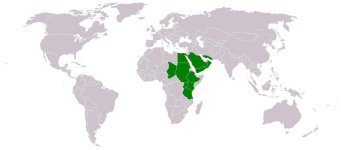
it is found in Sudan, Kenya, Uganda, Tanzania, and the South Arabia Peninsula to South Iran and South Iraq.
..it also has reported traditional medicinal usage..
"root of Acacia nubica, decoction added to soup as a strengthening tonic , decoction of root or branches drunk or added to soup for joint and-muscle pain [in] Tanzania (Batemi of the Ngorongoro district)" [Johns, Mhoro, Sanaya & Kimanani (1994)]..
in Uganda it is used to treat "body pain, soak the root in water, (Laughlin & AIlgeier 1979); general health, drink a decoction prepared from the bark or tie strings, of the hark around extremities or wash the body with the bark."
[Heine & König 1988]..
Acacia nubica..
floribunda is really only common within 50km of the coast..it doesn't have thick phyllodes like maidenii/longifolia etc..
.
..i'd really like to see some more work with African species [see Africa list here]
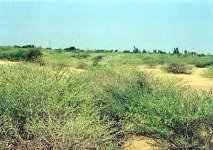
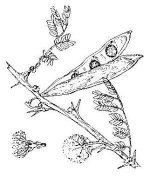
..a common species is Acacia nubica (of which Acacia oerfota is now considered a sub-species), and which has been renamed Vachellia nubica (most african acacias are now vachellia, for some pendantic botanical reason)
Khalil & Elkheir 1975 found DMT in the leaf, bark not tested..
it is found in Sudan, Kenya, Uganda, Tanzania, and the South Arabia Peninsula to South Iran and South Iraq.
..it also has reported traditional medicinal usage..
"root of Acacia nubica, decoction added to soup as a strengthening tonic , decoction of root or branches drunk or added to soup for joint and-muscle pain [in] Tanzania (Batemi of the Ngorongoro district)" [Johns, Mhoro, Sanaya & Kimanani (1994)]..
in Uganda it is used to treat "body pain, soak the root in water, (Laughlin & AIlgeier 1979); general health, drink a decoction prepared from the bark or tie strings, of the hark around extremities or wash the body with the bark."
[Heine & König 1988]..
Acacia nubica..
Attachments
Similar threads

- Replies
- 0
- Views
- 525
- Replies
- 6
- Views
- 2K

- Replies
- 4
- Views
- 473

- Replies
- 2
- Views
- 380

- Replies
- 149
- Views
- 16K
