..well
acacian, that's a part of the kind of thing i'm exploring in the fabled first book, which 'll actually be part II :?:
which will look at the history of acacian-human language, consciousness and mythos..or something along those lines, with an appendix on what's actually
in trees and what each tryptamine does to
our neurochemistry..
that's partly why i need a little more meditation instead of nexian time..also, the plants said 'about a year' on the net..i think they've got something else planned next..8)
..i suppose i'll give Nexus members exclusive access to a beta-copy pdf to comment on..then maybe it'll be published as a Windows or Cocoa (for Mac OS) application which is a self-evolving document which keeps updating and cross referencing itself with external feedback..
kinda like this thread, except with a access password/dongle..:d (or, as i suggested to the bemoaning Snu Voogelbreinder, who complains it's hard to shift books since the internet, he could do the 2nd edition of
Garden of Eden as a CD-ROM/blu-ray-rom..with fancy anti-piracy protection and photos! ..i mean, come on!..the guy spent literally years of his life putting that great work together so that i can just casually quote it on the nexus..

)
getting back to
Ancient Egypt..here's a groovy Russian site on ancient gods and goddessess..
some selected quotes from it:
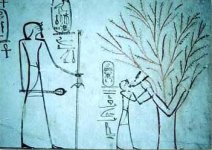
Seshat was the essence of cosmic intuition, creating the geometry of the heavens alongside Thoth. In Egyptian mythology, Seshat was originally the deification of the concept of wisdom, and so became a goddess of writing, astronomy, astrology, architecture, and mathematics. As reality is based on duality, one could consider Seshat the feminine aspect of Thoth. The Egyptians believed that she invented writing, while Thoth taught writing to mankind. She was known as 'Mistress of the House of Books', indicating that she also took care of Thoth's library of spells and scrolls.
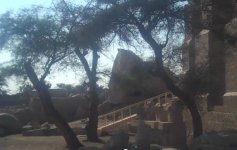
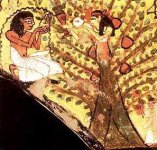
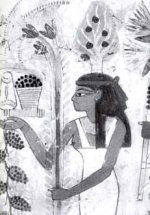
... trees were associated with different gods...none of these male deities were associated with trees nearly as much as a number of female deities...Nut, Isis, and Hathor - given the title, "Lady of the Sycamore"...in fact, this title has been interpreted to relate to a specific and particularly old tree that once stood to the south of the Temple of Ptah at Memphis during the Old Kingdom.
There were also a number of minor tree goddesses who were depicted in a number of ways. There were simply images of trees labeled as goddesses as well as fully anthropomorphic personifications of tree goddesses. Perhaps the most unusual representation is that of the upper body of a goddess rising from the trunk at the center of a tree, or sometimes a tree sprouting out of the head, such as in the case of Nut.
Today in Egypt, trees have not altogether died out as religious symbols, for their remains at least several sites where trees have modern religious significance, associated with, for example, the Holy Virgin Mary.
and like phyllode so excellently dug up and quoted:
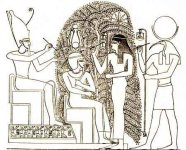
In ancient inscriptions Osiris is referred to as “the solitary one in the acacia,” and as “the one in the tree.”
for info in the thread on
Egyptian Acacias and star-beings see here..the fine print 'll be in the book..
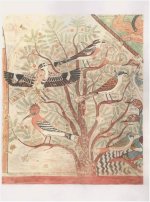
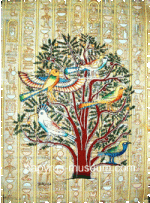
for now, some more ancient inscriptions and papyrii..certainly, acacian, with regards to your question, there was a lot of spiritual interest in acacias in the area back then..
below:
Tree Goddess
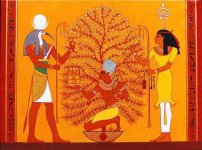
The Tree Of Life
Thoth and Seshat
Tree Goddess from the tomb of Pashedu in the Valley of the Kings
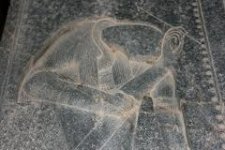
Thoth (carving at temple in Luxor)
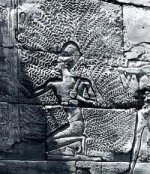
Worship in Tree
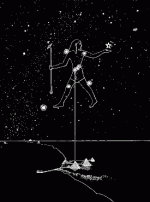
Orion...






 ,thanks for the interest and interests acacian..