• Members of the previous forum can retrieve their temporary password here, (login and check your PM).

What Is yaulls experiences on nutmeg and spices?

I'd have to rummage through my notes a bit further as the details are distinctly hazy. The specific effects were mostly like their own version of being a bit stoned. I'd tend to go for the antidepressant effects of lower doses, or otherwise the aforementioned boosting effect these formulations have on shrooms or cactus.
Here's one post:
I retried this double space tincture recently. Two teaspoons (in this case ~7mL) added to a cup of herb tea (Yogi tea brand "Men's Tea") was genuinely very pleasant indeed - euphoric, aesthetic, mild ECV. A friend also confirmed this, and was surprised at the rapid onset.

Testing the dill seed tincture the following day may have caused a headache, possibly from its carvone content; this was resolved after eating a curry with lots of fresh turmeric, ginger, garlic, black pepper and a number of other spices. Dill tincture requires the additional spices to modulate its effects to something more pleasant. With this in place, it quite possibly gives nutmeg a run for its money in the cheap culinary hallucinogen stakes.

The best dill seed is the Indian version known as 'sowa'. That is also its species name - Anethum sowa. There's a very large probability that a version of space paste - and by extension, space booze - can be made using dill seed, turmeric, black pepper, etc. as found in the original Space Paste recipe.

Did I ever post that recipe for double space tincture? I'm pretty sure there's a pdf of it around here somewhere.
EDIT: Actually I never typed it up from the original notes, only my original mace variant Space Paste recipe. So, this document is a work in progress.

 
I had grounded nutmeg maybe five times in my life, while it was quite enjoyable and similar to cannabis, higher doses are too long lasting and have some kind of side effects and hangover.

It could be probably a good admixture for some modern version of theriac.
how did you take it I took it like 2 teaspoons of ground nutmeg no hallucinations but to be fair I take Vyvanse everyday as its my perscription.
 
I just ate 2 or 3 grounded nutmegs, but got stronger effects only 2 times out of 5.
It's quite variable it seems and taking other substances could affect the outcomes.
 
I just ate 2 or 3 grounded nutmegs, but got stronger effects only 2 times out of 5.
It's quite variable it seems and taking other substances could affect the outcomes.
oh so what's the equivalent in teaspoons of powdered nutmeg I only did nutmeg once a long time ago
 
Hm, maybe you tried the "Space Paste" recipe? I've tried the version shared by the infamous @69ron and it works to a certain extent:

I can't believe you're promoting 69ron stuff?(!?)

Oilmans space booze works well, see:
Now a way to try space paste without eating 2 tablespoons of spices! The procedure is ridiculously easy. This creates a high proof alcoholic beverage with hallucinogenic properties.
 
I can't believe you're promoting 69ron stuff?(!?)
In that instance, it appears he was merely the messenger, and not trying to sell anything. Unearthing the sources he used for that recipe would help with resolving some of those credibility issues. For the record, the effects of the spice mixture don't resemble LSD - if I had to draw a parallel maybe more like oral cannabis to a certain extent, and even then it's not a 1:1 comparison.
Edit: also, describing him as "infamous" doesn't necessarily count as promoting that distinctly sketchy individual.

Oilmans space booze works well,
Check out the recipe for "double space tincture" - that stuff's pretty good.
 
Last edited:
For the record, the effects of the spice mixture don't resemble LSD - if I had to draw a parallel maybe more like oral cannabis to a certain extent, and even then it's not a 1:1 comparison.
Have you tried altering space paste as was discussed on one of the old nexus threads? Basically replacing nutmeg with either mace or basil/parsley. I think I saw a version with cloves somewhere (maybe it was on another forum).

No nutmeg = no sedative cannabinoid compounds (eg "iicarin" iirc). Also I've noted that regular lysine can help.

Check out the recipe for "double space tincture" - that stuff's pretty good.
Thanks, I'll have a look.
 
Have you tried altering space paste as was discussed on one of the old nexus threads? Basically replacing nutmeg with either mace or basil/parsley.
Mace works too, at least in tincture form, as does Indian dill seed ('sowa'). The transdermal route proved to be surprisingly effective - something I found out inadvertently after using mace tincture as an impomptu hand sanitiser. Iirc, Carmelite water ('Melissengeist') was used to prepare the mace tincture, so it already contained several other components that are know to synergise with phenylpropenes/allylbenzenes.
 
Mace works too, at least in tincture form, as does Indian dill seed ('sowa'). The transdermal route proved to be surprisingly effective - something I found out inadvertently after using mace tincture as an impomptu hand sanitiser.
I've seen the early discussions which implied dermal application was more efficient (effective? reliable?) than ingestion.

Also mace tincture as a hand sanitiser, what an idea!! Ethanol is a pretty good absorption enhancer.

Iirc, Carmelite water ('Melissengeist') was used to prepare the mace tincture, so it already contained several other components that are know to synergise with phenylpropenes/allylbenzenes.
That word phenylpropenes reminds me of propylbenzenes. I've also seen info that implies the propylbenzenes "setup the appropriate environment" for allylbenzene activity. Anethole which is dirt cheap and very common was mentioned for this purpose.

Anethole, a naturally-occurring aromatic phenylpropene compound, is commonly present in the essential oils derived from botanically diverse plants, including anise, star anise, fennel and basil. (source)
 
That word phenylpropenes reminds me of propylbenzenes. I've also seen info that implies the propylbenzenes "setup the appropriate environment" for allylbenzene activity. Anethole which is dirt cheap and very common was mentioned for this purpose.
"Propenylbenzene" is a synonym for both allylbenzenes and phenylpropenes, and although the latter of those last two terms is technically a synonym for allylbenzenes as well, it's commonly used to refer to the compounds with the sidechain double bond closer to the benzene ring. "Allyl" is a preferred common name specifically referring to propenes substituted at the saturated carbon atom and remains in use despite being archaic and unsystematic largely because of convenience and, in the case of older chemists, habit - a bit like how "acetic" is still favored over "ethanoic" in all but formal contexts. Systematic naming makes up in clarity for what it often loses in brevity, as long as one has learned and understood the rules.

Propylbenzene would have a saturated sidechain, i.e. no double bonds other than the delocalised ones within the benzene ring. Interestingly(?), piperonyl butoxide - the pyrethroid insecticide synergist - has a saturated sidechain and is therefore a propylbenzene.
 
"Propenylbenzene" is a synonym for both allylbenzenes and phenylpropenes, and although the latter of those last two terms is technically a synonym for allylbenzenes as well, it's commonly used to refer to the compounds with the sidechain double bond closer to the benzene ring.

Fair point. Thanks for the clarification. I just remembered the word similarities tbh. I searched these terms and found this 1977 paper:
Metabolism of naturally occurring propenylbenzene derivatives. III. Allylbenzene, propenyl benzene, and related metabolic products
10.1016/0304-4165(77)90216-1
The acidic and neutral urinary metabolites of allylbenzene, propenylbenzene, 1'-hydroxyallylbenzene, and cynnamyl alcohol were identified and related through a common metabolic scheme.
Propenylbenzene is oxidized to cinnamyl alcohol. Both 1'-hydroxyallylbenzene and cinnamyl alcohol are excreted unchanged. ... Allylbenzene and 1'-hydroxyallylbenzene yield basic ninhydrin-positive metabolites.

...and this one:
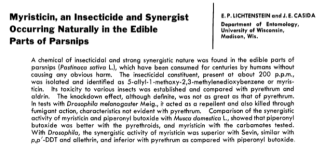
Naturally Occurring Insecticides, Myristicin, an Insecticide and Synergist Occurring Naturally in the Edible Parts of Parsnips
10.1021/jf60129a017
jf60129a017.fp.png_v03.png

So the common parsnip contains ~200ppm myrstricin. Maybe space paste can be made with a parsnip "pie-type" crust!
 
Last edited:
Fair point. Thanks for the clarification. I just remembered the word similarities tbh. I searched these terms and found this 1977 paper:


...and this one:

View attachment 110579

So the common parsnip contains ~200ppm myrstricin. Maybe space paste can be made with a parsnip "pie-type" crust!
Some parsnip essential oil can contain far higher levels of myristicin, which shouldn't be altogether surprising considering it's a representative of the carrot family.

The insecticide testing suggests that myristicin acts somehow to amplify cholinergic signalling, or at least this is what the synergy with carbamates seems to indicate. (Carbamates act as cholinesterase inhibitors, thereby increasing the synaptic concentration of acetylcholine.) I'm yet to see any published research which confirms the specific mode of action of myristicin - or its metabolites - in this respect, but that waper on allylbenzene metabolites contains a few hints. I'd speculate that there may be room for extension of those ideas to cover (transient?) adducts with, say, acylglycerols or acylethanolamides perhaps, plus a consideration of the similarity between 1'-oxomyristicin's cationic trimethylamine adduct and acetylcholine/butyrylcholine, etc.
 
Some parsnip essential oil can contain far higher levels of myristicin, which shouldn't be altogether surprising considering it's a representative of the carrot family.
Iirc I read something about that on erowid.

I'm yet to see any published research which confirms the specific mode of action of myristicin - or its metabolites -
Indeed, there should've been one by now...!!!

...but that paper on allylbenzene metabolites contains a few hints. I'd speculate that there may be room for extension of those ideas to cover (transient?) adducts...
So I looked at the author of that paper and found a few papers on similar themes, they mention a few amine metabolites some of which I found in pubchem, these are based on safrole:
 
Back
Top Bottom