• Members of the previous forum can retrieve their temporary password here, (login and check your PM).

Which Non polar solvent? - Naphtha (petroleum ether 100-120) or (40-60) 60-80 fractions) - for freeze-precipitating

First off, there might not be much DMT in the 40-60 right now if it was done cool.

Check this solubility curve for n-Heptane (a component of naphtha that boils at 98 C).
solubility-curve-231-2c-dmt-freebase-2c-per-g-solvent-png.87553

At 20 C, the solubility is around 4mg per g. 150ml of heptane is about 100g. So if your solvent was heptane, it might only pull 400mg in 150ml. Generally the lower the boiling point for pet ether, the less capacity for DMT. So in your case with 150ml of 40-60 pulled below room temp, there might be significantly less than 400mg to collect.

Back to your steps:
2) When you add vinegar it's called salting the (non-polar) solution, it should happen very quickly, but stir it for a minute or so to be safe, since the layers won't want to mix naturally.
3) if you don't see any precipitate already, the solvent residue isn't going to yield anything worth spending time on.
4) See 2)
5) After adding base you can pull right away and it won't take longer than mixing the two layers together again. 30 seconds maybe.

But since there might not be much DMT in those pulls, you might as well just skip the mini-a/b for now and warm the solvent up to do another pull at a higher solubility point. (you'll want to warm up the bark-soup too otherwise the 40-60 will cool down fast.) The low amount of DMT in there right now won't go anywhere, and will have a better chance to crash out if you saturate the solvent at a higher temp.

If you don't have a way to condense or ventilate the vapors coming off the hot solvent though, I wouldn't recommend it. You could wait to get 60-80 or 100-120 and save the lowest boiling stuff for purification. I guess you could do it outside in a hot water bath or something.
Thanks for the solubility data. ( I was trying to find this when I started out)

I started with the 100-120 and got nothing.

What am I doing wrong?

Confirmed Mimosa hostillis bark (authentic)
Sodium hydroxide (100% Kosha)
Solvent ( I’ve tried 100-120 and 40-60 ) both ends of the spectrum- both, chemically pure

I’ve got 100 grams of bark left, only 40-60 in the house and sodium hydroxide ( also some calcium hydroxide as a back up base )

My extraction method is to add water to the bark, then add sodium hydroxide, check PH is over 12, and then add the Naptha, wait 3 hours, draw off the Naptha into the glass dish (replete with tightly closing lid) and bung it in the freezer)

I did start off heating the bark with vinegar for 8 hours, then freezing, thawing and repeating before adding base and the solvent on top once cooled. Am I missing anything extra (other than creating the ideal temperature to increase solubility?)
 
if you’re not stirring the non-polar into the basic layer, I’d try that. It might not be picking up much just from sitting on top, even for 3 hours.

As long as you haven’t thrown stuff away nothing’s been wasted from your trials.

I can tell you want to see results but don’t worry, be patient, you’ll get there. All the info you need is here, might just take more background research for it to click.

I don’t want to overload you with more info than you can digest right now, but if you find time look into the benzoic acid tek on this site. If you get some BA you can use it in place of vinegar for salting out DMT from non-polar solvents. And it instantaneously precipitates out, so it acts as its own visual indicator of when the solvent is depleted. Not only does it yield superior results, but it’s an educational tool that helps visualize the extraction and qualitatively assess the various factors that could be tweaked during the pull. It would pair very well with 40-60 solvent, even at room temp, since you could salt out the dmt instantly and recycle the solvent for the many small pulls it may take. And dmt-benzoate is vapeable, so it’s a bit of a shortcut around freebase freeze precipitating that relies on solubility curves.

I think you could get away with what you have though, just have to carefully work with it warm. Use water baths to get it to 40c, use even less solvent, maybe 50ml. Stir it well for 1-5 minutes. Do it outside. This may take more pulls, but increases the chance that each pull will be supersaturated and effectively freeze precipitate at room or lower temperatures. Don’t forget the intermediate jug to catch the lye drops.
 
Last edited:
What am I doing wrong?
Firstly, I hope you haven't thrown any of your materials away…

We do seem to be homing in on poor polar/non-polar phase contact, as @Icon already mentioned. It applies just as much for getting the DMT out of the base soup as it does in the case of pulling it back into vinegar, as discussed in the context of mini A/B.

This will only be compounded by the low solubility of DMT in 40-60 pet ether, although it doesn't bode so well that you got nothing using the 100-120 either.

Were you pulling from the same soup with both of these solvents, i.e., did you do the 100-120 pulls and after that tried the 40-60 on the exact same extraction? If this were the case, there could possibly have been aromatics (xylene, toluene and ethylbenzene) carried over as remnants from the 100-120 into the 40-60 pull, in which case freeze precipitation won't work.

If that's what happened, you need to ascertain whether there's any product in the vinegar backsaltings, or, correspondingly, pull from any suspect naphtha back into vinegar.

BUT first of all, you need to do some pulls where you actually mix the naphtha and the base soup together properly. Relying on diffusion alone would mean that extractions would take weeks (like they supposedly did back in the bad old days)!

Once you have some vinegar backsaltings that should by all rights contain something, you can either evaporate them, or carefully add drops of sodium hydroxide solution and observe whether clouding occurs once all the vinegar has been neutralised.

One more thing to be aware of is that crystals floating in the freeze-precipitated naphtha may in fact be ice, especially if your dish wasn't sealed in the freezer.
 
Bonjour fellow space rangers and keepers of the faith, could someone tell me if my (Non polar solvent)
- Naphtha (petroleum ether 100-120) will work or will I need to use 40-60 or 60-80 fractions) - for freeze-precipitating from (finely shredded MHRB + Sodium Hydroxide)

And just incase I can save it (does the higher boiling point 100-120 petroleum ether make crystalline formation impossible?

Daft questions from a somewhat frustrated, yet undeterred kitchen chemist. 🙂 my thanks for your patience in advance.
Occipital Bob
I like heptane but it is expensive
 
I like heptane but it is expensive
It’s my biggest problem at the moment, can’t get anything to crash out. Not even in a vinegar wash, just got some floaters that look like little white nerves. Could you recommend an easily obtained solvent you have tried that works?
 
It’s my biggest problem at the moment, can’t get anything to crash out. Not even in a vinegar wash, just got some floaters that look like little white nerves. Could you recommend an easily obtained solvent you have tried that works?
Your lab grade materials should be doing the job, though. We already seem to have established that you need to mix the soup and solvent more thoroughly.

  • Can you link to a data sheet/SDS for the exact 100-120 pet ether you used?
This is just to get a picture of whether we're dealing with any aromatic content inhibiting the freeze precip.
 
Your lab grade materials should be doing the job, though. We already seem to have established that you need to mix the soup and solvent more thoroughly.

  • Can you link to a data sheet/SDS for the exact 100-120 pet ether you used?
This is just to get a picture of whether we're dealing with any aromatic content inhibiting the freeze precip.
 

Attachments

  • IMG_2936.jpeg
    IMG_2936.jpeg
    344.9 KB · Views: 5
  • IMG_2938.jpeg
    IMG_2938.jpeg
    211.2 KB · Views: 5
  • IMG_2937.jpeg
    IMG_2937.jpeg
    170.2 KB · Views: 5
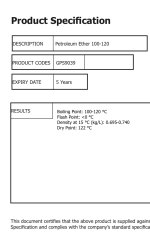
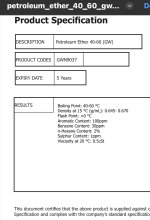
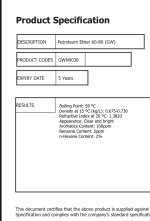
There's a suspicious lack of mention of aromatics content with the 100-120 stuff… hard to draw any firm conclusions on that one. The other two essentially won't/can't have aromatics since the lowest boiling aromatic hydrocarbon by any sensible metric is benzene (80°C).

It would be imperative at this point to get some data on the toluene, xylenes and ethylbenzene content - can you link to a more detailed SDS?

Edit, tbf with a dry point of 122°C there likely won't be much of the C₈H₁₀ isomers. The density is also too low for there to be a significant toluene content.
 
Last edited:
Your lab grade materials should be doing the job, though. We already seem to have established that you need to mix the soup and solvent more thoroughly.

  • Can you link to a data sheet/SDS for the exact 100-120 pet ether you used?
This is just to get a picture of whether we're dealing with any aromatic content inhibiting the freeze precip.
SDC for all three fractions (attached)

stirring and moderate heating as per the boiling point. Info Assimilated,
Muchas gracias again to yourself and icon🙂

( found myself sitting in traffic, somewhat defeated) trying to figure out what I’ve done wrong thus far, which was somewhat compounded by a bloke on YouTube who just had a box of bits and bobs in the back of a pickup, and was like, I’ve got everything I need except the freezer. 🤣) and this led me to wondering how this was done in days of yore (in the urban setting). has to be lighter fluid for the great unwashed right?


  • In days of yore
 
There's a suspicious lack of mention of aromatics content with the 100-120 stuff… hard to draw any firm conclusions on that one. The other two essentially won't/can't have aromatics since the lowest boiling aromatic hydrocarbon by any sensible metric is benzene (80°C).

It would be imperative at this point to get some data on the toluene, xylenes and ethylbenzene content - can you link to a more detailed SDS?

Edit, tbf with a dry point of 122°C there likely won't be much of the C₈H₁₀ isomers. The density is also too low for there to be a significant toluene content.
that’s the full extent of SDC available , the other available pdfs cited product Lab CoSH, stipulations etc

I’ve started round 6 concurrently with round 5 🤣 gonna let this one very gently warm for a few hours, freeze, thaw, salt & draw, ( it’s old school but it’s time to try the lighter fluid )

Your awesome knowledge is melting my melon 🍉 , but I’m keen to learn, so on the face of it, which ether fraction would you endorse in light of the minimal SDC?

Thanks in advance, and happy Halloween 🎃

Occy Bob
 
Based on all the available information so far, indications suggest that it's either the lack of proper mixing during the pulls, or that the bark you've used has low to zero alkaloid content, as being the reasons behind your disappointing results so far.

There's no reason why lab grade naphtha shouldn't work for this. Since you ask, I'd tend to use the medium naphtha for most things on grounds of overall practicality.

As far as my knowledge goes, it's largely a matter of thinking where the DMT will go under any particular set of extraction conditions, how to ensure it does in fact go there, and how to ascertain where it might be at any stage. The rest of it comes from studying chemistry for a few decades, on and off.

DMT more than any other substance has led me to wonder that chemistry might be in equal measure art and magic as much as it is science. Even so, there has got to be some level of sense behind what you've been going through, and your best way of getting there is to improve your understanding of the principles of chemistry.

Merry Samhain, indeed!
 
Based on all the available information so far, indications suggest that it's either the lack of proper mixing during the pulls, or that the bark you've used has low to zero alkaloid content, as being the reasons behind your disappointing results so far.

There's no reason why lab grade naphtha shouldn't work for this. Since you ask, I'd tend to use the medium naphtha for most things on grounds of overall practicality.

As far as my knowledge goes, it's largely a matter of thinking where the DMT will go under any particular set of extraction conditions, how to ensure it does in fact go there, and how to ascertain where it might be at any stage. The rest of it comes from studying chemistry for a few decades, on and off.

DMT more than any other substance has led me to wonder that chemistry might be in equal measure art and magic as much as it is science. Even so, there has got to be some level of sense behind what you've been going through, and your best way of getting there is to improve your understanding of the principles of chemistry.

Merry Samhain, indeed!


Roald Hoffmann (Nobel Prize in Chemistry):

“There is a kind of poetry in the transformations of chemistry — materials changing color, structure, and purpose, as if under a spell.”
 

Attachments

  • IMG_2869.jpeg
    IMG_2869.jpeg
    2.2 MB · Views: 3
I find it kind of hilarious that this is also the intended outcome when communing with the products of the type of chemistry we discuss here

the event horizon is dissolving nicely. 😆

Oooof that time already.

it’s wild when you think about it, atoms moving from column to column, gaining and losing, and that’s all going on beneath the chemical compound level analysis. And at a quantum level. All physical chemistry remains part of the whole yet seperated by scale and or perception
 
You and me both, I guess! It's fully thirty years since I hit the motherlode of liberty caps and life really was never the same after that point. Prior to that it was just dabbling. And to think, around 1993 or 4, CEVs on LSD were enough to startle me into opening my eyes - I could kick myself for not just going right into that vision of whirling cogs and gears. Still, everything in its time - and I've more than made up for that omission/bail-out since, you could say.
 
Back
Top Bottom