• Members of the previous forum can retrieve their temporary password here, (login and check your PM).

4-ACO-DMT Acid Hydrolysis

Migrated topic.
Nathanial.Dread said:
maranello551 said:
Nathanial.Dread said:
The problem with that kind of anecdotal evidence is that it's not blinded. You know whether you're taking a 'natural' or 'artificial' compound, and given how much mindset and preconceptions can affect a trip, it doesn't seem at all impossible to me that this alone may cause the perceived differences in quality.

I personally think that this placebo (or nocebo) effect underlies a lot of the differences people report between different drugs. I imagine that, under properly double-blinded conditions, most psychedelics would be much harder to tell apart than we generally report.

Blessings
~ND

What? Are you being serious? I've done mushrooms a literal hundred times. I know what it's like. It doesn't have to be blinded. I know a pear tastes different from an apple even though it's not a blind test lol. It wasn't a placebo difference. It was a major difference. One hurt and one didn't. One made me physically sick and one made me feel like God. i regularly dose from 5-10g dry cubensis. I've dosed 10-35mg 4-aco-dmt. The test needs not be blind. The differences pecome more pronounced the higher the dosage of each......the more you dose of each, the more different they are from each other. They are only reminiscently similar at threshold doses, anything above, and 4-aco-dmt is as different from mushrooms as LSD is.

Do you need a blind test to tell if something is weed or mushrooms? I doubt it. This is the same to me. They feel like 2 different drugs, and the higher you dose, the more true this will ring.
Do the experiment, see what results you come up with. Dissolve several analogous doses of 4-AcO and psilocybin in water, blind yourself and a friend to conditions, and see how reliably you can figure out which one is which. You'd need multiple trials (or people) to help out with the experiment if you wanted enough statistical power to make even the most rudimentary conclusions, but it could quite easily be done.

Blessings
~ND

-.-

No. It feels different for me. It's not a question. I have no prejudices against substances. LSD feels natural to me. 4-aco-dmt did not feel like "coming home" like 4-ho-dmt or n,n dmt feel. It felt like getting "lost in the sauce" like halfway phenethylamine halfway lysergamide....and it felt physically inhibiting as opposed to the sensory fine-tuning of 4-ho-dmt....there was no clarity....there was psychedelic "noise". 4-ho-dmt allows one to hear farther, 4-aco-dmt feels like its making one hear sounds that aren't even there....it's just messing with my head.....maybe what I had wasn't 4-aco-dmt, but it was reasonably accurate in terms of intensity in the dosage range that it should have been.

M.
 
The placebo effect is pretty powerful when it comes to psychoactive drugs - look at some of the work Irving Kirsch has put out looking at the role of the placebo effect on serotonergic antidepressants.

There's a reason that double-blind, placebo-controlled is the gold-standard in psychopharm studies. As a species, we're just not as good at objectivity as we think we are.

Blessings
~ND
 
Nathanial.Dread said:
The problem with that kind of anecdotal evidence is that it's not blinded. You know whether you're taking a 'natural' or 'artificial' compound, and given how much mindset and preconceptions can affect a trip, it doesn't seem at all impossible to me that this alone may cause the perceived differences in quality.

I personally think that this placebo (or nocebo) effect underlies a lot of the differences people report between different drugs. I imagine that, under properly double-blinded conditions, most psychedelics would be much harder to tell apart than we generally report.

Blessings
~ND


I don't agree with that at all. Differences in receptor binding affinity are rather telling.
 
pitubo said:
maranello551 said:
So what do I do?
Research.


Do not try base catalyzed hydrolysis, the hydrolyzed 4-HO-DMT does not like that and will quickly degrade if you try that. In fact the molecule is so fragile that you should take care to exclude oxygen out of the reaction as much as possible until the reaction solution has been cooled down and neutralized.


What if you use a base first and then an acid as two seperate steps?

1) NaOH
2) H30(H+)

I worked through the basic reaction and it left me with an oxidized 4-0-DMT molecule because it was always deprotonated by the more unstable OH molecules. With its ring and reasonance it was better able to hold the charge than any free OH.

But I wonder if this is what you mean when you say the ring is very fragile and prone to destruction in basic conditions?

Do you mean prone to deprotonation by the base (OH) or are there other perhaps more troublesome reactions that I havent yet considered?

I would like to get a better understanding of how the 4-OH-DMT molecule degrades under basic conditions and at what other points on 4-OH-DMT (4-O-DMT) the molecule beside the O/OH group might react with either the base or any free oxygen?

Many thanks
 
wolf8312 said:
After a bit of thinking about this conundrum, it seems that a hydride-based reduction might feasibly cleave off the acetate group, and it wouldn't even need boron tribromide for cleaving off a resulting ethoxy group because the acetate wouldn't reduce that far. Viz, you could try a borohydride (commercially available for legitimate purposes and fairly safe-ish - watch out for the hydrogen, don't blow yourself up).

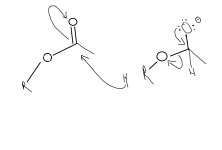
Sorry I dont understand. Can you maybe show me or explain the proposed mechanism for such a reduction? When you say 'hydride based reduction' you are talking LAH or other hydrogen nucleophiles right?

As far as I can work out a hydrogen nucleophile would attack the electrophilic carbonyl, and push its electrons up onto the oxygen which would then need to be neutralized.

Oh sorry I see now ha yes hydride would indeed seem like a viable way to do it!
 

Attachments

  • hydride.png
    hydride.png
    26.4 KB · Views: 0
wolf8312 said:
What if you use a base first and then an acid as two seperate steps?
The point of that being?

wolf8312 said:
I worked through the basic reaction and it left me with an oxidized 4-0-DMT molecule because it was always deprotonated by the more unstable OH molecules. With its ring and reasonance it was better able to hold the charge than any free OH.

But I wonder if this is what you mean when you say the ring is very fragile and prone to destruction in basic conditions?

Do you mean prone to deprotonation by the base (OH) or are there other perhaps more troublesome reactions that I havent yet considered?
I am not an expert in these matters either. What I think I know is that phenols oxidize to benzoquinones easily under basic conditions. Polymerization can also be an issue, possibly as a side reaction to the above.

I found some explanations here (read all 6 pages):

The redox process hydroquinone - quinone can be seen as a sequence of proton and electron transfers. In the first step, deprotonation leads to a phenoxide ion which is transformed into a phenoxy radical by a one-electron oxidation. Dissociation of the second OH group generates the radical anion semiquinone followed by a second one-electron oxidation to give benzoquinone. All intermediates are resonance stabilized. Similar redox processes are frequently observed in nature.
oxschritte_english.gif
(apologies for the transparent gif not displaying nicely on a dark background)
 
pitubo said:
The point of that being?

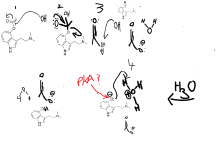
Well I thought it would serve to neutralize the deprotonated O group. In fact when dealing with carboxylic acid derivatives and hydrolysis under basic conditions I was led to believe that one should always employ the base (NaOH) first and then an acid as a separate step, because the carboxylic acid group being resonance stabilized will happily give up its hydrogen to the base and free OH.

The only difference here though is that we end up with two negatively charged molecules (RO- and COO-) that are both more stable than any free OH. However the carboxylic acid is more stable than the 4-O-DMT molecule which would surely then be protonated first once the acid is added.

Seeing how one would be neutralized and the other not they should after that be fairly easy to separate anyway though I should think stabilizing both of them would be a matter of how much acid is used.

Thanks for the papers! I’ll try to see if I can figure out what they are talking about and then apply that to what we are talking about! Seems quite advanced:p !
 

Attachments

  • ___.png
    ___.png
    89 KB · Views: 0
The redox process hydroquinone - quinone can be seen as a sequence of proton and electron transfers. In the first step, deprotonation leads to a phenoxide ion which is transformed into a phenoxy radical by a one-electron oxidation.


Can anyone explain in relation to what we are disscussing exactly how the phenoxide ion is transformed into a phenoxy radical by one electron oxidation? Does the hydrogen take its electron with it and the oxygen just take its one electron back too (as in half headed arrow). Could this be a result of other free radicals (in our case perhaps oxygen free radicals) forming bonds with the hydrogen molecule on OH perhaps?

Seems like both base and acid hydrolysis is OK but you'd still end up with a very unstable molecule no matter what you did. I realize now that its OH on a phenyl group that is the problem.

You really might as well just lemmon tek shrooms I think.

Anyway this has been interesting and I've learned a few things, or at least learned that I need to learn quite a few things.
 
The negative charge on the phenoxide oxygen is passed as a single electron to a suitable electron receptor, e.g. Fe3+ or molecular oxygen.

The pyrrole ring of the molecule can also lose a proton and an electron from the imine nitrogen, leading to an ortho-quinoid bond arrangement on the benzene ring after the combination of these two oxidation steps. (Diagram to follow.)
 
wolf8312 said:
You really might as well just lemmon tek shrooms I think.

Sorry, but that won't lead to the result desired.......a lemon tek feels a lot less like 4-aco-dmt than eating mushrooms straight up does.....so clearly something doesn't make sense here..
 
maranello551 said:
Sorry, but that won't lead to the result desired.......a lemon tek feels a lot less like 4-aco-dmt than eating mushrooms straight up does.....so clearly something doesn't make sense here..
Hi, you never bothered to respond to my question to you. Did you ever compare pure 4-HO-DMT against pure 4-AcO-DMT? (and was the latter that you claim to have had pure at all?)
 
pitubo said:
Hi, you never bothered to respond to my question to you. Did you ever compare pure 4-HO-DMT against pure 4-AcO-DMT? (and was the latter that you claim to have had pure at all?)


The closest i've tried to pure 4-ho-dmt is lemon tekked mushrooms. From what I hear, a lemon tek experience if fairly reminiscent of a 4-ho-dmt experience....to me a lemon tek's feel is not at all as far removed from the one experienced by just eating the mushrooms.................unlike my 4-aco-dmt.....which I assume is pure as makes no difference......do RC vendors really make their compound samples so contaminated with other actives that the experience no longer resembles what it was intended to? I have trouble believing that....especially when I have read positive reviews of this aco by others who obtained it from the same source.....then again, the reviewers may have been far less experiences with the effects of mushrooms.....
 
Did you read my comments about the possible influences of the form of administration in my original question? My experience with mushroom extracts is that the unusually fast peaking due to a rapid uptake of strong doses of psilocin/psilocybin in a tincture can cause unpleasant effects. To me this calls into question your assumption that the differences you noticed must be caused by the difference in substance. You have not ruled out other factors, such as the form of administration and the dynamics of uptake.

Besides, you apparently have no way of knowing what you have actually been ingesting. You could at least have sent a sample to an independent analysis facility before making such uncertain claims here.
 
Found this interesting in relation to some of the above discussions:

Unifying electron transfer mechanism for psilocybin and psilocin
Kovacic, Peter
Medical Hypotheses , Volume 73 , Issue 4 , 626
DOI: Redirecting

In 2005, a unifying mechanism for the psychic action and toxicity of abused drugs was proposed based on electron transfer (ET)[1]. Among the principal ET functionalities, one of the main ones is the quinone category which is usually formed as a metabolite. The abused drugs that appear to function by the quinone route include amphetamine, methamphetamine, ecstasy, morphine, heroin, phenobarbital, and aspirin. Recently, mescaline has been added to the list [2].
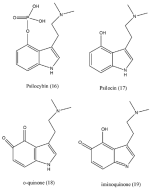
Psilocybin, present in certain mushrooms, is a hallucinogen belonging to the tryptamine family. It has been banned in most countries. In vivo, psilocybin is converted by dephosphorylation into the phenol psilocin which also exhibits psychedelic (hallucinogenic) properties. Studies have been carried out entailing enzymatic oxidation which provide important evidence concerning the mechanistic mode. The product from psilocin, possessing a deep blue color, is believed to contain an o-quinone structure [3]. A similar result was obtained in a subsequent investigation in which the product was assigned either an o-quinone or iminoquinone structure [4].
Psilocybin yielded a similar result in accord with facile cleavage to psilocin. o-Quinones display quite favorable ET properties. The data fit nicely into the prior unifying framework involving participation of ET entities in the physiological activity [1]. There has been scant attention paid to action mode at the fundamental molecular level.
Pharmacological studies were reported on receptor participation [5]. Psilocin behaves as a partial agonist at the 5-HT2A serotonin receptor in the brain. It is not surprising that the effects are somewhat related to those of serotonin which possesses a closely related structure.
In conclusion, the quinoidal metabolite from enzymatic oxidation of psilocin and its capability to undergo ET which apparently plays a crucial role in drug action, support the earlier mechanistic hypothesis.
Attached is a picture from another article by the same author, titled "Novel, unifying mechanism for mescaline in the central nervous system" (full pdf here)
 

Attachments

  • Psilocin+quinone.png
    Psilocin+quinone.png
    53.4 KB · Views: 0
Back
Top Bottom