• Members of the previous forum can retrieve their temporary password here, (login and check your PM).

a general approach to A/B extraction of any alkaloid

Migrated topic.
Joined
May 21, 2008
Messages
7,209
Merits
345
look up the compound of interest on chemicalize.
after clicking search, the engine will do calculations. you should notice a logp value listed on the page, compare this number to the logp values of various solvents, the ones closest to it will be ideal to use for extraction. Next, click on Manage Calculations, Protonation (pKa); scroll down..you will see a graph with the pKa curve and percentages of microspecies across the pH range. Note the pKa value, and use +/- 2 pH units as a general approach to preparing your dilute acid and base solutions for extraction. you can use lower pH for acid, and higher pH for base, if desired.
 
calculatiigherons? Oh really mister? Calculatiigherons indeed!


I make up words just to beguile people all the time, but I do this irl, not online where people can easily copy and paste into google and see that your making these words up. Really, your post made little sense to me....so I set it as a goal to decipher through your techspeak and figure it out....the first word I look at, made up.


google said:
Did you mean: Calculating Herons


Still, I clicked the link. Fascinating stuff.
 
Bedazz, no offense to you but i completely udnerstood everything benz was saying. I don't think it can get simpler than that. Maybe you should take middle school chemistry?
 
That is hilarious !( Beddazzle post )
The rest is serious and very useful, thanks for the reminder benz !
 
forgot to mention...the pKa is the value listed next to the nitrogen, the point at which the lines on the graph intersect. if there are multiple pKa's, exceed the higher one during basification, and lower one for acidification.


with respect to multi-alk extractions, consider the logp values.. for ex. mytragynine and 7-hydroxy... a binary solvent system using heptane and dcm, respectively, can be used to separate the analytes, since a bilayer will form. dcm is more polar and denser, thus it will be the bottom layer, containing primarily 7-hydroxymytraginine. the top layer should contain mostly mytragynine. as you imagine, this approach can be employed in chromatography as well.
 
"Dumb down" and "middle school chemistry" eh?

You both felt the need to imply imbecility on my part?

Is that perhaps childish--

Alright benzy, I just saw your edit....my kidding around was a riff on typo+jargon=comedic confusion. I can however follow directions, did follow the link, and honestly I found myself spending some time on the site and bookmarking it.

Very cool stuff.

Calling me dumb however, a lot less cool. Just for future reference.
 
I didn't call you dumb. would you prefer "put it in layman's terms"?
some of what I type seems esoteric, but they are merely concepts, which I did not make up. I can translate the terms, if you prefer, just ask. The application is quite simple in practice

I didn't notice the typo I made until after I replied
 
Thanks for the info benz.

One thing though.

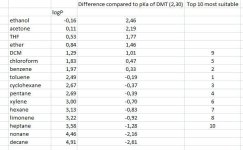
If my calculations are correct, many solvents are more ideal than DCM ?
 

Attachments

  • logp4.jpg
    logp4.jpg
    36.5 KB · Views: 0
the old adage in chem: like dissolves like.
If you look at a surface electrostatic map centered on solvent accessibility, DMT is highlighted about the carbons shared by the benzene ring and pyrrole. thus, it's not surprising toluene or benzene have similar partition coefficients..dmt free base is highly soluble in aromatic solvents and cyclic alkanes; the predominant intermolecular forces are Van Der Waals interactions.

the halogenated hydrocarbons have a prominent dipole (except carbon tet), but they're also commonly used; just look at the classic Microgram abstracts.
 
Back
Top Bottom