

-
Members of the previous forum can retrieve their temporary password here, (login and check your PM).
You are using an out of date browser. It may not display this or other websites correctly.
You should upgrade or use an alternative browser.
You should upgrade or use an alternative browser.
AMANITAS IN MY YARD!!! ID help required... lotsa pics
- Thread starter jbark
- Start date
Migrated topic.
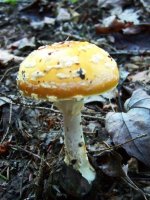
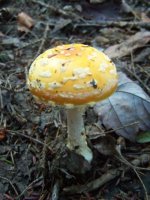
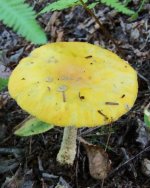
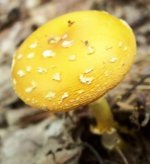
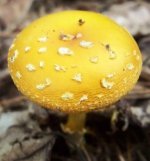
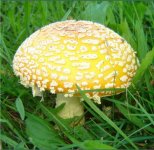


Nice, Rising Spirit - those look just like mine! Do the spores print white? I am storing mine in my freezer until I feel comfortable enough with the ID, and until my Spirit Rises...
Cheers,
JBArk
Cheers,
JBArk


The tricky part about identifying fly agarics in the northeast is that the local variety (A. muscaria var. guessowii) has very similar coloring to Amanita frostiana.
A. frostiana can have some fuzziness around the base, but it doesn't present as clear concentric rings; sometimes it will have a very slight collar, either with or without the fuzzy texture continuing a little ways up the stipe. Typically (but by no means always) the cap is smaller in proportion to the rest of the mushroom than with A. muscaria. The stipe often tapers towards the cap, while the width of the stipe is more consistent along the entire height with A. muscaria. The annulus (the part that looks like a skirt hanging off the stipe) of A. frostiana is more fragile than that of A. muscaria and may fall off with age.
Spore prints examined with the naked eye are not a helpful indicator. Nearly every mushroom that looks like A. muscaria will also have a white spore print. Examination of the spores under a microscope can be helpful though. In A. muscaria, the spores are smooth, non-amyloid, and broadly ovate; they typically measure around 10 x 7 µm; clamps are often present at the bases of basidia. In A. frostiana, Spores are globose to subglobose, typically measuring around 8.5 µm across; otherwise they are similar to fly agaric spores, being non-amyloid, and having clamps present at the bases of basidia.
The most helpful thing in getting a positive ID is to be very gentle with the base of the stipe when harvesting (so as not to damage or disturb the concentric rings) and to get high-resolution pictures of the base.
Other lookalikes to look out for in the northeast are Amanita crenulata and Amanita flavoconia.
A. frostiana is probably not toxic, and may even contain muscimol and/or ibotenic acid... still, I'd try to be assiduous in identification and avoid eating them. From your pictures, there are a couple that stick out as possibly being A. frostiana:


(Especially the one on the right in that second pic)
I'm also suspicious about the coloring on these:
 Then again the pigment could have been washed away by rain, and color isn't a very good indicator for identification anyway. It would be helpful to see some of the more important morphological features (shape of the stipe, close-up of the base of the stipe).
A. frostiana can have some fuzziness around the base, but it doesn't present as clear concentric rings; sometimes it will have a very slight collar, either with or without the fuzzy texture continuing a little ways up the stipe. Typically (but by no means always) the cap is smaller in proportion to the rest of the mushroom than with A. muscaria. The stipe often tapers towards the cap, while the width of the stipe is more consistent along the entire height with A. muscaria. The annulus (the part that looks like a skirt hanging off the stipe) of A. frostiana is more fragile than that of A. muscaria and may fall off with age.
Spore prints examined with the naked eye are not a helpful indicator. Nearly every mushroom that looks like A. muscaria will also have a white spore print. Examination of the spores under a microscope can be helpful though. In A. muscaria, the spores are smooth, non-amyloid, and broadly ovate; they typically measure around 10 x 7 µm; clamps are often present at the bases of basidia. In A. frostiana, Spores are globose to subglobose, typically measuring around 8.5 µm across; otherwise they are similar to fly agaric spores, being non-amyloid, and having clamps present at the bases of basidia.
The most helpful thing in getting a positive ID is to be very gentle with the base of the stipe when harvesting (so as not to damage or disturb the concentric rings) and to get high-resolution pictures of the base.
Other lookalikes to look out for in the northeast are Amanita crenulata and Amanita flavoconia.
A. frostiana is probably not toxic, and may even contain muscimol and/or ibotenic acid... still, I'd try to be assiduous in identification and avoid eating them. From your pictures, there are a couple that stick out as possibly being A. frostiana:
(Especially the one on the right in that second pic)
I'm also suspicious about the coloring on these:

Rising Spirit said:Just a few more pics of these Northern Vermont, yellow "Soma" mushrooms.
looks like 2 different species, growing in two different habitats. the only one that looks like a. muscaria -to me- is the last one (in the green grass)
biopsylo said:Rising Spirit said:Just a few more pics of these Northern Vermont, yellow "Soma" mushrooms.
looks like 2 different species, growing in two different habitats. the only one that looks like a. muscaria -to me- is the last one (in the green grass)
Yeah, I have had similar thoughts, so I accept your assessment and am concerned with jbarks "Amanita" findings and their potentially disastrous, toxic effects. Along with the Formosa lookalikes, I have seen many yellow stemmed variants and they do not have all of the the tell-tale signs of genuine Amanita Muscaria. The first pic here is that type.
Just a quick mention here. For the 29 summers I have lived in Northern Vermont, I have seen what APPEAR to be Amanita Muscaria Formosa growing in the woodlands and even in our grassy yard, bordering the woods. Since there is a risk of toxic shock and/or liver & kidney damage... I have never eaten any of them. After all, who needs to get so potentially sick form a mushroom which, as far as my research indicates, is vastly less psychedelic than any species of psilocybin shrooms.
Now this summer was a bit little different, in that my experiences led me to cross paths with them quite frequently and this struck me as an invitation of sorts. I even found a large one in my lawn when I was mowing it. Accepting the seeming invitation to partake, I bought an OZ of AAA Washington red-capped Amanitas and also, an OZ of Pantherinas, from BBB. I feel that unless I am getting something quite special from the Amanita species (in terms of the head space)... why risk the toxicity?
So, I collected these guys simply to deposit them, as well as the snow-white spores they released, in the woodlands surrounding our home. If I have some amazing rapport with the "Soma" mushrooms, perhaps I might consider eating some of the local fare. Perhaps... if they are in fact the Formosa variant. But I just can't really say yet, being an Amanita virgin and all.

BTW, I also found these guys in a similar habitat. the white ones are likely to be Death angels? Not going to ever try any white Amanitas but the brown one has me wondering. It doesn't look like Pantherina and it doesn't bruise reddish, as with "blushers". Again, not likely to ever eat any of these guys. Any thoughts on what the brown ones are?
Attachments
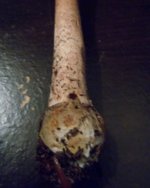
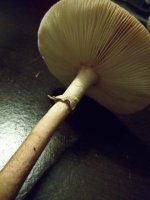
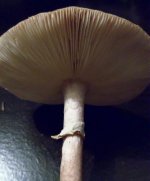
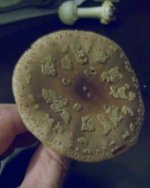
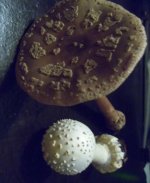
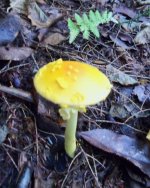
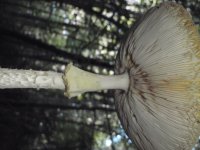
At a glance, I'd say the yellow-stemmed one looks like Amanita flavoconia and the tan one looks like Amanita crenulata. The white one isn't a death cap (A. phalloides) or destroying angel (A. virosa); neither of those have spots on their caps. But since I don't know exactly what it is, I definitely wouldn't eat it.
This one, on the other hand, I would definitely cook into some tasty food:

This one, on the other hand, I would definitely cook into some tasty food:
Entropymancer said:At a glance, I'd say the yellow-stemmed one looks like Amanita flavoconia and the tan one looks like Amanita crenulata. The white one isn't a death cap (A. phalloides) or destroying angel (A. virosa); neither of those have spots on their caps. But since I don't know exactly what it is, I definitely wouldn't eat it.
This one, on the other hand, I would definitely cook into some tasty food:
my thoughts exactly^^
i have found many of the yellow stemmed variety, and they are always a bit smaller, and less stout, not fully resembling classic fly agaric. for this reason, and the fact that im not sure of ID, i have avoided them. for all i know they could have a high muscimol content???
i have also picked amanita muscaria in vermont, and consumed quite a bit--never any ill effects save a bit of sweat
one time while biking on the kingdom trails near Burke mt., VT, i came across hundreds of huge amanita lining the trail. it was so amazing. Here is a tip that you may already know-- and this is true for NZ as well as NE:
where there are amanita muscaria, there are bound to be plenty of yummy edible boletes. kings and birch bolete as well as several others. I often find amanita near birch trees. there is an obvious symbiosis with the mycelia and tree roots.
happy picking

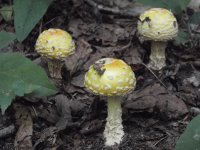
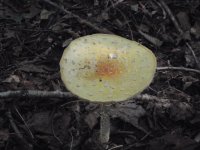
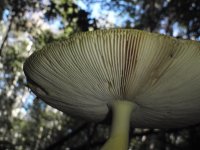
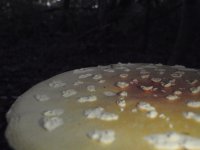

Entropymancer said:At a glance, I'd say the yellow-stemmed one looks like Amanita flavoconia and the tan one looks like Amanita crenulata. The white one isn't a death cap (A. phalloides) or destroying angel (A. virosa); neither of those have spots on their caps. But since I don't know exactly what it is, I definitely wouldn't eat it.
Me and three friends almost died as teenagers for mistaking destroying angels... It was a very uncomfortable night spend in ICU. I don't have time now for the full story, but suffice it to say I didn't touch ANY form of mushroom again for years. In fact I am still leery of eating any mushroom that wasn't ID'd by me or grown by people I know. However, mushrooms are without a doubt my favorite ally. They have literally taken me to the brink of death (destroying angels) and shown me heaven (p. cubensis)
Be safe friends.
Peace
joedirt said:Me and three friends almost died as teenagers for mistaking destroying angels... It was a very uncomfortable night spend in ICU. I don't have time now for the full story, but suffice it to say I didn't touch ANY form of mushroom again for years. In fact I am still leery of eating any mushroom that wasn't ID'd by me or grown by people I know. However, mushrooms are without a doubt my favorite ally. They have literally taken me to the brink of death (destroying angels) and shown me heaven (p. cubensis)
Be safe friends.
Peace
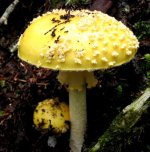
I thank God you lived to remain amongst us, Brother. Dying of toxic poisoning would have been such a waste of limitless potential. Your near-tragic experience does seem to underline how dangerous the Amanita family is. Yes, always consider the consequences and then examine the specimens thoroughly, before ingestion.
For myself, the question about Gordon Wasson's proclamation that Amanita Muscaria was the main ingredient to the legendary Vedic Soma elixir... keeps me wondering about the effects of muscimol on ones' psyche. So, I purchased those OZs from BBB, since there is no doubt about the specificity of their genus.
I will be posting a detailed trip report or two, after my experiences have been integrated and I have assessed the virtues of this Magic Mushroom. I'm pretty sure this one is Formosa but until I have a direct integration with such species of shrooms, I will think twice before consuming any over a campfire (roasted with garlic, ginger, sesame seeds and tamari sauce). 8)
Attachments
Rising Spirit said:I thank God you lived to remain amongst us, Brother.......
Thank you. I am also glad to sill be among the living.
keeps me wondering about the effects of muscimol on ones' psyche. So, I purchased those OZs from BBB, since there is no doubt about the specificity of their genus.
I had an opportunity to acquire a bottle of pure muscimol at my last job. A very good friend, who has never touched any drugs, was using it for a synthesis (No I don't remember, but it was a macrocycle...).... In any event. I declined and decided this wasn't the way I wanted to experience it...but I did indeed have the opportunity.
Actually.... is muscimol controlled? I honestly don't know..and don't feel like googling it. If it's not it can certainly be purchased online from Sigma Aldrich and probably many other companies. What am I thinking...I live in the USA...everything I could think about putting into my body is probably already controlled.
Maybe I'm wrong and it's legal?For sure let us know what it's like. I'm especially interested in your report of it since you and I both like to meditate with our psychs!
Peace

Similar threads

- Replies
- 31
- Views
- 687


- Replies
- 27
- Views
- 2K


