Muriatic acid (HCl) test was interesting :d
1) Room temp extract of 50g of rue seeds using 4% NaOH was done. Pulls where done with ~150ml of base each time. Total of 9 pulls. Dramatic dark red color was observed in the first two to three base pulls. 9 total pulls where combined into 3 jars:
2) First jar (pulls 1-3) was pressure filtered with 4 stacked coffee filters then acidified with 32% HCl from the hardware store. Using 32% HCl is not trivial from a safety stand point.
It is each person's responsibility to research this or any new chemichal and make their own decision on using it or not. Mods, please help if I'm stating anything improperly. I ended up acidifying outside with chem gloves (I bought the blue ones in honor of Jees), safety googles, close toe shoes, and a big fan blowing behind me (this is not a how-to guide for this chemichal and will not guarantee safety, I'm just documenting this experiment).
Here is a UV picture before the acidification started (pH 12.5)
After adding some HCl UV clouds of green (compatible with 534nm) start to appear.
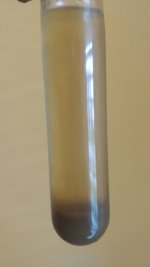
Eventually what lool like crystals started to appear! pH was measure at 1 at this time, but the crystal candidates started appearing a bit before that.
3) Jar with Crystal candidate precipitates was put in the fridge to settle. Everything else was cleaned and washed carefully. HCl was stored outside in a plastic weather bin.
So what is a possible interpretation?
-The NaOH pulled the harmalol candidate by "grabbing" on to the -OH group. A strong base is needed because of the electronegative amine group.
-It does not seem like much harmine or harmaline where pulled by the base (expected) since there is no major precipitate in the strong base and yellow fluorescence was not observed in any of the pulls or during acidification. Also, while at pH 12.5, the NaOH pull was filtered with 4 stacked coffee filters to remove harmine/harmalol that still made it out of the rue seeds.
-As the pH was lowered by HCl the green harmalol fluorescence at (apparently) 534nm starts to appear (expected from the paper previously uploaded). Once the pH is very low, the harmalol can be pronated at the amine group, overcoming the electropositive -OH group. Once pronated it can combine with Cl (harmalol HCl candidate). This may work also with 10% phosphoric (which is a relatively strong acid concentration not tested yet, but 3% did not seem to work).
Since 150ml of 32% HCl where added to a 4% NaOH 450ml solution, it is the equivalent of 73g of salt for Cl- concentration and 26g for Na+ concentration. Usually for this solution (ended at 600ml), 120g of salt will be added for manske. Plan is to let the crystal candidates settle, filter, and add salt to see if more precipitates out. Also, need to acidify the other two jars with base pulls.
These are all just pie in the sky ideas right now. We need external analysis of the harmanol candidate. Until then this could be all wrong. However, laying out the experiments and my understanding so far for review/feedback/corrections. If anyone can repeat this even better.
It should be very easy to obtain a free base harmalol candidate. Simply do base pulls at pH of 12.5, filter, then reduce to pH of 10 to 5. Harmalol candidate will slowly precipitate out at the lower pH. Clean with repeated water rinses allowing for water precipitation. Any takers to try this?:d



 i need to read them later when i am more focused.. anyway good work and thank you :thumb_up: