• Members of the previous forum can retrieve their temporary password here, (login and check your PM).

Can DMT be stored in airtight 304 surgical grade stainless steel container?

Migrated topic.
I would be interested if someone with chemistry knowledge could answer this. Given the high grade 304 surgical grade stainless steel, I wonder if any reaction or leaching would occur. Maybe this post should be moved to the chemistry section?
 
To my understanding, 304 designates the most common grade of stainless and is not surgical steel. While stainless alloys that contain molybdenum (etc.) would be designated as surgical grade and have a higher resistance to chemical destruction, I don’t think it’s a necessary precaution. I have an aluminum pill fob that’s had the same dmt in it for going on eight years, and there don’t appear to be any signs of corrosion whatsoever. If you do store freebase for this long, it will likely polymerize (and turn red) over time, as my sample has. Fumarate is reputed to be better for long term storage. But take all this with a grain of salt, as I’m no chemist either.

 
I did a bit of research on this for anyone interested. It’s seems that dmt has a pKa of 8.68 which is less caustic than sodium bicarbonate aka baking soda (pKa 10.33).

“Austenitic 304 and 316 stainless steels are considered surgical or medical-grade stainless steels, they are the most commons stainless steels. The key difference between 304 vs 316 stainless steel that makes them different is the addition of molybdenum, an alloy that drastically enhances corrosion resistance, especially for more saline or chloride-exposed environments. 316 stainless steel contains molybdenum, but 304 does not.” - Eagle Stainless Tube and Fabrication.

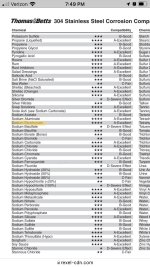
This is a stainless steel corrosion compatibility chart showing baking soda has excellent compatibility with 304 stainless steel. So dmt should be even better compatibility considering it’s lower pKa caustic properties.

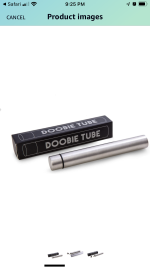
I don’t sponsor or represent doobie tube I just think it’s a great option and should be considered given the durability of steel. I don’t have a chemistry background but if anyone can add to this or concur I would appreciate it.
 

Attachments

  • IMG_4771.jpg
    IMG_4771.jpg
    280.2 KB · Views: 0
You'd want to check compatibility with something more like triethylamine which appears to be dropping off the right-hand edge of your screenshot. DMT freebase shouldn't be particularly corrosive to stainless steel but it will react with copper and brass. I've checked the compatibility chart and it gives 304 stainless 'A' rated compatibility with TEA and other amines.

I'd be more concerned with potential interactions with the plastic seal. Do you know what material is used for that?
 
Not sure exactly it just says “premium rubber o ring”. But this gets me thinking..with this tube the only possible negative reaction would be with the o ring. In contrast the glass vials that everyone suggest all have a large plastic lids.. thoughts?:?
 
Not sure about reactivity with plastic lids in glass vials, but I assume vials are intended to be kept upright anyways, harder to keep that tube on a vertical position though 😁

The oring seems to be below the threading, so whatever you store in there "shouldnt" make contact with the plastic, unless the DMT makes its way inbetween the lid and the body threading.

I guess there could also be some plastic under the lid to push against the body when sealing.
 
Moonshine said:
Not sure exactly it just says “premium rubber o ring”. But this gets me thinking..with this tube the only possible negative reaction would be with the o ring. In contrast the glass vials that everyone suggest all have a large plastic lids.. thoughts?:?

Those infinity jars are all glass errythang :D

One love
 
Does UVa harm DMT?

Infinity Jars allow UVa, violet light in the range of 380-420 nanometers penetration of 25%-45% and infrared light in the range of 730-1050 nanometers penetration of approximately 60%.

UVa light has the highest density of energy of all lights. By allowing this type of invisible light to bathe your products you are exposing your products to the highest amount of bio-energy in the safest way possible.
 
Moonshine said:
Does UVa harm DMT?

Infinity Jars allow UVa, violet light in the range of 380-420 nanometers penetration of 25%-45% and infrared light in the range of 730-1050 nanometers penetration of approximately 60%.

UVa light has the highest density of energy of all lights. By allowing this type of invisible light to bathe your products you are exposing your products to the highest amount of bio-energy in the safest way possible.

Not sure what parts of the light spectrum contribute to the degradation of DMT. This has never really been a concern for me as my jars are stored in wooden boxes. When the jars are out, it's for brief periods and never really in any direct light.

One love
 
Back
Top Bottom