• Members of the previous forum can retrieve their temporary password here, (login and check your PM).

TEK Converting CBD to THC using only Zeolite and heat.

This topic contain a TEK
Migrated topic.
Hi there,I'm new in here.
I'm truly inspired by the deep knowledge of those who came before us.

I have a question about Zeotek.

One of them concerns the color change of the solution.
When I dissolve a Zeotek mixture in IPA, the solution initially appears purplish, but by the next day, it has turned yellowish.
Could this indicate that an unstable form of compound delta-9 is transforming into compound delta-8?

If that's the case, what can be done to preserve more of compound delta-9?


There are two methods of preparation, but both result in a change in color.
The basic amount is 3g of CBD and 6g of zeo per batch.

/method1
1. Mix CBD and zeo in a 1:2 ratio in a 100ml heat-resistant glass container.
2. Fill the container with argon gas.
3. Bake in a household oven at 130°C for 3 hours.
4. The resulting product shows little change, with powdery clumps of approximately 3mm in size forming.

/method2
1. Mix CBD and zeo in a 1:2 ratio on a folded piece of baking paper.
2. Cover with aluminum foil and seal tightly.
3. Place the mixture from step 2 into a sealed metal container and press it firmly against the bottom.
2. Bake in a household oven at 130°C for 1 hour.
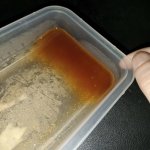
3. The resulting product is a grayish-red, clay-like substance.
 
I sent a sample to EC and they revealed that my zeotek results are 79% d8-thc and 0% d9-thc.
I don't know why I have 0% d9, as I did care a lot about drying and keeping O2 out. But whatever, I'm happy with the results, it gets me high a lot.

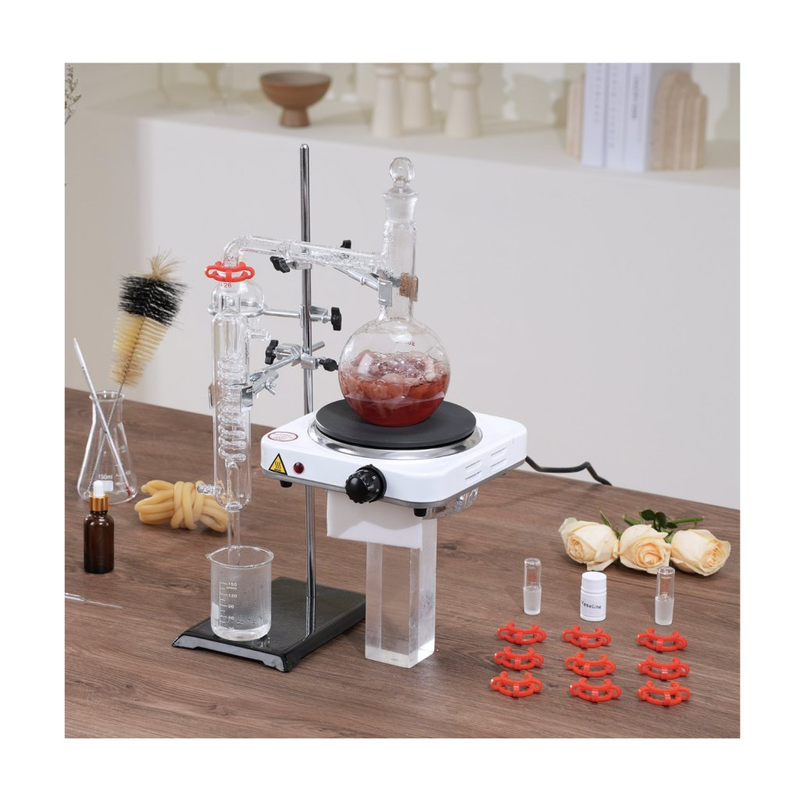
Now I've a question, would a distillate kit like this be appropriate to distillate it?

imagen.png


it's upside down, it's made for essential oils, but the price is very interesting, that's why I ask.
 
I sent a sample to EC and they revealed that my zeotek results are 79% d8-thc and 0% d9-thc.
I don't know why I have 0% d9, as I did care a lot about drying and keeping O2 out. But whatever, I'm happy with the results, it gets me high a lot.

Now I've a question, would a distillate kit like this be appropriate to distillate it?

imagen.png


it's upside down, it's made for essential oils, but the price is very interesting, that's why I ask.
It's a nice enough kit for essential oil distillation, but you'd need a few more things for distilling THC, such as vacuum apparatus. A better kit for essential oils would include separate steam generation and a steam inlet tube. I can't remember of the top of my head whether THC is actually steam volatile, but somehow I don't think it is.
 
Hey everybody, this thread is truly inspiring! I discovered it a few weeks ago when looking for safe and efficient cbd2thc conversion teks right as I was starting a 3 hour train ride. It held me busy the entire time brainstorming!

I've just completed my second conversion run and am waiting for the zeolite to sediment so I can decant the cleared solvent with the THC, I will update and elaborate on my methods as soon as I have the finished product of run #2, as I got myself a ProTest TLC kit and would like to see if any insight can be gained on how different reaction parameters connect to different results.

In the meantime I've had some questions brewing in the back of my head:

If you've yet to perform the conversion it's also possible to wash the zeolite before use. Swirling in ethanol and leaving it to mostly settle will leave much of the tiniest particulate content in suspension for decanting off. Do this at leart three times, or find some coarser zeolite if all these cleaning steps start to look too tedious!
Concerning the filtering of the finer zeolite particles to make the end-product safe to vaporize and inhale; Would one be able to "reverse filter" the Zeolite before using it? Similarly to the method Transform mentioned, but hypothetically with the advantage of clearing all unfilterable zeolite particles:
  1. Put Zeolite in solution with regular H2O.
  2. Filter said solution through e.g. a 30 Micron Filter paper.
  3. Wash remaining zeolite in the filter thoroughly with more H2O.
  4. For each wash collect the filtrate and check for sedimentation.
  5. Repeat washing the zeolite with H2O until no more sedimentation can be seen in the filtrate
    (Maybe confirm # of needed washes through evaping all the H2O and checking for residue?).
  6. Theoretically the residue in the filter should now only contain zeolite particles that are too big to pass through the filter, i.e. 30 micron.
  7. Dry residue and use for CBD2THC like normally.
  8. After CBD2THC, solve your product like normally, let it sediment for 12-24 hours, decant.
  9. Pass your cleared solution through a e.g. 10 Micron Filter paper (this should theoretically catch any particles of concern left,
    as nanoparticles as well as any other particle sizes smaller than 30 micron should've been washed out during step 2-4).
  10. Evaporate Solvent.
That being said I do believe that Transforms method is a smart and efficient way to achieve a smokable end-product. Especially if you do 5 or more washes, in my opinion.
I don't think that inhaling zeolite diluted to homeopathic quantities poses any real risk, especially when you consider the amount of pollution our lungs deal with on a daily basis. Just wanted to put an alternative idea out there :)


Secondly, concerning the flame in jar method:
now as you mentioned the burning of ethanol will
create water and carbon dioxide, but here is the trick: this happens only in a oxygen containing environment (source: The science of alcohol) ,now remember water needs oxygen to be formed and we have a flame in a sealed environment which will keep going for as long as there is sufficient oxygen inside 😉 ,so there shouldn't be any significant amount of H2O created if any at all

Forgive me if I’m missing something, but isn’t H2O always produced when the fuel contains hydrogen (such as in ethanol, C2H5OH)? In that case, burning an ethanol-soaked piece of cotton in a sealed reaction chamber would essentially convert the available O2 into H2O and CO2. The reaction would of course stop once the oxygen is consumed, but by that point, all the possible water would already have formed.
Is an oxygen-free but water-rich atmosphere more beneficial than one that still contains oxygen but comparatively less water? Does anybody have results that speak for the merit of the technique here?

I'll give it a good old college try anyways as soon as I get to it (as well as the argon method 👀), just want to hear some opinions.

Will update once I have the results of my second run.
Kind regards!
 
Last edited:
Hey everybody, this thread is truly inspiring! I discovered it a few weeks ago when looking for safe and efficient cbd2thc conversion teks right as I was starting a 3 hour train ride. It held me busy the entire time brainstorming!

I've just completed my second conversion run and am waiting for the zeolite to sediment so I can decant the cleared solvent with the THC, I will update and elaborate on my methods as soon as I have the finished product of run #2, as I got myself a ProTest TLC kit and would like to see if any insight can be gained on how different reaction parameters connect to different results.

In the meantime I've had some questions brewing in the back of my head:


Concerning the filtering of the finer zeolite particles to make the end-product safe to vaporize and inhale; Would one be able to "reverse filter" the Zeolite before using it? Similarly to the method Transform mentioned, but hypothetically with the advantage of clearing all unfilterable zeolite particles:
  1. Put Zeolite in solution with regular H2O.
  2. Filter said solution through e.g. a 30 Micron Filter paper.
  3. Wash remaining zeolite in the filter thoroughly with more H2O.
  4. For each wash collect the filtrate and check for sedimentation.
  5. Repeat washing the zeolite with H2O until no more sedimentation can be seen in the filtrate
    (Maybe confirm # of needed washes through evaping all the H2O and checking for residue?).
  6. Theoretically the residue in the filter should now only contain zeolite particles that are too big to pass through the filter, i.e. 30 micron.
  7. Dry residue and use for CBD2THC like normally.
  8. After CBD2THC, solve your product like normally, let it sediment for 12-24 hours, decant.
  9. Pass your cleared solution through a e.g. 10 Micron Filter paper (this should theoretically catch any particles of concern left,
    as nanoparticles as well as any other particle sizes smaller than 30 micron should've been washed out during step 2-4).
  10. Evaporate Solvent.
That being said I do believe that Transforms method is a smart and efficient way to achieve a smokable end-product. Especially if you do 5 or more washes, in my opinion.
I don't think that inhaling zeolite diluted to homeopathic quantities poses any real risk, especially when you consider the amount of pollution our lungs deal with on a daily basis. Just wanted to put an alternative idea out there :)


Secondly, concerning the flame in jar method:


Forgive me if I’m missing something, but isn’t H2O always produced when the fuel contains hydrogen (such as in ethanol, C2H5OH)? In that case, burning an ethanol-soaked piece of cotton in a sealed reaction chamber would essentially convert the available O2 into H2O and CO2. The reaction would of course stop once the oxygen is consumed, but by that point, all the possible water would already have formed.
Is an oxygen-free but water-rich atmosphere more beneficial than one that still contains oxygen but comparatively less water? Does anybody have results that speak for the merit of the technique here?

I'll give it a good old college try anyways as soon as I get to it (as well as the argon method 👀), just want to hear some opinions.

Will update once I have the results of my second run.
Kind regards!
Hi and welcome!

Your filtration approach seems like a good way of removing ultrafine sediment from from the zeolite if you're prepared to make the extra effort.

In relation to oxygen removal - yes, it's better to eliminate oxygen and have a corresponding amount of water. Ethanol or IPA are hygroscopic so all but the most dedicated users won't be working under anhydrous conditions in any case. The zeolite also contains adsorbed water, a small amount of which is almost certainly necessary to provide the catalytic amount of protons for the cyclisation reaction.

The reaction has been proven to work under domestic conditions. Performing this conversion under a fully anhydrous and inert atmosphere would be something of an overkill, serving only to satisfy scientific curiosity.

Hats off to anyone should they go to those lengths, including baking out the zeolite. Strange things might start occurring if the usually hydrated Lewis acid sites become open to occupation by organically-bound oxygen atoms in the alcohol solvent or the cannabinoid material - or it might simply dehydrate the alcohol to its corresponding alkene.

Most people capable of going to these extreme efforts would think to check the literature carefully for prior art and relevant data regarding likely side-reactions, as well as observing that alcohols count as a source of protons such that a parallel experiment with an aprotic solvent would potentially provide some useful insights on the whole process.

This thread has become rather enormous, but to my recollection there may have been a couple of trials of the conversion using a hydrocarbon solvent.
 
In relation to oxygen removal - yes, it's better to eliminate oxygen and have a corresponding amount of water. Ethanol or IPA are hygroscopic so all but the most dedicated users won't be working under anhydrous conditions in any case. The zeolite also contains adsorbed water, a small amount of which is almost certainly necessary to provide the catalytic amount of protons for the cyclisation reaction.
Awesome explanation @Transform
Forgive me if I’m missing something, but isn’t H2O always produced when the fuel contains hydrogen (such as in ethanol, C2H5OH)? In that case, burning an ethanol-soaked piece of cotton in a sealed reaction chamber would essentially convert the available O2 into H2O and CO2. The reaction would of course stop once the oxygen is consumed, but by that point, all the possible water would already have formed.
Is an oxygen-free but water-rich atmosphere more beneficial than one that still contains oxygen but comparatively less water? Does anybody have results that speak for the merit of the technique here?

it's also worth noting that any flammable solvent that contains hydrogen will create water as a byproduct while burning, now a solvent without hydrogen is certainly not an easy find, there are some exotic examples that are mostly non flammable like carbon tetrachloride but of course its out of the question (mainly for being deadly toxic)

Also a deeper explanation for why choosing water contamination over oxygen is that water appears to simply be highly selective for the Δ8 isomer, which is still psychoactive THC, while oxygen contamination is much more crucial, mainly because it leads to the production of HU-331, which is unstable and can undergo light induced isomerization to form a very reactive intermediate that reacts with oxygen (even at room temperature) to produce colored cannabinoid byproducts.


Stay safe and DYOR.
 
Last edited:
s also worth noting that any flammable solvent that contains hydrogen will create water as a byproduct while burning, now a solvent without hydrogen is certainly not an easy find, there are some exotic examples like carbon tetrachloride but of course its out of the question (mainly for being deadly toxic)
In terms of removing oxygen by combustion but without producing additional water, the most accessible example that springs to mind is those shisha charcoal blocks. They'd tend to produce a bit of carbon monoxide though.

Steel wool might do the job, if it could be kept from shedding sparks into the reaction mixture. Some of those single-use handwarmers use iron powder, so it might be worth a try to repurpose them as oxygen absorbers. They'll also remove small amounts of water vapour.
 
Is the conversion efficiency consistent when using the remaining zeolite from an old run, or does it decrease over multiple runs? Is an activation step required?
 
Finally got around to giving this a go.

Instead of rolling it into a ball I used a series of careful folds in the foil so the end result was like a tightly wrapped flat envelope. I used baking paper for the first inner parcel as I heard it would make removing the resin easier. The result was grayish brown like hash but sticky like resin.

I think my paper was too brittle so I simply broke up the parcel and dissolved the resin into a jar of hexane. The zeolite powder settles very quickly in this solvent.

To filter I just used a small funnel and stuffed pieces of cotton balls into it. I used the pointy end of a meat thermometer to stab them down as hard as I could, compacting them as much as possible. Leaving the zeolite in the jar, I slowly poured away the solvent through the funnel into another jar. The result was completely clear like pure hexane with a very faint warm orange-pink color.

The final product after evaporation was definitely more on the pink side. I just bong vaped a few pinheads worth and it definitely does the trick. This feels not too heady and quite relaxing, a pleasant surprise.
 
Last edited:
Finally got around to giving this a go.

Instead of rolling it into a ball I used a series of careful folds in the foil so the end result was like a tightly wrapped flat envelope. I used baking paper for the first inner parcel as I heard it would make removing the resin easier. The result was grayish brown like hash but sticky like resin.

I think my paper was too brittle so I simply broke up the parcel and dissolved the resin into a jar of hexane. The zeolite powder settles very quickly in this solvent.

To filter I just used a small funnel and stuffed pieces of cotton balls into it. I used the pointy end of a meat thermometer to stab them down as hard as I could, compacting them as much as possible. Leaving the zeolite in the jar, I slowly poured away the solvent through the funnel into another jar. The result was completely clear like pure hexane with a very faint warm orange-pink color.

The final product after evaporation was definitely more on the pink side. I just bong vaped a few pinheads worth and it definitely does the trick. This feels not too heady and quite relaxing a pleasant surprise.
I also fold it and press it into a sheet.

Though for now I only decant the solvent and let it evaporate.
The oil is then used in chocolate and into molds (I use 5g of oil.) That gives me 10 bars (with 5 squares) which supposedly contains 500 mg THC each. I believe mine contains mostly delta 9, since I cant see any pinkish color in my oil.

I want to filter the zeolite completely, so that I can smoke/vaporize it without any harm.
Is the cotton through a funnel enough for you in terms of speed and how much zeolite was removed?
 

Attachments

  • 2a9ab9d8-2d67-4de6-a112-e85fd8fca046.jpeg
    2a9ab9d8-2d67-4de6-a112-e85fd8fca046.jpeg
    219.4 KB · Views: 2
Is the cotton through a funnel enough for you in terms of speed and how much zeolite was removed?

For now (unless I discover something). And with caveats:

The zeolite must be settled to the point of the solvent being completely transparent, not even the slightest hint of cloudiness. The solvent should be poured away without disturbing the sediment whatsoever. The crystal clear solvent should pass through a very dense filter such as thick and extremely tightly packed cotton or similar.

All of the above is very easy with hexane because it's such a low viscosity, low density solvent.

Edit: Just to be clear, it's still not a smokable/vapable product in the end, but a perfectly suitable edible one, since the dosage will be far more accurate with almost no zeolite at all.
 
Last edited:
For now (unless I discover something). And with caveats:

The zeolite must be settled to the point of the solvent being completely transparent, not even the slightest hint of cloudiness. The solvent should be poured away without disturbing the sediment whatsoever. The crystal clear solvent should pass through a very dense filter such as thick and extremely tightly packed cotton or similar.

All of the above is very easy with hexane because it's such a low viscosity, low density solvent.
I use N-heptane for now since it is cheap. I see why hexane is better, but I just found out I can get alot of pentane for the same price as heptane (No I cant.)

With pentane's lower boiling point and viscosity it should be better in this case. Though im not sure of how many ml of it is needed to dissolve 1 gram THC.

Edit:
Can't get pentane without bulk buy and its expensiiiiive.

What products contains hexane? Have looked around all the local workshops.
 
I want to filter the zeolite completely, so that I can smoke/vaporize it without any harm.
Is the cotton through a funnel enough for you in terms of speed and how much zeolite was removed?
A cotton filter will not be enough to remove the remaining zeolite, zeolite is too small and will flush through.

For smoking/vaping you really need to remove all zeolite through another method.


Kind regards,

The Traveler
 
You should be aware, hexane is neurotoxic, and for this reason its use is discouraged at the Nexus, besides its significantly higher flammability and explosion risks.
I had already read about its neurotoxicity when I was looking into DMT extractions. I'm also often getting reminded in the videos on my Youtube recomendations to not huff 'n' puff that stuff.

I worked with pentane last week and I understand why it might be harder to get, what I dont understand about it is the smell that sticks. I could smell it for hours after leaving the fume hood. Even if I had gotten some on my jeans it would have evaporated.
 
A cotton filter will not be enough to remove the remaining zeolite, zeolite is too small and will flush through.

For smoking/vaping you really need to remove all zeolite through another method.


Kind regards,

The Traveler
Then I will buy some micronfilters and a vacuum filtration kit.

No reason in taken risk with ones lungs, mine have already been subjected to the god awful cigs.
 
A cotton filter will not be enough to remove the remaining zeolite, zeolite is too small and will flush through.

For smoking/vaping you really need to remove all zeolite through another method.


Kind regards,

The Traveler

This is the safest assumption, that trace amounts of microscopic particles may pass even if you have a totally crystal clear solution.

Another issue is the hexane itself. Whilst it makes it much easier to separate the zeolite, it does need some good vacuum or heat to fully purge, which leads to other problems.

I think having a guaranteed particle size for the zeolite would make things easier to filter with the correct filter and vacuum. I don't know how easy it is to guarantee the particle size though.
 
what I dont understand about it is the smell that sticks. I could smell it for hours after leaving the fume hood.
That sounds rather like what we might call "neurological lock", where the response to the stimulus remains "switched on" for some considerable while after the stimulus has been removed. It could be that an olfactory neuron became temporarily paralysed in the "on" state, for example.
 
Don't ever use hexane of a toxic solvent. You won't be able to remove it with vacuum, or vacuum + heat, and even less with just heat and even less with just evaporation at room temperature. A big big amount of it do stay locked in the thick, sticky THC crude. The only real solution is to at least distill.

Anyone tried to use a buchner funnel to filter the zeolite? I fear it would take forever if you have a thick 100g zeolite cake blocking the thing. How fast is it?
 
Last edited:
Anyone tried to use a buchner funnel to filter the zeolite? I fear it would take forever if you have a thick 100g zeolite cake blocking the thing. How fast is it?
I'm not convinced that this will be effective.

You can simply shine a bright flashlight at the end-product to become aware of the amount of zeolite in it, my own results clearly show that simple filters and decanting are not fully effective in removing the zeolite.

It's best practice to only take it orally if you cannot filter all of it. Your lungs are a very precious organ after all.


Kind regards,

The Traveler
 
Back
Top Bottom