

-
Members of the previous forum can retrieve their temporary password here, (login and check your PM).
You are using an out of date browser. It may not display this or other websites correctly.
You should upgrade or use an alternative browser.
You should upgrade or use an alternative browser.
Current project(s) - the mathematical side of doodling
- Thread starter downwardsfromzero
- Start date
Migrated topic.
downwardsfromzero
Boundary condition
Something maybe worthy of note with regards to the number of archetypes in the 6×6 group is that 149 = 6²+7²+8²
It has a certain beauty to it, but does it tell us anything about generalisations?
I'll need to take another look at HT's results for the other series and have a good think about it.
Any other ideas out there?
It has a certain beauty to it, but does it tell us anything about generalisations?
I'll need to take another look at HT's results for the other series and have a good think about it.
Any other ideas out there?
downwardsfromzero
Boundary condition
downwardsfromzero
Boundary condition
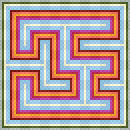
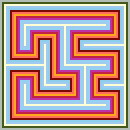
downwardsfromzero
Boundary condition
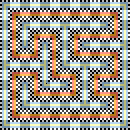
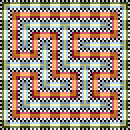
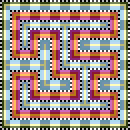
Well, as it turns out, I did my first sketch of a 'hexaglyph'...downwardsfromzero said:Thanks for the link! I would like to use something similar to generate a continuous stream or flowing sheet of random glyphs instead of the hexagonal mazes. This will help develop the animation end of the idea. The glyphs could easily be made to fit an isometric grid which would mean the hexagonal grid would still be useful.ShadedSelf said:There are simple algos to tile an infinite plane with infinite closed loops, reminds me a bit to this.
In this case I guess you could just bruteforce it, there are 6^36 possibilities.
Recursion might be a better angle, since you skip any possibility where cells dont connect, kinda like HT suggests, you just keep going until a closed loop happens or cant continue, if the closed loop is exactly 36 cells long its a winner.
It's a bit crappy, squares are far easier.
Attachments
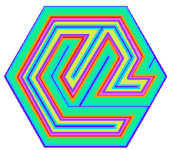


Whoa, that thing looks awesome though!
downwardsfromzero
Boundary condition
Thanks, it was just a rapid sketch. Next I'll try some higher res stuff, improve accuracy, devise templates etc.Homo Trypens said:Whoa, that thing looks awesome though!
Fingers x'd on the animation too!
downwardsfromzero
Boundary condition
Things quite glyphy in places in this thread too - and it's an important bit of Nexian graphic art history. Maybe the most recognisable symbol on the Nexus was born here.

I love this thread awesome work. my work often combines the mathematics of drawings so I relate to your journey a lot 
downwardsfromzero
Boundary condition
Thanks for the reply - I'm so pleased you like it!Muskogee Herbman said:I love this thread awesome work. my work often combines the mathematics of drawings so I relate to your journey a lot
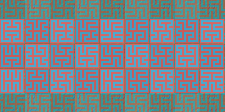
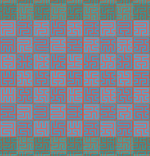
Part way through a montage here, to represent the value of diversity over blind conformity:
Attachments

downwardsfromzero
Boundary condition
Bookmarker for me - HT's glyph online library
downwardsfromzero
Boundary condition
downwardsfromzero
Boundary condition
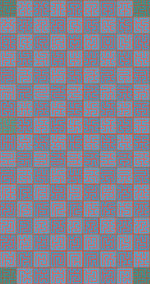
Well, I've virtually finished the montage/chart - just one thing is baffling me. Having gone through the glyphs systematically several times now, I can only find 148 if I draw them manually (on paper or the computer). Homo Trypens has assured me that his generation and checking algorithm returns 149 archetypes, so I guess the next stage is to check these atchetypal glyphs from the file.
To that end, generating just the archetypes with the SVG tool would make this somewhat easier than reading of a bunch of 'Lrf...' directions. Any chance of a hand with that? I haven't succeeded in teaching myself anything about vector graphics yet...
To that end, generating just the archetypes with the SVG tool would make this somewhat easier than reading of a bunch of 'Lrf...' directions. Any chance of a hand with that? I haven't succeeded in teaching myself anything about vector graphics yet...
Attachments
downwardsfromzero
Boundary condition
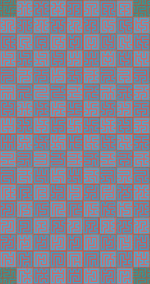
Well, I detected the numbering problem, knuckled down and went through all the algorithm-generated glyph-pattern data. This led me to the glyph that I (of course) had been overlooking and thus could the chart be completed. I've now more-or-less learnt to read the glyph forms from their 'rfL' descriptions, which could count as a marginal arcane bonus.
The process did give me a bit of an idea about how data inputs might be used for glyph generation too. I'll get to that later, but for now here is the finished chart. Can you spot which one was the missing glyph?
The process did give me a bit of an idea about how data inputs might be used for glyph generation too. I'll get to that later, but for now here is the finished chart. Can you spot which one was the missing glyph?
Attachments
downwardsfromzero
Boundary condition
After a long bookshelving, here's a recent update:





Thanks - that's like a generalisation of the special case of what I'll now call circuit glyphs. I'm pretty sure @Hyper Turtle pointed out that they constitute Hamiltonian cycles.Another interesting one.
One particular thing that still needs doing for the further development of this project as I see it is defining the ruleset for legitimate stepwise conversion of one glyph into another, to which your attached paper appears to contribute.
One approach I've long contemplated is defining each glyphs adjacent neghbours within this scheme and using that to define a graph (in the sense of subcubic graphs, etc.)
The relationships in the graph would then, ideally, be used to define transformations between glyphs, finally moving towards the ultimate goal of morphing dancing glyph animations.
I would also envisage a colour channel for the boundaries and pathway of the generalised glyph which could also be algorithmically steered through a function of the form of the specific glyph instance and some aspect of an audio input.
Using the glyphs as transparencies within a broader video editing application would essentially make them into a specific pattern overlay library for use in a wider VJ context, although that starts to get beyond the scope of this project.
Also, since this project was first published here, I have noticed one of the glyph designs being used as an app icon for some android app or other. I'd struggle to recall where - or even whether - I've noted which app that was. Whoever did this, you know who you are…
I thought they were exactly the same. Is there any hamiltonian cycle in a rectangular, solid grid graph that wouldn't constitute a circuit glyph? If so, I don't fully understand what constitutes a circuit glyph.that's like a generalisation of the special case of what I'll now call circuit glyphs
While I was looking into this topic, I came across the concept of reconfiguration (I hadn't heard about it before), which seems to be the technical name for the idea you mention:One particular thing that still needs doing for the further development of this project as I see it is defining the ruleset for legitimate stepwise conversion of one glyph into another
Reconfiguration problems arise from exploring the solution space of some particular problem. For example, a solution space of the Hamiltonian cycle problem for a specific graph G would contain all possible solutions of the problem, i.e., all possible Hamiltonian cycles in G. Reconfiguration of the Hamiltonian cycles of G asks the following question: can we transform one Hamiltonian cycle of G to another Hamiltonian cycle of G using some operations such that the intermediate steps are also Hamiltonian cycles of G?
The attached PhD thesis answers this, among other questions:
Question 3. Can we define operations to reconfigure Hamiltonian cycles and paths in grid graphs using properties of grid graphs such as limited degree and the fact that the graph is embedded ? When do the operations preserve Hamiltonicity?
Thank you for this thread, I find these topics very interesting and I had a good time reading both the thread and some papers. I'd also been wondering where your profile picture comes from.
It's a nice idea. I may look into that. Do you have any preferred format for output? I saw @Hyper Turtle was emitting SVG as output, I think that's a good idea.The relationships in the graph would then, ideally, be used to define transformations between glyphs, finally moving towards the ultimate goal of morphing dancing glyph animations.
I would also envisage a colour channel for the boundaries and pathway of the generalised glyph which could also be algorithmically steered through a function of the form of the specific glyph instance and some aspect of an audio input.
Attachments
I was looking into implementing this algorithm, but it's very informally specified and I couldn't come yet with a reasonable way of implementing the constraints. If I figure out a good way to do it I'll generate some cycles and post them here.Another interesting one.
Similar threads


- Replies
- 14
- Views
- 904


- Replies
- 0
- Views
- 112
